
(Photo by Steve W, via Flickr. CC BY-NC-ND 2.0)
What are Curlews?
Curlews are large wading birds (often shortened to waders) belonging to the genus Numenius. They are instantly recognisable by their long, down-curved bills, long legs and mottled brown plumage. In North America, Curlews are included within the wider group known as shorebirds, which also includes plovers, oystercatchers, avocets and jacanas. Globally there are around 200 species of waders, with Curlews among the most distinctive.
How many species of Curlew are there?
Today there are seven living species of Curlew. Sadly, the Slender-billed Curlew is now officially extinct, and the Eskimo Curlew has not been seen for decades and is almost certainly lost. The surviving species are:
- Eurasian Curlew
- Bristle-thighed Curlew
- Long-billed Curlew
- Far Eastern Curlew
- Little Curlew
- Whimbrel (now split into two species: Eurasian and Hudsonian)
Eurasian Curlew (Numenius arquata)
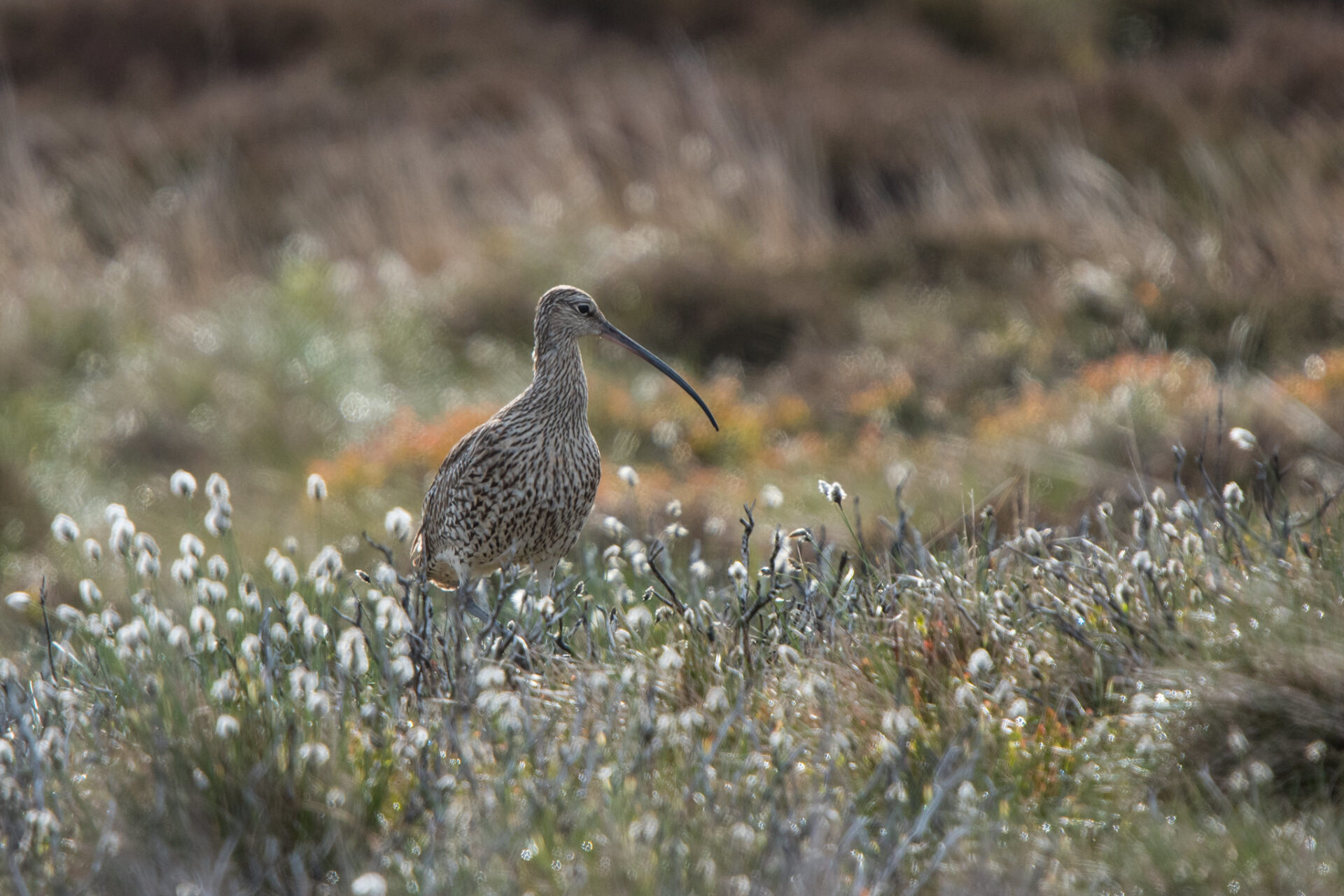
The Eurasian Curlew is the flagship species at the heart of Curlew Action’s work. It is the bird that inspired our founder, Mary Colwell, to walk 500 miles across Ireland and Britain — a journey that led to her book Curlew Moon and ultimately to the creation of this charity.
This is the largest European wader with mottled brown plumage and a distinctive downcurved bill, especially long in females. Its range stretches across Europe, Asia and Africa, yet it is declining everywhere. Once a familiar presence in meadows, moors and estuaries, Curlews now face severe threats, especially on their breeding grounds..
Curlews can be seen year-round in the UK as some of our breeding birds winter along our coasts and estuaries, while others migrate to Ireland, southern Europe and the north coast of Africa. The Eurasian Curlew shares much of its range with the Whimbrel. Telling them apart is not difficult, Curlews are larger, with a longer bill, while Whimbrels show a distinctive pale eye-stripe (the supercilium). You can hear our podcasts on the Eurasian Curlew here:
- Geoff Hilton - Saving the Eurasian Curlew
- Curlew in the 21st century
- Irish Curlew Crisis
- Galloway Curlews
- Urban Curlews
Eurasian Curlew – At a Glance
Scientific name: Numenius arquata
Size: 50–60 cm (like a Mallard duck on long legs)
Wingspan: 80–100 cm
Bill length: up to 15 cm (longer in females)
Lifespan: Can exceed 30 years
UK population: ~58,000 breeding pairs (down over 50% in 25 years)
Global importance: UK holds c. 25% of the world’s breeding Curlews
Habitat: Farmland, wetlands, moorland, estuaries, coastal mudflats
Call: The haunting, bubbling song and the long ‘curleee’ that we all find so evocative of wild places
Whimbrels
There are two species of whimbrel: the Eurasian Whimbrel (Numenius phaeopus), found across Europe, Asia and Africa, and the Hudsonian Whimbrel (Numenius hudsonicus), which breeds in North America and winters as far south as South America. Both are smaller than the Eurasian Curlew, with shorter bills and a distinctive pale eye-stripe, but share the same elegant, migratory lifestyle that connects coasts and wetlands across continents.
Curlew vs Whimbrel – How to Tell Them Apart
| Feature | Eurasian Curlew (Numenius arquata) | Whimbrel (Numenius phaeopus / hudsonicus) |
| Size | Larger: 50–60 cm | Smaller: 40–46 cm |
| Bill | Very long, strongly downcurved (longer in females) | Shorter, less curved |
| Plumage | Mottled brown overall | Similar mottling, but darker crown |
| Distinctive Markings | Plain head | Prominent pale stripe above eye (supercilium) |
| Call | Long, bubbling, mournful | Shorter, rippling whistle, often repeated rapidly |
| Range | UK, Europe, Asia, Africa | Eurasian: Europe/Asia/Africa; Hudsonian: Americas |
Listen to our podcast on the Hudsonian Whimbrel here:
Long-billed Curlew
The Long-billed Curlew (Numenius americanus) is North America’s largest shorebird, easily recognised by its exceptionally long, downcurved bill. It breeds in the grasslands of the western United States and Canada, migrating south in winter to coastal estuaries and mudflats as far as Mexico. Once widespread across the Great Plains, its range has contracted significantly due to hunting in the 19th century and the large-scale conversion of native prairies to farmland. Although populations have partially recovered, ongoing loss of breeding habitat and recreational hunting continues to threaten this remarkable species.
Long-billed Curlew – At a Glance
- Scientific name: Numenius americanus
- Size: 50–65 cm
- Wingspan: 80–100 cm
- Bill length: up to 20 cm (longest of any Curlew)
- Breeding range: Western USA & parts of Canada (prairies, grasslands)
- Winter range: Coasts and estuaries of southern USA and Mexico
- Population trend: Reduced historic range; despite a temporary rebound in the 20th century, populations are declining again in certain areas due to ongoing threats. It has been lost from the eastern states.
Little Curlew (Numenius minutus)

The Little Curlew (Numenius minutus) is the smallest member of the Curlew family and perhaps the least known. Often overlooked but considered to be declining, it breeds in the remote tundra of Siberia and migrates vast distances to spend the winter in northern Australia. Delicate and graceful, with a finely curved bill and subtle plumage, this beautiful bird often passes unnoticed in the open grasslands and wetlands it inhabits. Not much is known about its ecology, and its population remains poorly understood, making it one of the more mysterious of the world’s Curlews.
Why it matters: The Little Curlew reminds us how much remains unknown about migratory birds. Studying and protecting such overlooked species helps us understand the health of global ecosystems and highlights the urgency of conserving fragile habitats along migratory flyways.
Little Curlew – At a Glance
- Scientific name: Numenius minutus
- Size: 30–35 cm (smallest Curlew species)
- Wingspan: 60–70 cm
- Bill: Shorter and finer than other Curlews, gently curved
- Breeding range: Remote tundra of northeastern Siberia
- Winter range: Northern Australia, with passage records in Southeast Asia
- Population: Estimated 180,000–240,000 individuals (IUCN)
- Status: Near Threatened (IUCN Red List)
- Threats: Habitat loss in wintering grounds, climate impacts on Arctic breeding areas
- Notable feature: Secretive and easily overlooked, yet capable of long transcontinental migrations
Far Eastern Curlew (Numenius madagascariensis)

The Far Eastern Curlew (Numenius madagascariensis) is the largest migratory wader in the world, breeding across northeast Asia, including Siberia, the Kamchatka Peninsula and northern China. Each year it undertakes extraordinary migrations south to Australia, with smaller numbers reaching New Zealand, Japan, the Philippines and Indonesia. Yet this remarkable bird is now one of the most threatened of all Curlews. In Australia, populations have fallen by more than 80%, driven largely by the destruction of vital intertidal feeding grounds in the Yellow Sea and the loss of coastal wetlands in its wintering range. The Far Eastern Curlew stands as a stark warning of how fragile migratory flyways have become.
Listen to our podcast episodes on the Far Eastern Curlew.
Far Eastern Curlew – At a Glance
- Scientific name: Numenius madagascariensis
- Size: 60–66 cm (largest migratory wader in the world)
- Wingspan: 110–120 cm
- Bill: Exceptionally long and downcurved, especially in females
- Breeding range: Northeastern Asia – Siberia, Kamchatka Peninsula, northern China
- Winter range: Mainly Australia; also New Zealand, Japan, Indonesia, Philippines
- Population: c. 32,000 individuals (IUCN)
- Status: Endangered (IUCN Red List)
- Decline: >80% decline in Australia since 1980s
- Threats: Loss of critical intertidal feeding grounds in the Yellow Sea; coastal wetland destruction in Australia and hunting on migration in Russia.
Bristle-thighed Curlew (Numenius tahitiensis)

The Bristle-thighed Curlew (Numenius tahitiensis) is a medium-sized species, mottled brown with a distinctive cinnamon rump. It breeds only in two remote regions of western Alaska and migrates thousands of kilometres to winter on small islands and atolls in the central Pacific, including Hawaii, Fiji and French Polynesia. This remarkable bird makes the journey in a single non-stop flight of at least 5,000 km. When it arrives on its breeding grounds it is the only Curlew to become flightless during its moult as, historically, it had no predators on the islands. Sadly, that has now changed with introduced pigs, cats and other animals. Its English name comes from the unusual thigh feathers, where the shafts extend beyond the plumage to form visible bristles. Rare and highly specialised, it is one of the least-studied Curlews.
Listen to our podcast episode on the Bristle-thighed Curlew.
Bristle-thighed Curlew – At a Glance
- Scientific name: Numenius tahitiensis
- Size: 40–44 cm
- Wingspan: 80–88 cm
- Bill: Long, slender, downcurved
- Breeding range: Two remote regions in western Alaska (tundra)
- Winter range: Central Pacific islands and atolls – Hawaii, Fiji, French Polynesia, Marshall Islands.
- Migration: Non-stop flights of 5,000 km or more
- Population: c. 10,000 individuals (IUCN)
- Status: Vulnerable (IUCN Red List)
- Threats: Habitat loss on Pacific islands, hunting, invasive predators, climate change impacts on breeding tundra and from increased storm activity on its migration route.
- Notable feature: Elongated feather shafts on thighs form visible “bristles,” unique among Curlews. During its winter moult it becomes flightless.
Listen to our podcast episode on the Bristle-thighed Curlew.
Hudsonian Whimbrel (Numenius hudsonicus)

Once thought to be a subspecies of the Eurasian Whimbrel, the Hudsonian Whimbrel was recently elevated to species level. It has a dark rump, rather than the white rump of the Eurasian Whimbrel. It breeds in subarctic North America, and flies to southern North America and to South America for the winter.
Listen to our podcast episode on the Amberican Whimbrel.
Slender-billed Curlew (Numenius tenuirostris)
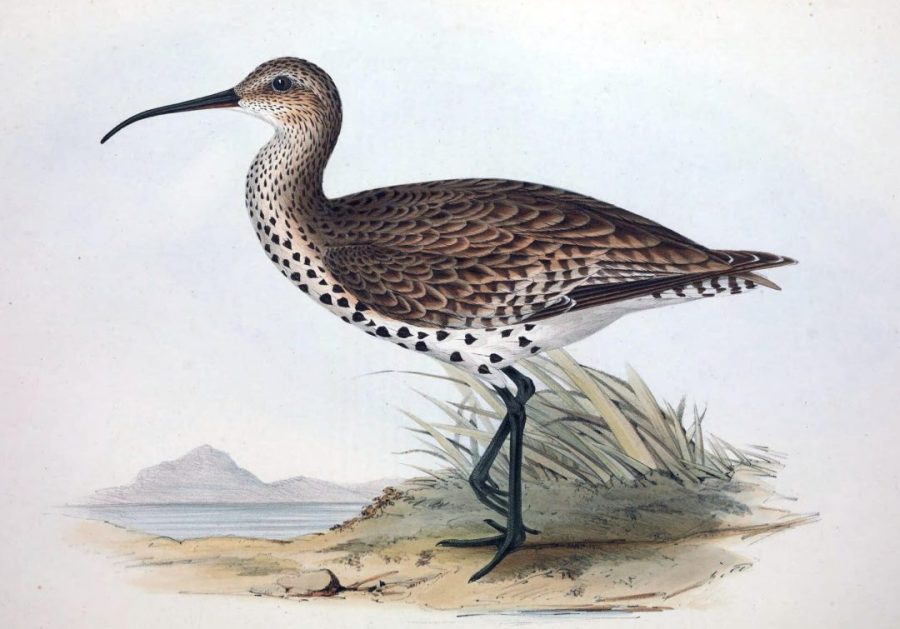
The Slender-billed Curlew (Numenius tenuirostris) has now been declared extinct by the IUCN. Once the rarest of the Curlews, its last verifiable sighting was a photograph taken in Yemen in 1995 by ornithologist Richard Porter (interviewed by Mary Colwell in our podcast). A 2024 study concluded there is a 99.6% chance the species disappeared around that time, which has sadly been proved to be the case. About the size of a Whimbrel, it bred in the steppes of southwest Siberia and possibly Kazakhstan, migrating to southern Europe and northwest Africa for the winter. Despite extensive searches, no confirmed sightings have been made in nearly three decades, leaving the Slender-billed Curlew as a poignant reminder of how easily species can vanish.
Listen to our podcast episodes on the Slender-billed Curlew.
Slender-billed Curlew – At a Glance
- Scientific name: Numenius tenuirostris
- Size: 36–41 cm (similar to Eurasian Whimbrel)
- Wingspan: ~77–88 cm
- Bill: Slender, gently downcurved
- Breeding range: Steppes of southwest Siberia; likely also Kazakhstan
- Winter range: Southern Europe and northwest Africa
- Last confirmed sighting: 1995, Yemen
- Population: 0 confirmed; study (2024) estimates 99.6% chance of extinction around 1995, declared extinct by IUCN in October 2025.
- Notable feature: Smallest and rarest of all Curlews — a stark warning of how fragile migratory birds can be.
Eskimo Curlew (Numenius borealis)

The Eskimo Curlew (Numenius borealis), also known as the Northern Curlew, is almost certainly extinct, although it remains officially listed as Critically Endangered on the IUCN Red List. Once numbering in the millions, it bred in Alaska and Canada and migrated to the grasslands of South America for the winter. The last confirmed sightings were in the 1960s, though there was a report of 23 birds on a remote island off the coast of Texas in the early 1980s. Despite extensive searches, no further evidence has emerged, making the Eskimo Curlew one of the great lost birds of North America.
Listen to our podcast episode and YouTube discussion on the Eskimo Curlew.
Eskimo/Northern Curlew – At a Glance
- Scientific name: Numenius borealis
- Size: 30–34 cm (one of the smallest Curlews)
- Wingspan: 60–70 cm
- Bill: Short, slightly downcurved
- Breeding range: Alaska and northern Canada
- Winter range: South America, mainly Argentina, Uruguay, and Brazil
- Last confirmed sighting: 1960s; unverified report of 23 birds off Texas in the early 1980s
- Population: Once millions; now almost certainly extinct
- Status: Critically Endangered (IUCN), though widely believed extinct
- Notable feature: Known as the “prairie pigeon,” flocks once darkened North American skies before collapsing from overhunting and habitat loss. It stands as a stark reminder that sheer numbers are no guarantee of survival.
Message: Within just a century, two Curlew species have slipped into extinction. The remaining seven face many of the same threats. They need urgent action to avoid the same fate.
Which curlews are found in the UK?
Two species of Curlew are resident and breeding in the UK, the Eurasian Curlew and the Eurasian Whimbrel.
The Hudsonian Whimbrel is rarely found in the UK, appearing here as a vagrant. The BTO lists that the first UK record was at Fair Isle in 1955, with less than 20 records since.
Are Curlews endangered?
Of the nine species of Curlew, two are listed as Critically Endangered on the International Union for Conservation of Nature’s (IUCN) Red List of Threatened Species, one as Endangered, two as Near Threatened, and three as Least Concern. The Hudsonian Whimbrel has not yet been assessed by the IUCN Red List (are there plans to?).
The IUCN Red List was established in 1964 as a tool to analyse the health of animal, plant and fungi populations and thus, the biodiversity of the world. A species can be listed in nine categories: Not Evaluated, Data Deficient, Least Concern, Near Threatened, Vulnerable, Endangered, Critically Endangered, Extinct in the Wild and Extinct.
For the two Critically Endangered species – Slender-billed and Eskimo – many conservationists believe they may actually be extinct. The last confirmed sighting of a Slender-billed Curlew was in Morocco in 1995. The last confirmed photograph of an Eskimo Curlew was taken in 1962 and the last confirmed sighting was in 1963, when one was shot in Barbados.
- Eurasian Curlew – Near Threatened (date last assessed: 2017)
- Eurasian Whimbrel – Least Concern (2016)
- Long-billed Curlew – Least Concern (2016)
- Little Curlew – Least Concern (2016)
- Far-Eastern Curlew – Endangered (2016)
- Hudsonian Whimbrel – Not Evaluated
- Slender-billed Curlew – Critically Endangered (2018)
- Eskimo Curlew – Critically Endangered (2020)
- Bristle-thighed Curlew – Near Threatened (2020)
What are the threats to Curlews?
Curlews face a wide range of threats, including habitat loss and degradation, disturbance, changes in farming practices, predation, hunting, and climate change.
Which is the largest and smallest species of Curlews?
The Far Eastern Curlew is the largest Curlew species, with a body length measuring between 53-66cm, a wingspan of 110cm, and a weight between 565-1,150g. The species nearly doubles in weight before its migration.
As the name suggests, the Little Curlew is the smallest species of Curlew. It has a body length of between 28-34cm, a wingspan of between 68-71cm, and a weight of between 118-221g.
When is World Curlew Day and World Shorebird Day?

World Curlew Day was created by Mary Colwell in 2017 to raise awareness of Curlews and their declining populations. It is celebrated on 21st April, which is the same day as St Beuno’s feast day and the day that Mary Colwell began her 500-mile walk for Curlews in 2016. St Beuno is the patron saint of Curlews, after a Curlew saved the seventh-century Welsh missionary's book of sermons from the sea.
World Shorebirds Day is celebrated on 6th September and aims to raise public awareness of the world’s shorebird species. It was created by Gyorgy Szimuly, a shorebird conservationist, and encourages people to take part in the Global Shorebird Counts via eBird.
Lead image: Eurasian Curlew. (Photo by RTS Photography)