
Echoes of a Vanishing Song
by guest writer: Sarah Marles
With the slender-billed curlew now officially declared extinct, the Eurasian curlew’s call across the Dee Estuary feels more precious – and more precarious – than ever.
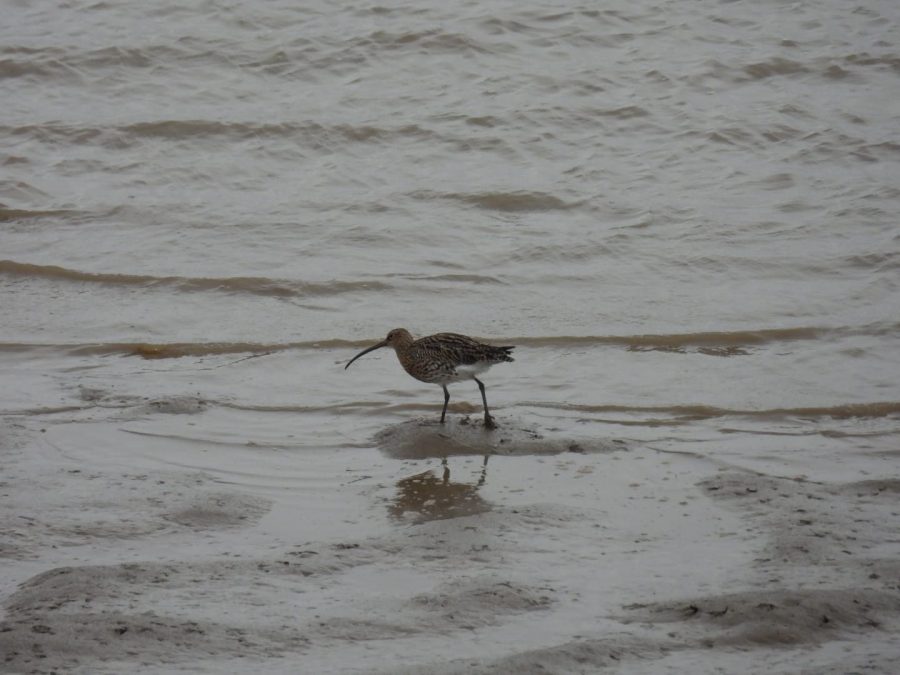
At low tide the Dee Estuary lies open; a vast, breathing sheet of slick mud and silt glazed in pewter light spreading between West Wirral and North Wales. It’s October and weary waders land collectively like children around sweets at a birthday party. A frenzy of feeding and fanfare unfolds across the mud. Amid the clamour, one call rises above it all; a bugling siren that swells to a crescendo, lifting my heart and hopes on the wind before fading out. The Eurasian curlew has returned, bringing with it that unmistakable sense of autumn.
For years, I’ve walked my dog along this stretch of the Dee, following the tide’s slow rhythm through every season, never realising the name of the bird whose call I was hearing until I learned of its decline. Now I know the circumstances – that wild, rising, melancholic cry haunts the marshes.
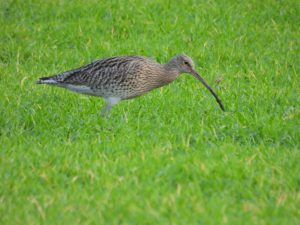
In winter, our biggest wader seems plentiful here. There are hundreds feeding across the mudflats and damp pastures, their long bills probing for ragworms and shrimps. It’s an easy abundance to mistake for security. But these winter flocks tell only half the story. When spring comes and the curlews leave the estuary for their breeding grounds – the high moors and meadow valleys of Wales and northern England – their numbers collapse.
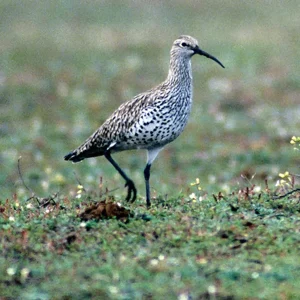
On 10 October 2025, news of the slender-billed curlew’s official extinction landed heavily. Although its near-extinct status had been acknowledged for decades, the official loss – the first global extinction of a migratory bird once widespread across Europe, North Africa and West Asia – was sobering. Its disappearance was slow: a handful of birds seen in Morocco in the 1990s, then nothing. Last year, after decades of searching, the IUCN finally confirmed what many had feared – the species was gone.
That extinction is a stark warning for its cousin. The UK holds around a quarter of the world’s Eurasian curlews, yet over sixty per cent of breeding pairs have vanished since the 1970s. According to the RSPB, the real crisis lies in those breeding landscapes, where too few chicks survive to replace the adults. Particularly worrying is the prediction that, here on the fringes of Wales, the Eurasian curlew could disappear as a breeding bird by 2033. That feels too close to comprehend, making each call over the Dee sound like a last stand.
To understand what’s at stake, you need to leave the tide behind and climb into those upland fields. Across North Wales, the fate of the curlew is tangled up with the rhythms of farming life. For generations, hay meadows and rough pastures offered perfect nesting sites, undisturbed, long grass for cover, plentiful insects for chicks and space. Now, the speed and intensity of modern agriculture leave little room for such balance. Lowland meadows have been drained, moorlands planted with trees and early silage cutting often destroys nests before chicks can fledge.
While attending an ‘Our Dee Estuary’ presentation, I heard farmers speak of this tension, the need to make a living from the land while trying to protect what lives within it. One told us,
‘We used to hear them every morning. Now we mark every nest like it’s treasure.’
Increasingly, conservation charities and partnerships are forming to bridge that gap. Curlew Action, led by campaigner Mary Colwell, is a key player in raising awareness and carrying out essential conservation work in the UK and abroad, while local projects here on the Dee in North Wales work alongside farmers to adjust cutting times, mark nest sites and fence off breeding areas for predator protection. Other leading charities such as the RSPB and BTO take part in headstarting programmes – raising chicks to fledging before returning them to the wild.
It’s not easy work. Wet weather, predation and funding challenges all take their toll. But there’s something hopeful in the sight of a farmer and a conservationist walking the same field, scanning for signs of life rather than loss. These are landscapes still capable of change – capable of song once more.
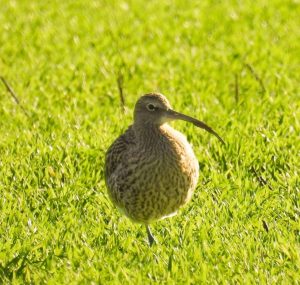
Here, evening is settling over the estuary and the tide is creeping back in, smoothing over the day’s earlier footprints. A little inland on the damp pasture close to the shore, a small group of curlews feed, perhaps twenty birds moving slowly through the grass, their long bills dipping and lifting in unison. Their plumage – frothy coffee, white and flecked brown – stands out against the lush vegetation, their downward-curved bills completing their rounded, stone-like forms. Never far away, a mix of gulls and corvids linger – eager to feed but never to mob. I like to think they understand, in their own way, the fragility in which these gracious birds exist.
Now and then, they call, a drawn-out note rising and fading like waves, merging into one chorus, stitched between land and tide. As dusk deepens, the curlews lift one by one, their calls trailing behind them as they fly straight out towards the open estuary, voices blending to join the sound of the tide. I’ll miss them when they leave in spring and will await their return the following autumn with anticipation. Their absence leaves me with a sense of hope, admiration and an urgent resolve to make sure that song does not fade while there’s still time to protect it.
About the author:
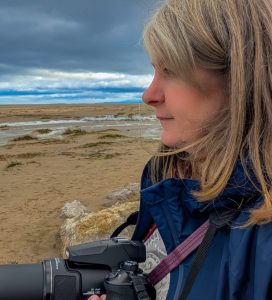
Sarah Marles is a Curlew Action ambassador, Wirral-based nature writer and MA student in Nature and Travel Writing. Her work explores belonging and connection with the land. As a Curlew Ambassador, she hopes to share the beauty and vulnerability of curlews and inspire others to protect the wild places they call home.