
Blog Posts from Curlew Action
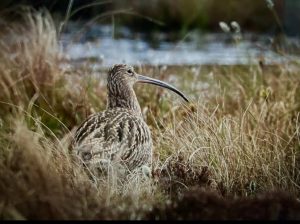
Memories of the filming phase with the RSPB Life Curlew Project officers, during the making of the Curlew campaign film, Stunned by Silence – by Malka Holmes, Greengage Films & Curlew Action Ambassador The Uplands of North Wales 2023-24 Curlew breeding Season 1 I remember I was quite excited when I got the first pin-drop […]
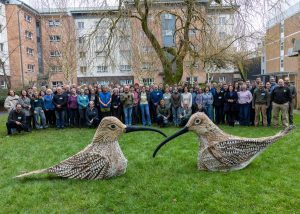
Over the weekend of 6–8 February, we held the second in-person European Curlew Fieldworker Workshop at Lancaster University in the north-west of England. This is Curlew Action’s flagship event, bringing together curlew conservationists, scientists, artists, educators, musicians and others from across Europe to share ideas and inspire one another. It is our contribution to a positive outcome for […]
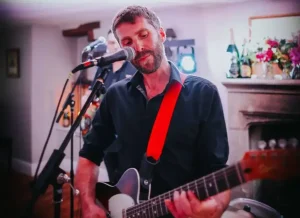
What the Hills Ask of Us Lee Schofield is an author, musician and conservationist. I will be interviewing him on Saturday evening as part of the European Curlew Fieldworker Workshop at Lancaster University (6–8 February). We will discuss his book, his valiant efforts to rewild an area of the Lake District, the personal cost of […]
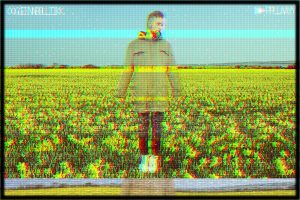
Listening for What’s Disappearing: Ogenblik on Sound, Nature, and the Call of the Curlew At Curlew Action, we spend a lot of time thinking about absence, and about the quieting of landscapes that once rang with birdsong, and what it means when a sound slips from everyday life into memory. Few artists explore […]
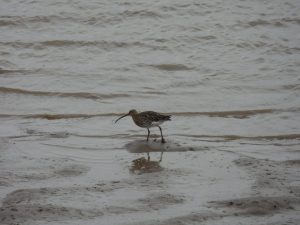
Echoes of a Vanishing Song by guest writer: Sarah Marles With the slender-billed curlew now officially declared extinct, the Eurasian curlew’s call across the Dee Estuary feels more precious – and more precarious – than ever. At low tide the Dee Estuary lies open; a vast, breathing sheet of slick mud and silt glazed in pewter […]
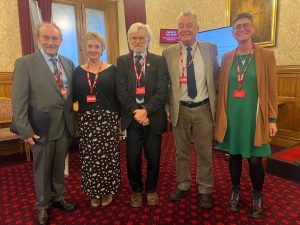
A Turning Point for Curlew Recovery: The UK Curlew Action Plan Launched in the House of Lords On Monday 19th January, the House of Lords became the setting for a pivotal moment in the unfolding story of one of Britain’s most iconic birds: the launch of the UK Curlew Action Plan. Hosted by Lord Randall of Uxbridge the event was […]

This year’s national Curlew round-up took us from the Angus Glens to Dartmoor, from the New Forest to Northern Ireland. The message was clear: where people, land managers and volunteers work together, Curlews can thrive, but overall, the threats remain stark and urgent. Here is a project-by-project summary of the results. Scotland – Angus & […]

By Mary Colwell – AEWA MOP, 11 November 2025 On 10 October 2025 the Slender-billed Curlew was declared extinct by the IUCN. It still feels raw to say the deadening finality of that word, extinct. This delicate, long-billed wader, once a part of the wildlife community of Asia/Africa/Europe has gone. A life once woven […]
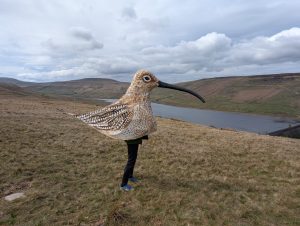
Interview with Matt Trevelyan — The Man Who Walked 53 Miles Dressed as a Curlew by Matt Lewis, RSPB When most people think of endurance challenges, they imagine marathons or mountain climbs, not hiking miles across the Yorkshire countryside in a towering, handmade curlew costume. But for Matt Trevelyan, Farming in Protected Landscapes Officer for […]
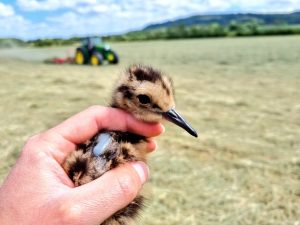
Curlew chick (Photo by WWT) On November 13th, 2024, Curlew Action hosted a free webinar bringing together conservationists, researchers, and curlew advocates from over 15 European countries. Chaired by Mike Smart, former Curlew Action trustee and long-time champion of wader conservation, the event provided a sobering yet hopeful snapshot of the Eurasian Curlew’s breeding […]
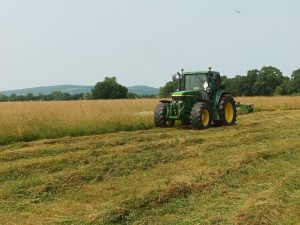
French Curlews Statistics: Around 1,000 pairs across France but the larger populations are concentrated in two main areas: In the east – the Val de Saône (400 pairs) and in the northwest in Normandy (200 pairs). There are smaller populations in other regions. Almost all of them are in farmland. French Curlews mainly winter in […]
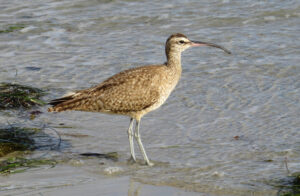
Whether the Hudsonian Whimbrel is a distinct species or not has been a debate amongst taxonomists and birders for a while – and has been settled… for now. The first version of AviList, published 12 June 2025, has listed Hudsonian Whimbrel (Numenius hudsonicus) as a distinct species from the Eurasian Whimbrel (Numenius phaeopus), bringing the […]