
Initial Reflections
Robert Frost’s poem Mending Wall kept coming into my mind as we visited four more reserves for wading birds strung along the banks of the Danube and Isar. We had just left the affecting Wiesmet, described in the previous blog, and now stood on a rise overlooking the Stöcklwörth meadows and woodland, with the stately Danube flowing in the background.
All the while, this first line of Frost’s masterpiece kept intruding into my thoughts: “Something there is that doesn’t love a wall.” Ostensibly, the poem is about repairing a stone wall that divides Frost from his neighbour, but, like all great art, it reaches far beyond its title. It asks questions about ownership and trust, about connection and interaction, or whether the risk of conflict is too great and it is safer to defend a defined boundary. In other words, it is a contemplation on barriers. Frost’s companion told him, “Good fences make good neighbours,” meaning that as long as there is separation, there is harmony, but Frost is not so sure, “Before I built a wall I’d ask to know / What I was walling in or walling out.” It all seemed so relevant to the day ahead of fields and fences.
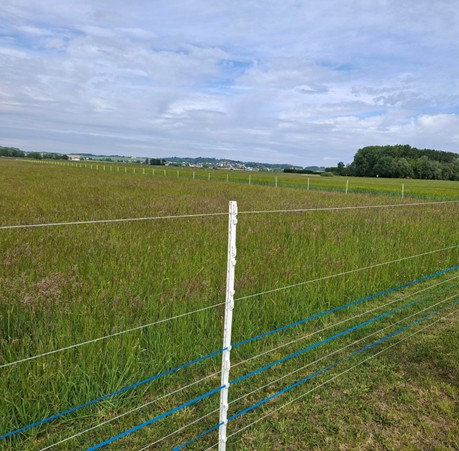
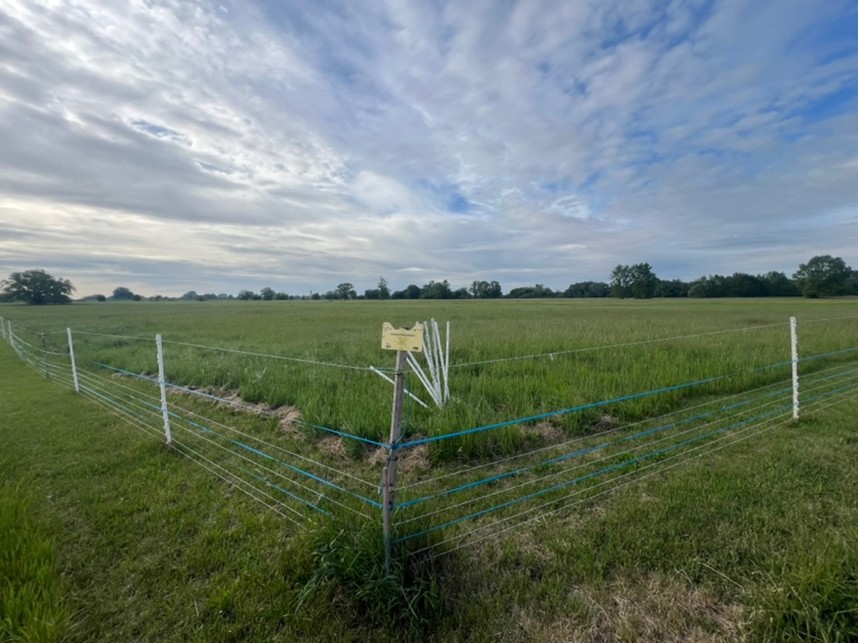
The deeper meaning in Mending Wall casts a shadow over the poem, much like the shadows of the trees falling over the fields before me. Here in Curlew breeding grounds, the walls are not built from stone, but electrified wires. They are a practical attempt to hold back foxes and other ground predators long enough for Curlew chicks to survive, but they also serve to keep us out.
It was impossible not to feel the deep unease at the heart of modern conservation - that to protect one vulnerable species, we are increasingly forced to fence fragments of nature away from the rest of nature itself, as well as from ourselves.
It reminded me of so-called “fortress conservation”, which was popular from the 1970s to the 1990s, when it was argued that keeping nature out of harm’s way (in other words, away from people), was the best way to ensure its long-term survival; nature reserves were literally walled off and fenced in. Increasingly, though, it fell out of favour as it proved difficult and expensive to sustain, as well as raising difficult moral questions. Critics asked who had the right to erect fences in the first place? They also argued that it excluded local communities and created isolated “islands” of protection surrounded by degraded environments.
The fortress mentality also deepened an increasing disconnect from the natural world, which was becoming evident at that time. Today, that trend has continued and people are more removed from day-to-day contact with nature than at any other time in human history. The conservation mindset therefore has shifted towards working with local communities, farming systems and wider landscapes, i.e. “sharing nature rather than sparing it”. Fencing off nature came to be seen as wrong-headed, especially as today’s popular refrain that people are “part of nature, not separate from it”, has, rightly, gained influence.
And yet, fencing in Curlews to exclude people and predators is widespread and effective. We saw it highlighted in Dümmer Lake in an earlier blog, and it genuinely does seem to be the only way these birds will survive the 21st Century, especially in lowland, agricultural landscapes.
I have increasingly come to realise that Curlew conservation is, in many ways, deeply counter-cultural. It challenges modern assumptions about unrestricted access to the countryside and opposition to predator management, sitting uneasily alongside popular ideas of stepping back and allowing nature to take its own course. That creates a difficult tension in a biodiversity-stressed world where people urgently need to reconnect with nature, even as support grows for more self-willed landscapes and less human intervention.
These dilemmas haunted me as we looked out over the Curlew fortresses fringing the Danube.
Stöcklwörth Reserve
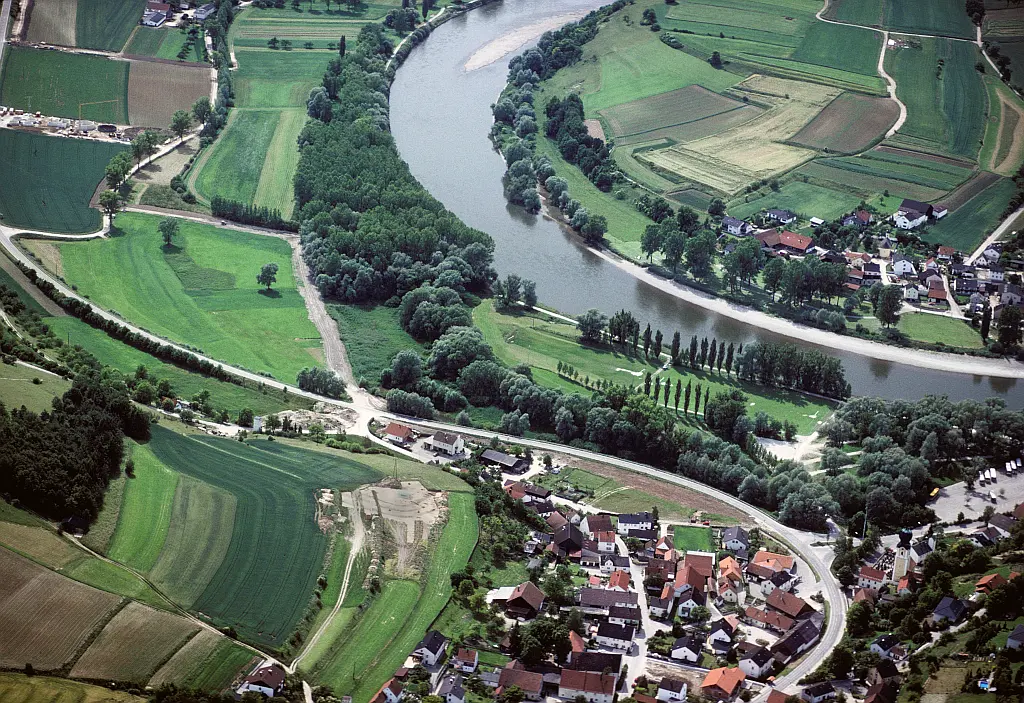
Stöcklwörth is a 69-hectare nature reserve located on the northern banks of the Danube river in Eastern Bavaria. It is part of the Upper Palatinate (Oberpfalz) administrative region.
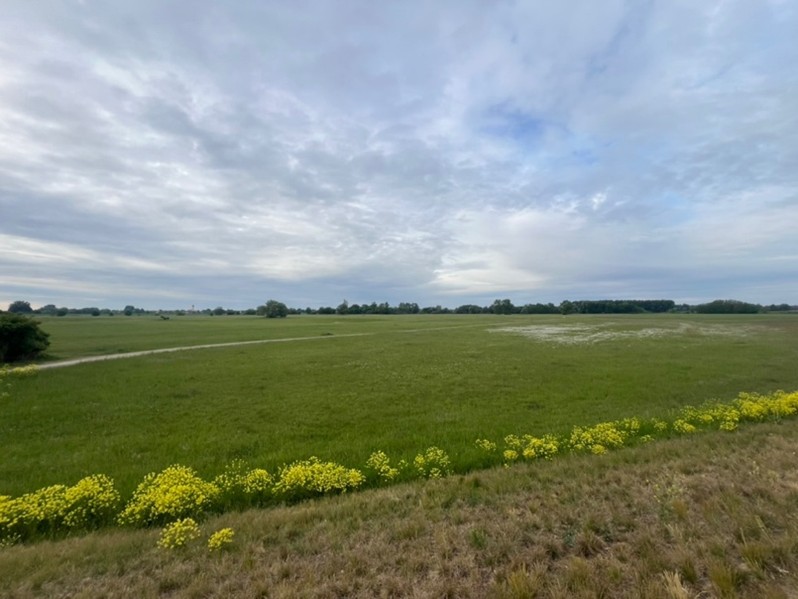
The landscape along the Bavarian Danube bears the marks of decades of engineering and bureaucracy. In the 1980s, sections of the river were straightened and modified to accommodate larger shipping traffic, triggering nationwide compensation schemes intended to offset environmental damage. Some of the floodplain meadows around Stöcklwörth were created or managed as part of those mitigation measures.
The legacy of that system still shapes conservation in the region today. Large areas are owned by the state forestry ministry, which manages the land according to rigid plans drawn up decades ago, often with little flexibility for rapidly changing realities. Ownership is fragmented between forestry authorities, water agencies, conservation bodies and private landowners, creating a maze of administration that can slow even minor management changes for years. In many ways, Curlews are now trying to survive not only within a damaged landscape, but within the inertia of the systems created to repair it.
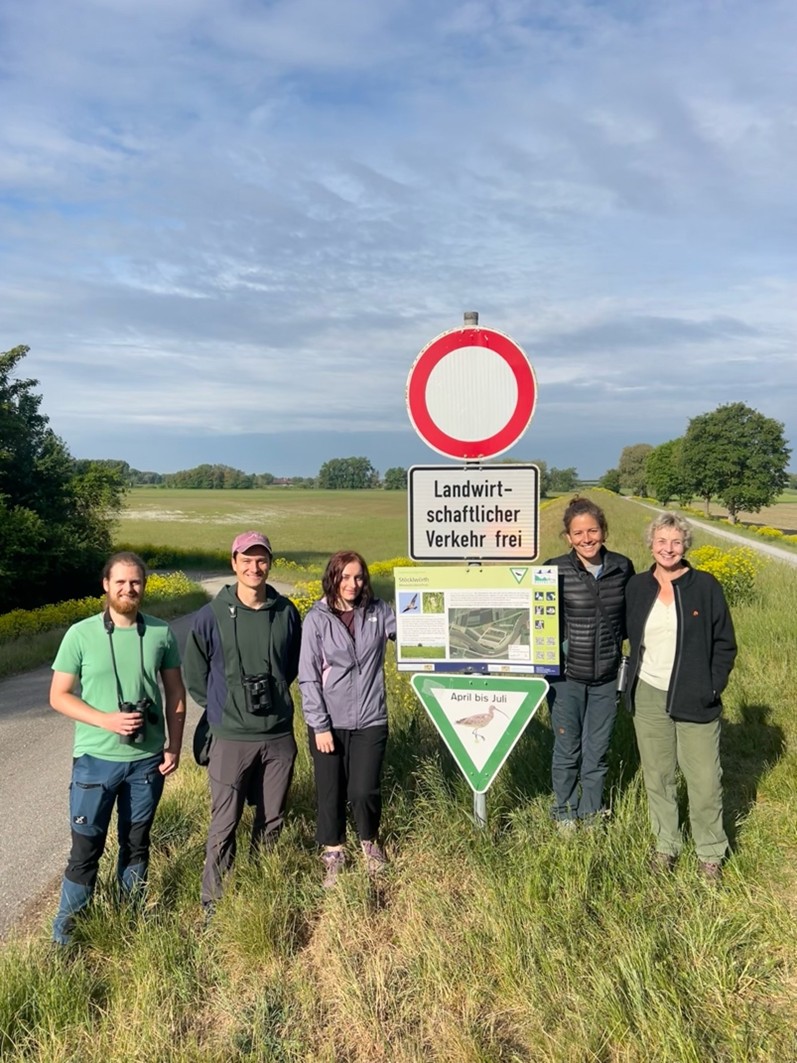
Yet, these vital river valley meadows, known as Stromtalwiesen, provide crucial breeding habitat for endangered wetland birds. Stöcklwörth is relatively secluded from heavy local usage, although it is still popular with dog walkers and people fishing along the Danube. We were accompanied by Bastian Thom, who is just leaving his post, and his replacement, Simon Köppl, and Verena Rupprecht, all from LBV.
15 hectares of meadow are enclosed here each spring by a huge, multi-strand electric fence erected by around forty volunteers. The project began around 2013 because of the high predation pressure. Foxes, Corvids, birds of prey and Badgers were all taking a toll on eggs and chicks. A small patch of reeds provided a home for Marsh Harriers, and Sparrow Hawks and Peregrines are also in the area. Last winter (2025), local hunters reportedly shot forty foxes around the reserve, yet Bastian thought this barely dents the problem. The reserve itself is small patch is a much larger landscape, surrounded by woodland and farmland from which predators quickly return.
Increasingly, even the fences are failing. This year, for the first time, nests inside fenced areas have been predated at several sites separated by many kilometres. Nobody yet knows exactly how, or which species is responsible, but something is learning how to breach the fortress, most likely Marsh Harriers.
The atmosphere was a mixture of pride and worry. Seven Curlew nests had been found this spring, six within the main fence and one outside. The outside nest was protected with a smaller enclosure and the chicks hatched successfully, eventually wandering into the larger fenced area nearby.
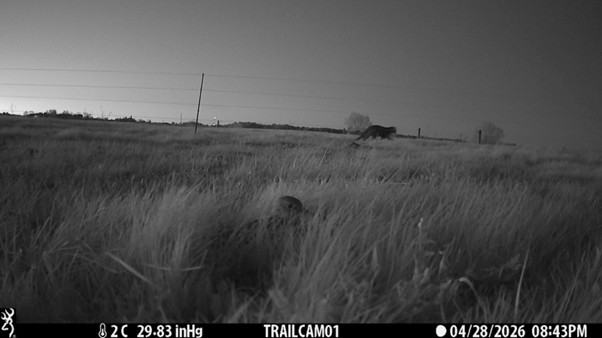
It is hoped the success of last year (2025) can be repeated. Six breeding pairs managed to raise nine fledglings, a genuinely successful season by today’s standards, yet previous years produced none at all. Not a single chick survived. One nest camera even captured a fox somehow getting inside the fence itself.
Every detail here is managed with care. The meadows are cut strategically to create a mosaic of short and long vegetation. Volunteers walk ahead of tractors searching for hidden chicks before mowing begins. Drones are flown overhead to count surviving hatchlings. Farmers are negotiated with constantly. Police patrols have even been increased because hikers ignored the signs and fishers were driving illegally into sensitive breeding areas. One culprit received a 400-euro fine after authorities decided to show they were serious about protection.
What struck me most was how modern Curlew conservation increasingly resembles emergency medicine. Every nest is intensely monitored and defended against threats coming from all directions. The wider landscape has become so hostile to breeding waders that survival now depends on these heavily managed refuges.
The fences stretching across the flood meadows felt symbolic of something much larger. They were practical barriers, but they also represented the uncomfortable reality that conservation is increasingly forced to create islands of safety within landscapes that are no longer in balance for vulnerable wildlife. Building a fortress seems to be the only way to save them.
Gmünder Au
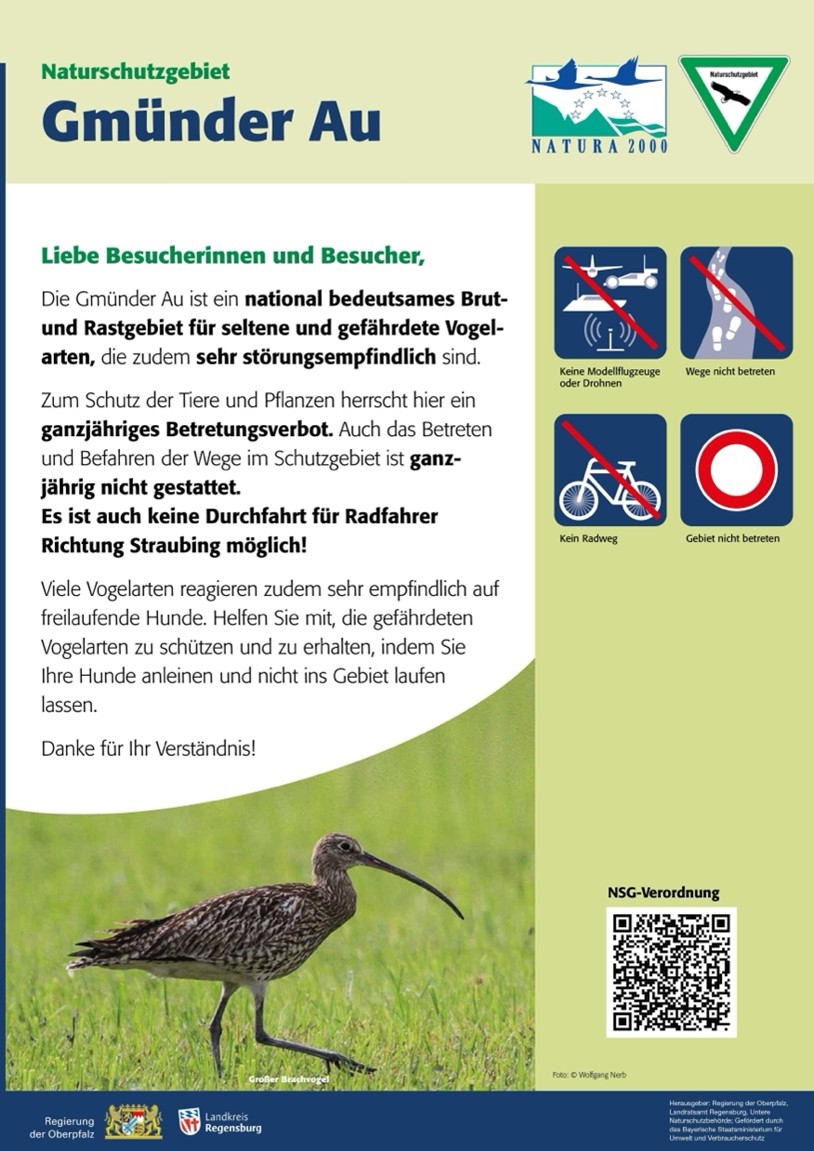
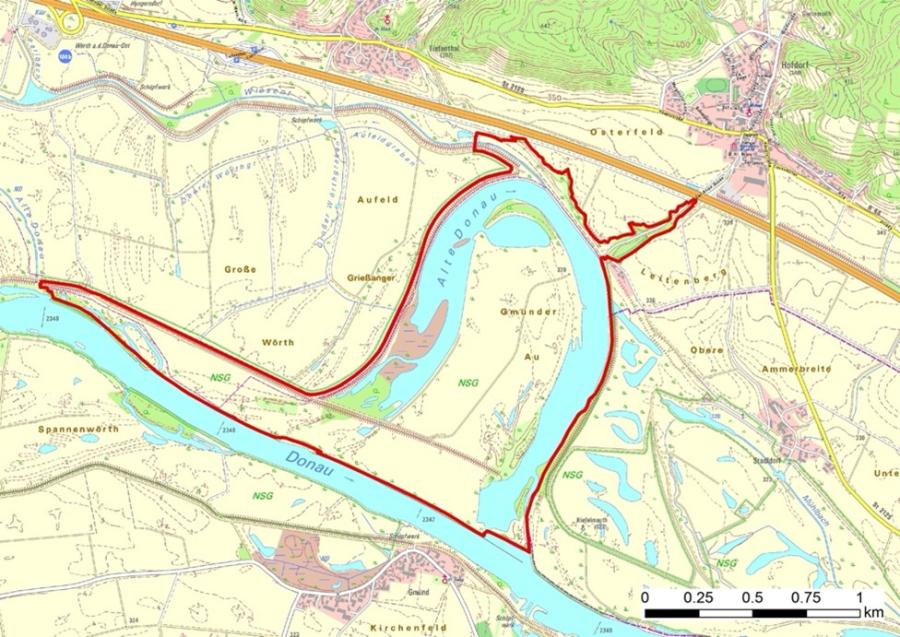
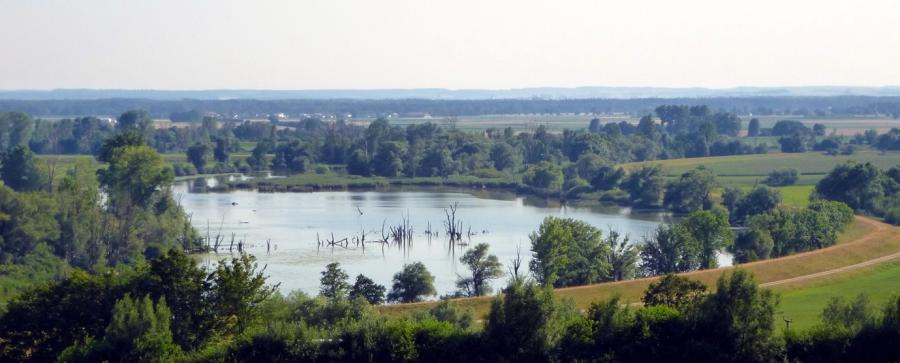
Gmünder Au is another protected floodplain reserve along the Danube, near the villages of Gmünd and Pfatter in the Regensburg district.
It covers 184 hectares and was created around an old Danube oxbow formed after the river engineering and straightening works of the mid-19th century. Despite embankments and modification, the area still floods regularly, helping maintain wet meadows, reedbeds, ponds and floodplain woodland.
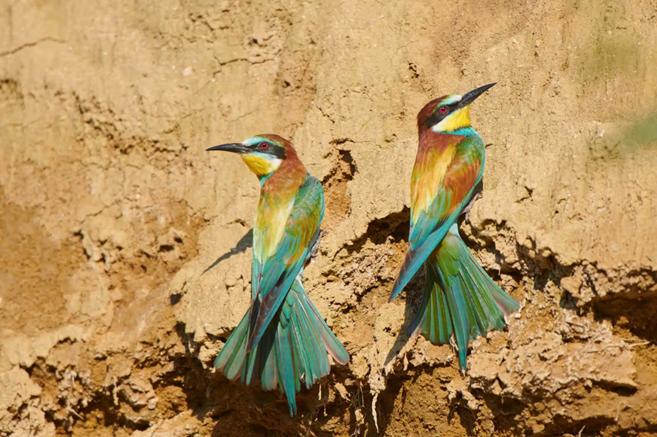
For Curlews, these meadows are especially important, but the reserve also supports breeding and migratory Purple Heron, Black-crowned Night Heron, Western Marsh Harrier, European Bee-eater, Common Cuckoo and Grey Heron.
The discussions here were more hopeful. Unlike many areas across Europe where populations continue to decline sharply, the Curlews at Gmünder Au appear to have achieved stability and, perhaps, even cautious recovery.
Bastian explained that the local population has remained stable for at least fifteen years, with breeding pairs recently increasing from four to seven, while six breeding pairs were recorded last year. There was also evidence that the site is producing birds capable of returning to breed. Ringing records showed that Curlews marked as chicks in 2017 have now returned as breeding adults, confirming that at least some fledged young are surviving to adulthood and returning to the same landscape.
The geography of the site helps explain both its value and its vulnerability. The protected areas include Gmünder Au itself, together with a series of meadow fragments scattered along the riverbanks. Rather than one large uninterrupted reserve, the habitat consists of small, fragmented floodplain meadows woven through a heavily managed agricultural landscape. These isolated patches still provide the wet grassland conditions Curlews need for nesting, and there is enough food in the more intensively managed areas.
The discussions also highlighted how fragile such successes remain. Even where populations are stable, everything depends on maintaining suitable habitat across enough connected land. Small floodplain meadows can easily become isolated islands surrounded by increasingly intensive farming, drainage or development. Curlews may persist for years in these landscapes because they are long-lived birds, but without sustained breeding success populations can age and decline.
Niederwinkling Moos
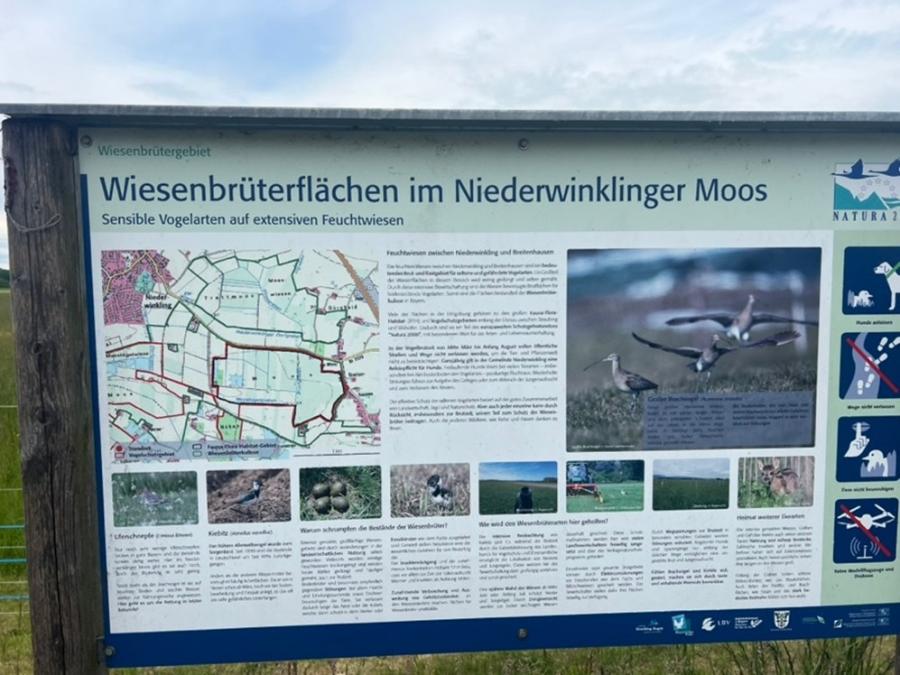
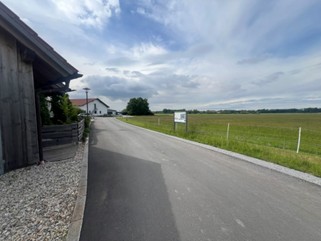
We left the relative seclusion of the last two sites to arrive at a far more municipal, utilitarian landscape, busier with major roads, towns and villages, and feeling rougher and more heavily used. The work is highly collaborative. LBV handles the organisational side of the project, liaising with land managers, organising the fences and coordinating much of the practical conservation work on the ground. They also organise and fund most of the monitoring and nest-searching. The LPV funds the fences themselves, provides additional support when needed and assists with nest searches using drones.
Niederwinkling Moos holds the highest density of Curlews within the SPA. At the time of our visit, there were seven breeding pairs nesting inside a protected fenced area, with a further two breeding pairs behind the fence and another two pairs across the busy road. At least five chicks were already known to be alive within the fenced section, and one adult bird was still sitting on eggs on the morning of our visit.
Janine Eurisch explained that all the land is privately owned and that 13 different farmers operate inside the 17 hectares of fenced meadow, requiring extensive farmer liaison. To help monitor the chicks they use drone technology, and once nests are found, teams spend long hours observing behaviour through telescopes, tracking breeding success .
Protective fencing has become one of the key tools in reducing nest losses. Temporary electric fences are placed around the unprotected, isolated nests, and the team reported that the large, fenced area had successfully produced fledged young the previous year.
Predation remains the greatest challenge. While the fence appears effective at preventing ground-based predation, the skies still hold dangers. Staff have noted numerous aerial predators in the area, including Black Kites, Red Kites, Marsh Harriers, Buzzards, and Crows were also present, while Ravens were breeding in nearby woodland. As mammalian predators such as foxes are increasingly excluded by fencing, birds of prey are becoming a growing problem for Curlew conservation, a pattern now being seen across parts of the UK and Europe.
What struck us most was how close the site lies to the newly constructed village. This development is still a source of frustration for the teams working so hard to protect the birds, who would like to have been involved in its planning. The nearest nest could not have been more than 200 metres away. It seemed that local people were largely detached from the Curlew work, though they tolerated the electrified fence so near their homes. For now, at least, the bubbling call of the Curlew can still be heard rising above the steady drone of traffic from the nearby main road.
Königsauer Moos
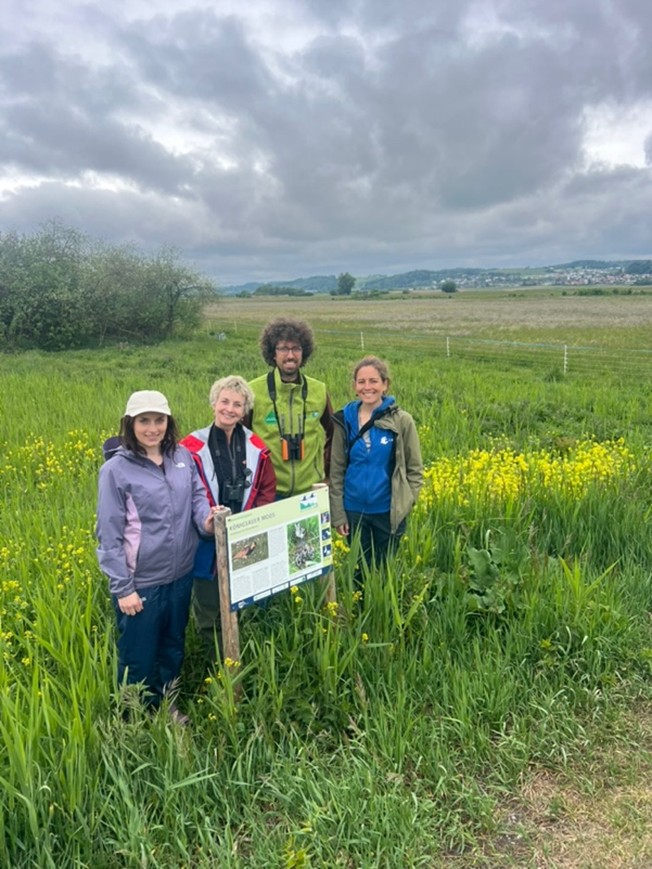
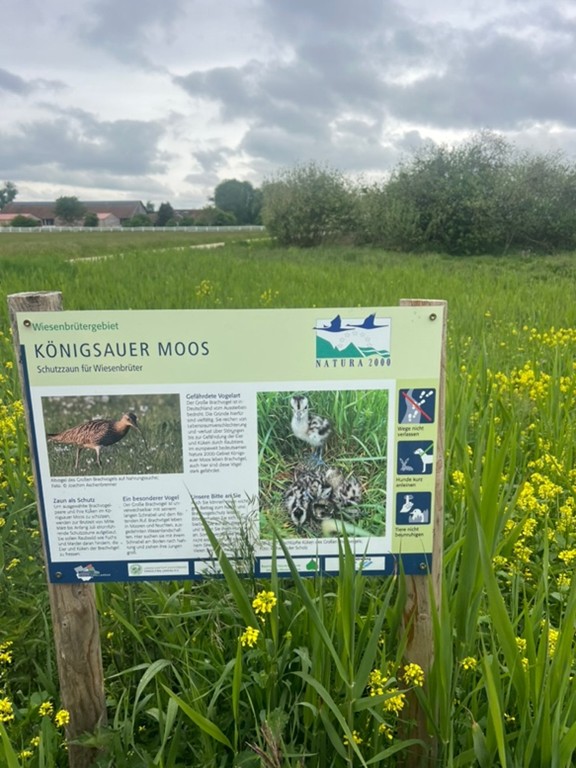
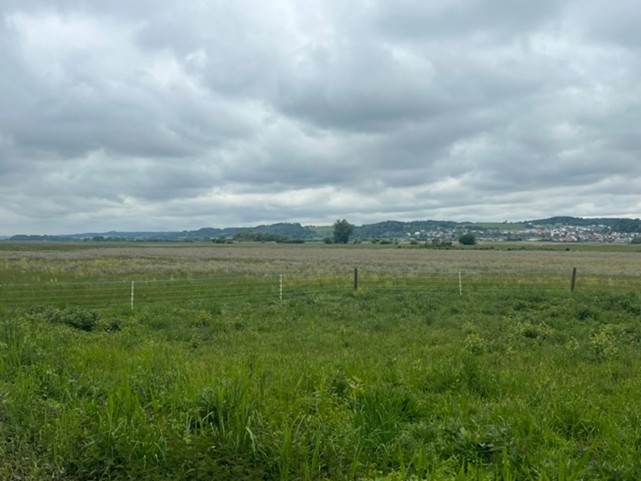
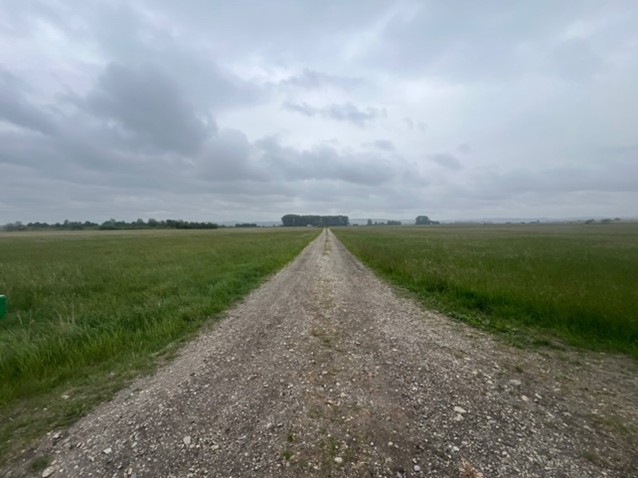
“I need more water” was the plea from Philipp Herrmann as we looked out over the area he manages, an expanse of meadows sandwiched between villages, roads and the Isar river. Historic, extensive drainage has dried out the soils and diminished the once abundant wildlife.
The area covers around 1,500 hectares, and the conversations here carried a strong sense of concern about the enormous effort now being invested in keeping the birds going, set against the seemingly limited success in terms of chicks fledged.
Philipp explained that Curlew numbers have fallen over the last decade from around sixty breeding pairs and up to twenty-five fledglings a year to roughly forty-five pairs and fifteen fledglings today. Although the population has remained relatively stable over the last five years, the long-term trend is clearly downward.
What struck me was how dramatically conservation management has intensified over recent years. The landscape now contains three large, fenced areas, each covering between fifteen and twenty hectares, alongside twenty-one smaller nest fences protecting individual nests. Philipp was blunt about their importance - nests outside fenced areas rarely, if ever, fledge successfully.
One of the larger fenced areas protects four breeding pairs on a patchwork of private contract land and highway compensation land, another reminder of how fragmented and negotiated modern Curlew conservation has become.
Philipp would like to experiment with fence designs used elsewhere, which not only to exclude predators, but to keep chicks safely contained within protected areas once they hatch. Yet even fencing is no guarantee of safety. Stoats and weasels can still exploit mouse holes beneath barriers, while aerial predation from Marsh Harriers and Goshawks is becoming increasingly serious.
The changing predator picture came up repeatedly throughout the trip. Research between 2010 and 2015, using temperature sensors placed in nests, identified foxes as the main nocturnal predators, and local hunters still remove around twenty foxes annually.
But, as elsewhere, bird predation now appears to be increasing, possibly because fences exclude mammalian predators and perhaps also because declining insect numbers and shrinking populations of small vertebrates are forcing birds of prey to specialise more heavily on Curlew chicks.
Philipp described the protected areas as becoming “honeypots” - islands where Curlews and other waders, concentrate within an otherwise increasingly empty landscape, attracting more predation.
Water, once again, emerged as central to everything. The area is already drained but recent dry weather has slowed meadow growth even more, leaving vegetation sparse and open, reducing cover for chicks. It may also be reducing the availability of insect food. Philipp has pushed mowing dates back from mid-June to early July in an effort to allow chicks enough time to fledge, but late laying dates this year mean some young birds may still not be capable of flight even by then. Outside the conservation programme, intensively farmed meadows continue to pose major risks.
There was also a sobering discussion about unusually high egg failure rates. Many nests contain only three eggs instead of the normal four, and embryos die during development despite eggs being fertile. The conversation ranged across possible causes, from pollution on wintering grounds such as the Po Delta to contaminants entering waterways through agriculture and human waste.
The Isar Valley also highlighted how conservation increasingly collides with wider social tensions. Attempts to rewet parts of the landscape have met resistance from local communities worried about flooding and impacts on property. Raising water levels in a meadow by only twenty centimetres triggered complaints from nearby residents who believed it was causing water in their basements, despite no evidence to support a link.
As elsewhere, there was no sense of easy answers. Philipp is trying to hold together a functioning landscape for Curlews within a countryside shaped by roads, intensive agriculture, fragmented habitats and a general lack of awareness of the issues in local communities. He found it demoralising that despite all the intervention Curlew numbers continue to decline. He wants to experiment with introducing cattle into the meadows to help with vegetation structure, and he would also love to do much more outreach to local people to encourage them to engage them with the birds that breed on their doorstep. So far, sadly, his suggestions have not been encouraged.
Philipp has a thriving personal Instagram account, @Vogelphilipp, which is dedicated to the joy of observing nature, and he has written a fun book on learning birdsong. He is engaging and knowledgeable, and his love for the birds he works with shines through. With this special talent it is even more of a pity he isn’t allowed to reach out to the people who surround the meadows for fear of – well, I’m not sure what.
We also had a thoughtful discussion on the importance of nature education and drawing everyone, young and old, into finding solutions to the immense environmental crises we face. I found meeting Philipp deeply moving, and I loved the few hours we spent with the Curlews. Philipp’s enthusiasm is infectious, but there is undeniably a sadness not far beneath the surface. If I could do more to help him do what he knows needs to happen, I most certainly would.
Looking back at the notes I wrote that day, the last few lines sum it up:
“This site the most unsettling so far. Birds too specialised for this habitat. The cry of curlew is one of desperation. Lack of public engagement, too many issues, too dry, too small, but at least they have Philipp.”