
Having spent a few days in North Rhine-Westphalia and then a day in Lower Saxony, it was now time to head to the very north of Germany to see some Curlew (Numenius arquata) breeding sites there. We took a five-and-a-half-hour journey by train to northern Schleswig-Holstein to the village of Bergenhusen, the base of one of the scientific institutes of Germany’s largest conservation organisations, NABU, which sits less than 80km from the Danish border. Bergenhusen is known as the ‘village of storks’, with up to 30 breeding pairs of White Storks (Ciconia ciconia) nesting there. The village seems proud of its storks - gardens surrounding colourful, often thatch-roofed houses, featuring stork statues, decorations, and artwork. There is even a man who rehabilitates injured storks living nearby.
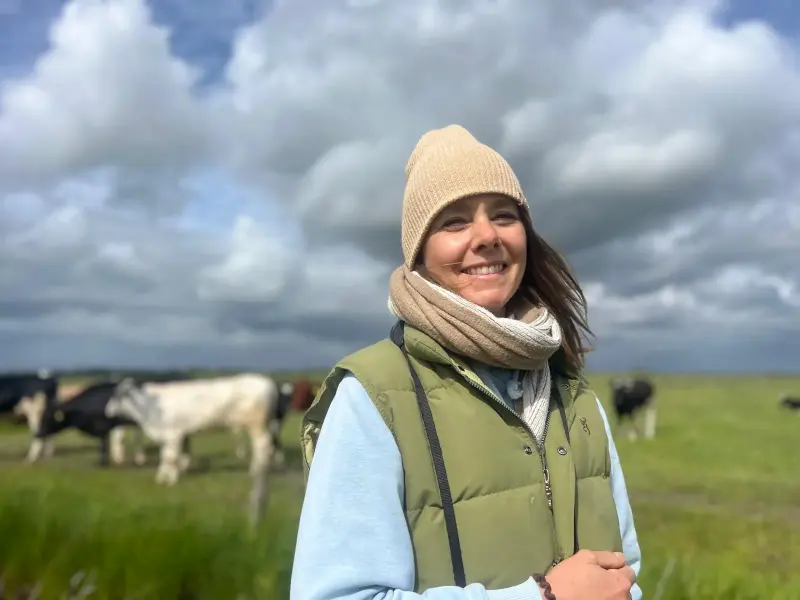
In the late afternoon at a small train station in Friedrichstadt we meet Natalie Busch, Scientific Assistant at NABU. Natalie’s work year is divided up into ‘breeding season’ during which her main role is in nest and chick protection and the scientific investigation of how to improve meadow bird protection, and ‘non-breeding season’ during which she writes papers and applies for funding for the programme.
The local area has around 70 breeding pairs of Curlews, the population having been stable for several years after peaking at about 90 pairs some decades ago. A few hundred Lapwing (Vanellus vanellus) pairs inhabit the area – despite a loss of up to 90% in Germany - and up to about 60 pairs of Black-tailed Godwit (Limosa limosa), with some Redshank (Tringa totanus) and Oystercatchers (Haematopus ostralegus). Fencing now means that most Curlew eggs successfully hatch. Curlews were originally the only species protected in this way, but following serious declines in Black-tailed Godwits, their nests are now routinely fenced as well. Older farmers have told Natalie that Godwits used to be seen sitting on every fence post of many of the surrounding fields in the breeding season – a far cry from today’s occasional sightings. Despite Curlew nest fencing, fledging success is low, at around 0.1 – 0.4 chicks per pair each year, although 0.4 is close to a sustainable rate, with last year’s success at 0.36 (26 individuals fledged).
Natalie is optimistic about this year’s breeding season. ‘It’s a good mice year,’ she explains — meaning conditions have favoured field mice survival and breeding, leading to a natural population boom. Mouse numbers often rise and fall in multi-year cycles, with occasional peak years when plentiful food, mild weather and high breeding success cause their populations to increase dramatically. This means that predators will have a food source in abundance, other than chicks and eggs. Even some Short-eared Owls (Asio flammeus) have stayed to breed in the area this year – a very rare and promising sign. This year, there are possibly more than 20 Short-eared Owls breeding in the area – a species which also nests on the ground and which is considered threatened with extinction in Germany.
Natalie explains that several decades ago Curlews began moving from the mires into the surrounding meadows and farmland, where most now breed. Why this shift happened is still not fully understood, though changes in food availability may have played a role. Ironically, these meadows were themselves once shallow lakes and wetlands before being drained for agriculture. Today, the population depends heavily on intensive conservation support within these managed grasslands, and without it the birds would almost certainly disappear from the area. In that sense, the population is now being sustained in a highly artificial landscape.
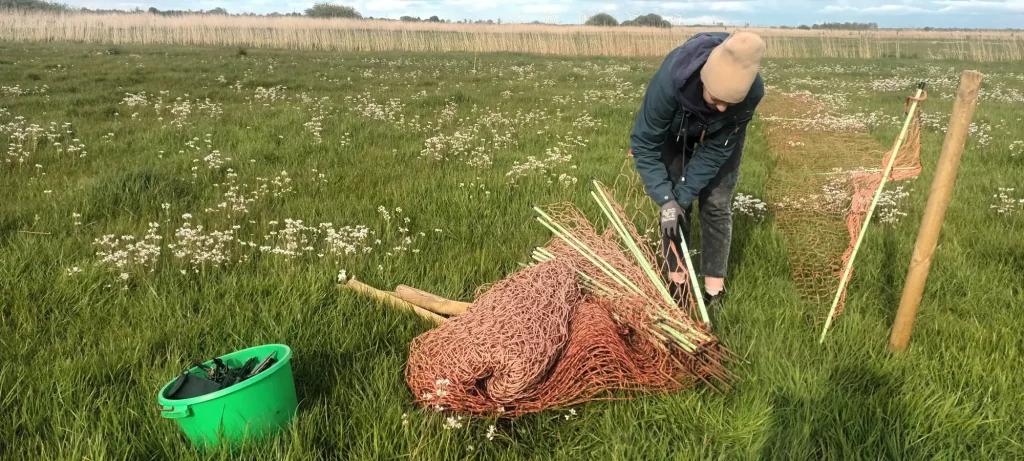
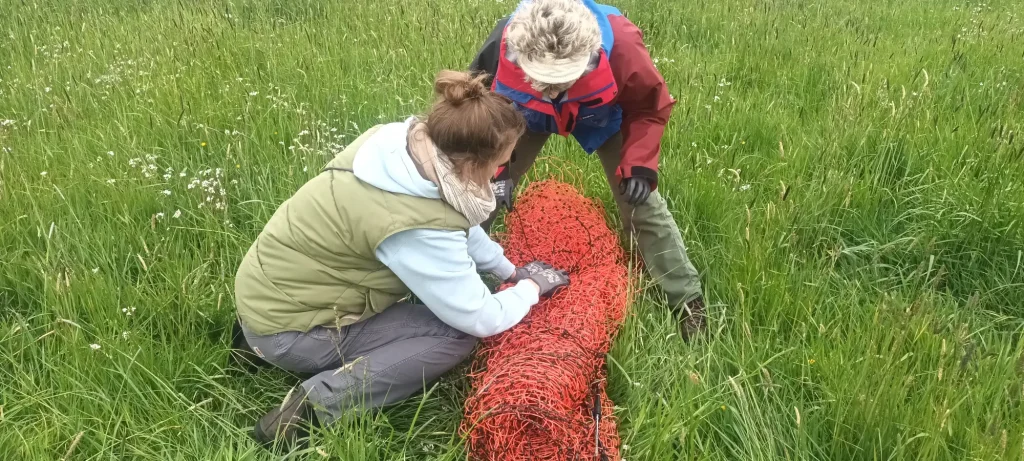
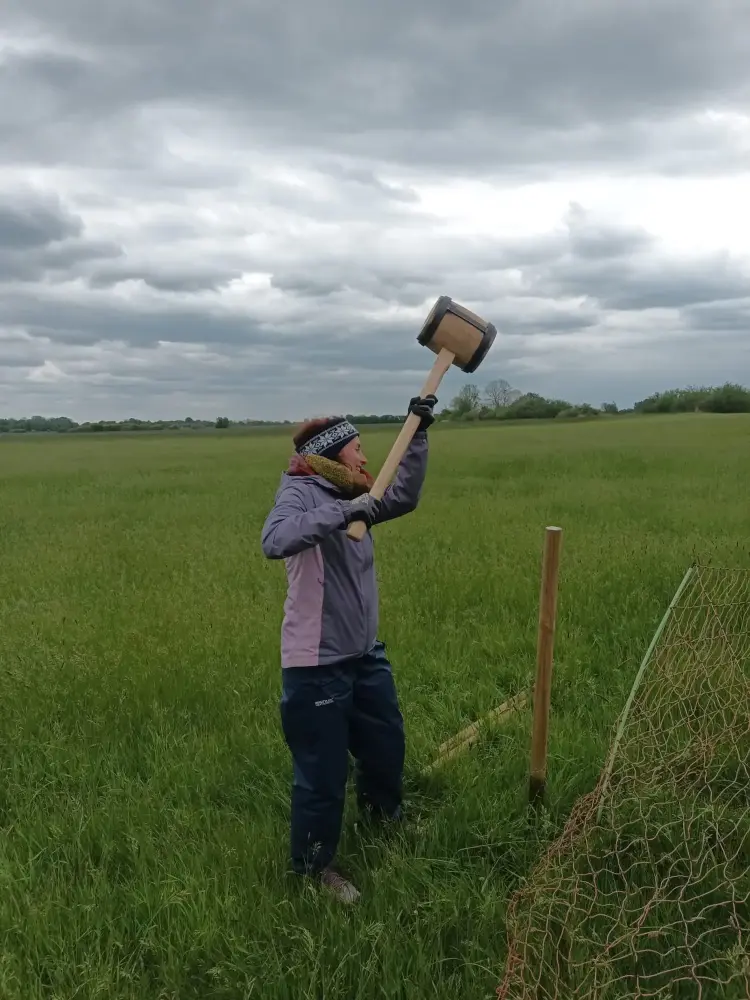
On our train journey north from Lower Saxony, Natalie had messaged to say that a volunteer who she works with had discovered a new Curlew nest that day, so soon after dropping our bags off at the Michael-Otto-Institute (NABU) I take a ten minute drive with Natalie to put an electric fence around the nest. As someone working in the world of Curlew conservation, and who has seen many an electric-fenced nest by now, it strikes me as I am carrying half of the fencing and the solar panel unit over the field towards the nest that I have never actually seen one of these fences being put up before. I get to the nest and peer over at the four, olive green eggs sat neatly in a cluster, and we get to work.
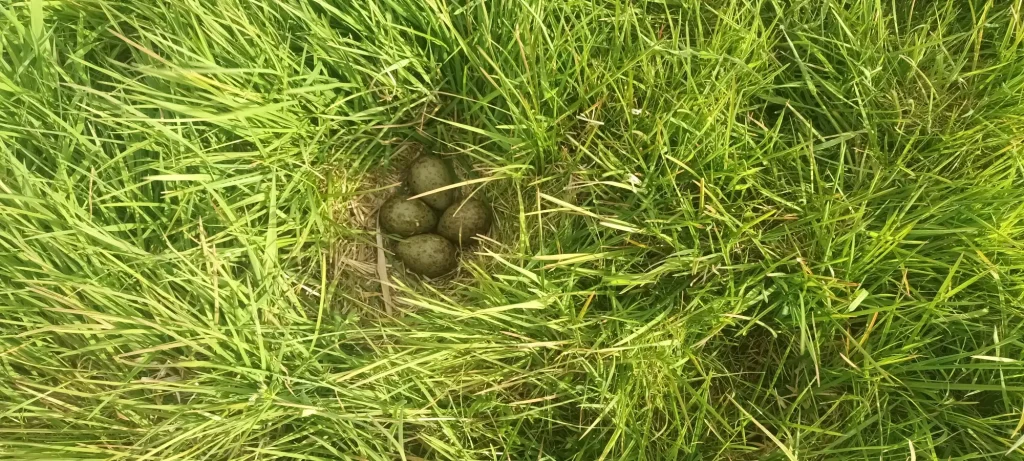
It is a privilege to be able to help – carrying equipment and securing sections of fence to the ground - and the whole process takes us about twenty minutes. I appreciate that the thoroughness of the job, or lack thereof, could directly impact the fate of the nest. The fence is a 25x25m orange mesh with electric fed through it, while the nest sits between two bamboo canes marked with red tape so that it is easy to find again between first discovery and fencing.
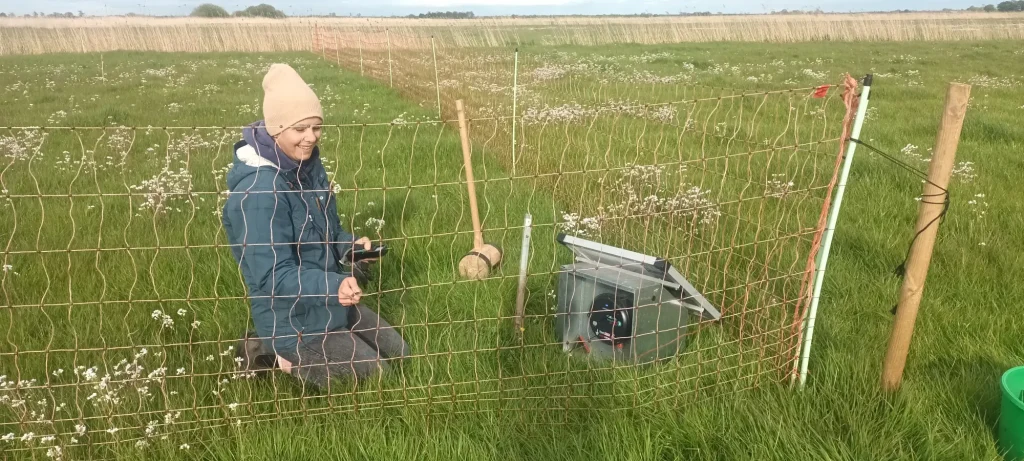
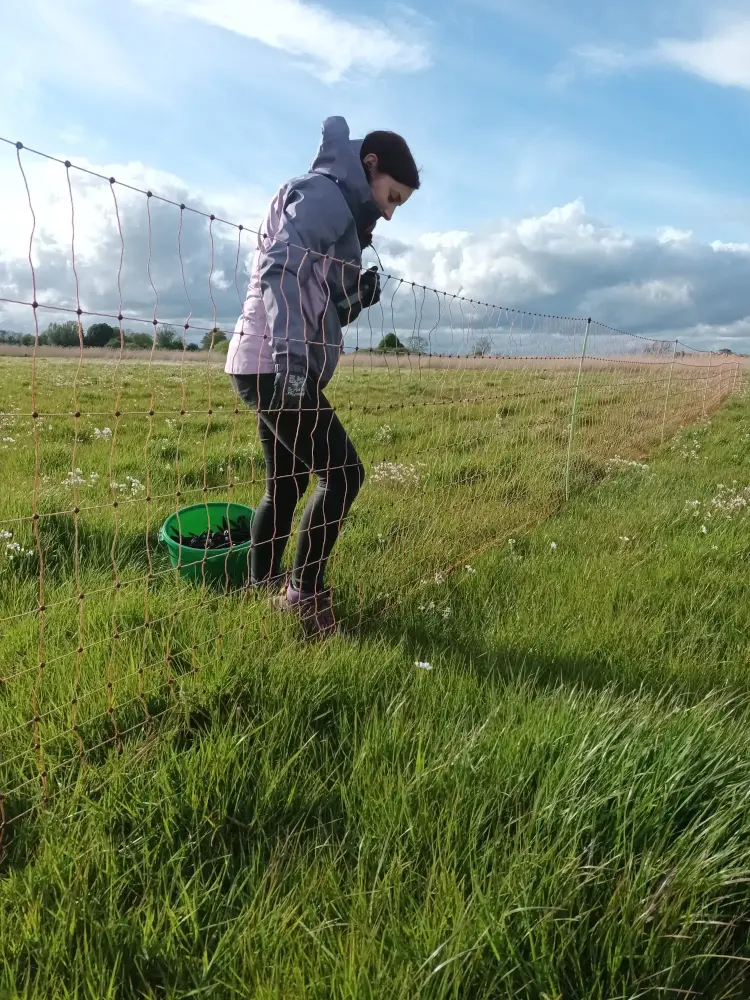
We return to the car to wait and see if an adult returns, and one appears almost immediately, inspecting the fencing from the outside before entering it and returning to the nest within five minutes. On your own, as many fieldworkers are when doing this work, the process of building the fence would have taken longer than it took us as a pair – there are a lot of materials to carry a few hundred metres, and they are heavy. After constructing the fencing, there is no guarantee of success at the end of it, of course.
On the drive back to our accommodation, we pass a field which is electric fenced all the way around. I am told that this was pre-emptively fenced before breeding began in hopes that birds would nest here and be protected even when chicks hatch and grow – unlike fencing for single nests, which chicks leave soon after hatching. This field is currently being used by at least four Lapwing and four Black-tailed Godwit pairs.
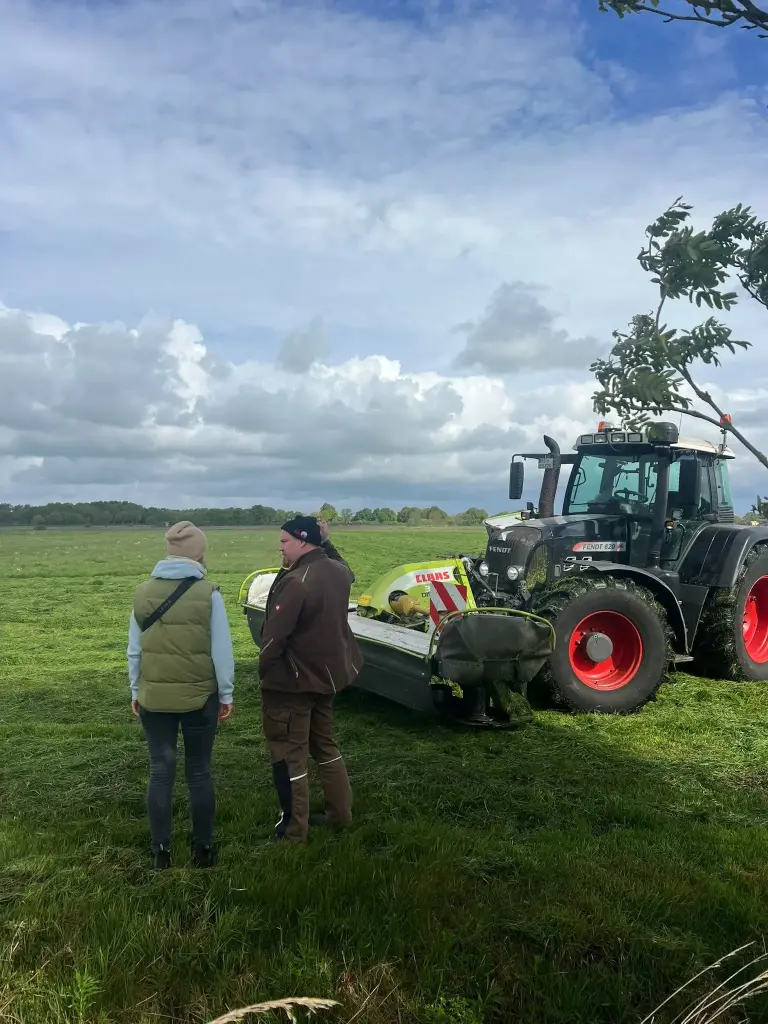
On our second day at the institute, Natalie takes us out to visit several Curlew nests to see how they are faring. Before that, however, we drive to a field where a Curlew family had been seen just two days earlier. Natalie has arranged to meet a local farmer who plans to mow the meadow today, and she hopes to ensure the chicks are safely located before the tractor moves in. This kind of emergency coordination forms a regular part of her work. She explains that even when mowing times are agreed in advance, farmers may arrive hours late (this time of the year is also very stressful for them), leaving her waiting all afternoon after spending hours searching for hidden chicks beforehand.
On this occasion the opposite has happened: the farmer has started mowing early. Natalie is visibly distressed and anxious as we walk the field, knowing the chicks may already have been killed beneath the mower blades or tractor wheels despite her arriving thirty minutes before the agreed time. “When you don’t know where the chicks are and there’s a field just been mown, it’s horrible,” she says quietly. “It’s the worst-case scenario.”
The field being mowed is the one adjacent to the last spot at which the Curlews were seen, and they may have wandered into it in the two days since they were last seen, putting the chicks at risk of already being lost. We walk around for a while looking for signs of (Curlew) life, several roe deer darting around in front of us, seemingly unable to decide where they want to go. After about fifteen minutes an adult Curlew is seen and heard alarm calling in the distance in the direction of where the family was last seen, which we take as a good sign. However, Natalie says that sometimes they will do this even up to a few weeks after their chicks have been killed. “It’s so sad,” she comments. Luckily, this is not what is happening here, as one chick is soon seen in an adjacent field, very much alive, and the other three are hopefully hiding nearby.
The farmer has chosen to mow his field from the outside in, which is meant to be good for young deer which are more likely to escape if they are hiding in the long grass, but it is not good for Curlews who like to use the field margin and ditches for chick-rearing. Natalie tells us that due to the speed of the tractors little escapes anyway, and she feels terrible when she is sitting inside a tractor alongside a farmer to ensure that Curlew chicks are not mown over, only to see Skylarks and other birds flying alongside with food in their beaks for the mouths of chicks which are being crushed under the machinery, and with nothing she can do to help them. Insects and mammals (including young deer and hares) meet a similar fate in the long grasses which are so quickly driven over and cut. Natalie feels guilty that she can only protect one species at a time. After the fields have been cut, storks fly in to feed on the scattered remains of whatever has fallen prey to the cutting or gathering of grasses.
The Curlew pair Natalie is protecting today successfully raised two chicks to fledging last year. Natalie speaks to the farmer about where the chicks are and asks him to avoid mowing that section for the time being, and he is happy to do so. Natalie tells us that he is a very friendly farmer, as the vast majority are. He turns off the engine of his tractor and gets out of it to talk to her, which she tells us she does not take for granted.
A small number of farmers are disinterested and occasionally she has issues with aggression and sexist attitudes. However, she stresses that this is not the majority. She describes the ‘ugly’ attitude of again, a small minority, who will try to haggle for more money in exchange for protecting a nest. Others simply refuse and knowingly mow over them, as has happened with several nests over the years. On one occasion Natalie pointed out some Lapwing and Skylark nests to a farmer, and a few days later saw that the field had been mown without her being made aware. “Sorry, my father decided to mow early,” was the explanation.
Interestingly, as well, there is a culture in farming whereby some farmers are worried about cooperating and fencing nests in case their neighbours judge them for it. Relationships can be tricky at the best of times, as farmers have felt vilified by conservationists in the past. “They work hard, often have to live off subsidies, then people tell them that they’re killing birds.” The lack of cooperation by some farmers is thought to be for these reasons. The whole initiative to compensate farmers to protect (meadow) birds was founded by farmers themselves almost 40 years ago. “That is why we have such a trustworthy relationship with most of the participating farmers even today”, explains Natalie. Today, a local organisation called Kuno e.V. acts as a mediator, helping farmers to receive governmental funding for their conservation actions by filling out the paperwork, going out themselves to protect nests, and helping to maintain good habitat for waders. An organisation like this is considered crucial for the success of this specific project. This protection approach grew from just a few farmers in the late 1990s to over 100 farmers (and almost 600 protected meadow bird broods) last year. Additionally, many volunteers, often farmers themselves, help protect these highly endangered birds. “The liaison of farmers, cooperations like Kuno e.V., nature protection organisations like NABU and government, together with the help of countless volunteers is what makes our project so special in an ever more complex world of ego-driven decisions” says Natalie with a smile that shows pride. Today, their approach of protecting meadow birds is applied in the whole province of Schleswig-Holstein, which is hard to grasp the immensity of.
In this case, the farmer Natalie meets today reports that he started mowing before her arrival because he didn’t think the risk was high since the Curlews were last seen in the next field. He even comments that while he had not considered the risk of the chicks being in the field being mown, he didn’t notice any adults flying around him alarming, which would have happened if the chicks were nearby. With an important job to do and no doubt many other responsibilities to fill his day, he has to prioritise his time, but doing so can prove fatal to chicks.
Mary asks Natalie if the parents are likely to now take their chicks into the field which has just been mown. Natalie says that while this is possible, Curlews in the area don’t tend to do this as much as Lapwings. One year, a Lapwing family avoided a field while it was being mown, but once cut the parents took the chicks in to feed and they were then killed by the machinery which turns and collects the grass. Even when mowing is complete, the danger is not over. It really does feel like things are stacked against these birds throughout the whole season, with one potential peril following the next.
As well as having to deal with occurrences like this, fieldwork can be lonely – Natalie and her colleagues mainly go out on their own, meet farmers alone, put up fences alone, see evidence of chick death alone, then finish the day with no one to talk to about it. Hours are long, and burnout is a real risk, one that a few people we have met on this trip have talked to us about. Some fieldworkers have told us that they don’t know how many more seasons they have left in them. Some become ill for weeks at the end of the season each year, some admit to feeling broken and upset, often finishing their days in tears. There are frustrations, a yearning for more governmental support, and often a sense of relief when the season is over. “If I was connected to my emotions while being out here, I couldn’t do it,” Natalie remarks simply when she explains the above story about seeing Skylarks flying around tractors. Comments like these are all too common and are a reason why Curlew Action has held sessions on ecological grief at both of our in-person European Curlew Fieldworker Workshops. Both have been met with immense positivity, allowing people to open up, share with their community, and feel less alone in their experience. The sessions have even encouraged others to do more to tackle this issue.
Natalie explains that she and her colleagues try to cope with the pressures of the breeding season by imposing strict rules on themselves, including getting at least eight hours of sleep and taking one full day off each week. Very early mornings are unavoidable in fieldwork, especially when conducting surveys or using drones to locate nests and chicks. Even so, switching off is difficult. Natalie admits that when she does take a day off, she tries to leave the area entirely because if she stays, she inevitably ends up working anyway - answering calls, responding to messages, or feeling compelled to check on a nest.
In the end, the hard work and long hours result in a Curlew population which is just about sustainable, and which would not persist without intervention. It feels like a never-ending battle. “My brain is on fire,” one fieldworker tells us. This is a large reason why so many fieldworkers feel that a greater cultural shift is needed – conservationists simply can’t be fighting these battles on their own. If most people in society understood and cared for nature, there would be more pressure on governments for it to be protected, and more understanding and sympathy in general about nest disturbance and why, unfortunately, culling is often part of the solution.
As has happened a couple of times on this trip, the conversation turns to the story of a humpback whale that recently washed up on a German beach, and who had huge amounts of resources put into attempts to save. It is felt that if only the numerous species failing quietly in front of our eyes received the attention of the individual, charismatic megafauna we see facing death, something could really be done to turn the tide.
Having spoken briefly about culling, we ask about predation in the area. Alongside mowing, we are told it is now the single biggest challenge facing the birds. The organisation Natalie works for does not carry out predator control directly, but local hunters manage mammalian predators instead. Unlike some other regions, however, avian predators such as Carrion Crows are not lethally controlled here because local hunters don’t engage with it.
Natalie speaks openly about the moral tensions this creates. She admits she does not like the fact that modern wader conservation increasingly depends on predator control, even though she herself is not involved in that side of the work. In an ideal world, she says, no species would be prioritised over another, but she also recognises that ecosystems are now so altered and out of balance that some form of intervention has become necessary. Even so, she reflects quietly that she could not bring herself to do it personally.
After leaving the site where the farmer is mowing, we go to check on some nests that should have hatched. We arrive at the first, climb over the fence, and find the nest. One egg has hatched, while the other three remain intact and cold. The one hatched egg probably did so around three days ago, we are told, and the parents are seen nearby. Mary asks if the eggs can be tested to try to establish why they failed, but there is no project looking into this at present. Mary asks Natalie what she thinks the cause is, and she suggests toxins or parental conditions, although nothing is yet proven.
In a previous year in Natalie’s project area, three eggs in a nest of four hatched and the remaining one was rotten and exploded, covering one of the chicks in its contents. The chick had to be removed from the nest, washed, and dried before being returned. From my own experience of exploded eggs in a wildlife rehabilitation context, I know how eye-wateringly awful it must have been – as chick or as human encountering said chick – the smell is something else entirely. An ongoing investigation at the institute of environmental contamination in Curlew eggs will hopefully bring some results soon.
Climbing back over the fence I realise that nothing has been done to switch it on or off. I ask Natalie why this is, and she tells me that there is not enough money to electrify every fence, and many are simply barriers. We visit a couple more nests, a maze of tracks and roads taking us there – learning one’s way around takes years, apparently.
The next nest we visit belongs to a pair breeding on land owned by a farmer close to retirement. In previous years he has even erected a second fence around the nest himself (a barrier to keep his cows from getting too close), such is his determination to help the birds succeed. He has told Natalie that he remembered how full of birds these meadows once were compared with today, and made it clear he wanted to help in any way he could. As we approach the nest an adult Curlew flushes when we are still around ten metres away, a reassuring sign that the nest is still active, so we quietly retreat, pausing on the way to greet a curious group of cows watching us from the field edge.
The following nest brings even better news. All four chicks had successfully hatched and the family has recently been seen only a short distance away. This particular pair managed to fledge one chick last year and, remarkably, were the only pair in the area out of seven or eight breeding pairs to raise even a single chick over the last four years. We finish the day by fencing another nest before returning to our accommodation.
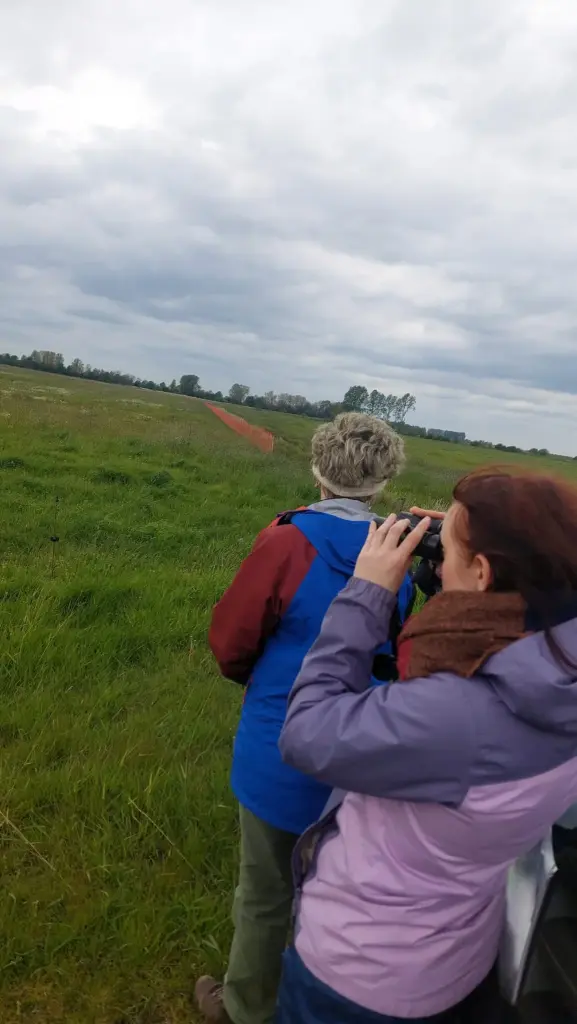
On our final day with Natalie, she heads out once again to look for the Curlew family she had tried to protect from mowing the previous afternoon. This time we spot the adults almost immediately. A young farmer arrives with his tractor and Natalie climbs in beside him, guiding him carefully around the area where the birds have been seen. After some discussion she persuades him to leave an unmown buffer of one to two hectares around the family. Mary and I watch anxiously as one of the adult Curlews flies back into the refuge while the mowing continues all around it.
Even when chicks are spared directly by actions like this, it does not mean they escape unharmed. I wonder aloud whether the constant noise of tractors might itself disrupt communication between parents and chicks, and Natalie agrees. She recalls watching one chick in a previous year become increasingly distressed whenever a tractor passes nearby. The bird ran frantically around the field each time the machinery approached, eventually collapsing, panting with exhaustion. Meanwhile its parents were repeatedly mobbing gulls drawn in by the freshly cut grass in neighbouring fields. The combination of noise, disturbance and distraction can leave chicks dangerously exposed, increasing the risk of predation even when the mowing itself misses them.
Because dairy cows depend on high-quality grass at this time of year, delaying mowing until after the breeding season would make little economic sense for most farmers. The protein and nutritional value of the grass declines rapidly as the season progresses, making late-cut silage far less useful. The farmer Natalie is working with explained to her that he had an enormous amount to get through and needed to finish mowing as many fields as possible before rain arrived over the next few days. Unlike some areas dominated by large agribusinesses, the land here is still divided between several local farming families. This means conservation depends on maintaining good relationships with many different farmers across relatively small areas.
Although I remark that the tractor seemed to be moving extremely quickly, Natalie later explains that the farmer was actually mowing quite slowly by modern standards, giving wildlife a better chance to escape. The machinery itself is also smaller than the huge tractors now commonly used on many industrial farms elsewhere in Europe. Even so, there is an awareness that agriculture here is likely to become more intensive in the coming years as farming methods continue to modernise.
Spending time with Natalie offered a moving insight into what Curlew conservation actually looks like on the ground during the breeding season. Her days move constantly between physical labour, nest monitoring, negotiating delicate relationships with farmers managing land for very different purposes, and dealing with the wider public. It is conservation at its most practical, personal and emotionally demanding.
Meeting Natalie has also revealed the stress that sits behind the work. I had never before experienced that sinking “what if?” feeling when chicks cannot be found and a tractor is already moving across the field nearby. To witness that uncertainty unfolding in real time was sobering, and it gave me a far deeper appreciation of both the emotional strain and responsibility carried by fieldworkers trying to hold these fragile populations together.