
In May 2026, Mary and Flo travelled to Germany and Austria to visit some of the country’s most important Curlew breeding landscapes and to meet the people working tirelessly to protect them. This trip is a continuation of Curlew Action’s outreach to our European colleagues, strengthening networks and information exchange across the continent and the UK. We are very grateful to everyone for your warm welcome and willingness to share your work and your time.
The journey began in Germany, where it is thought only around 3,600 breeding pairs remain, a population that has fallen by roughly 50% over the past two decades, mirroring the dramatic declines seen elsewhere.
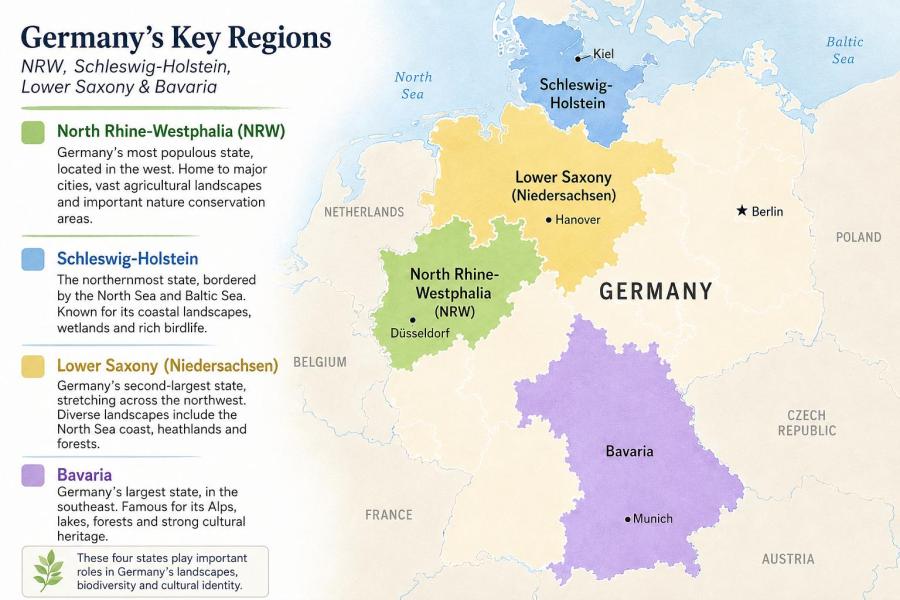
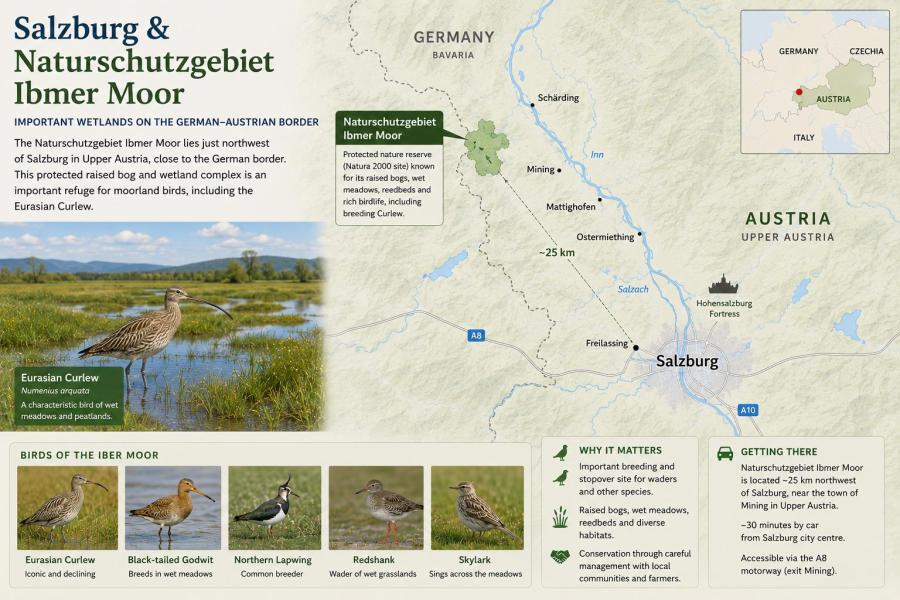
Over two weeks they visited North Rhine-Westphalia in western Germany, Schleswig-Holstein in the north, and Bavaria in southern Germany, before making a short trip across the border into Austria to visit important wetland sites there.
Germany
North Rhine Westphalia
One of the key areas for Curlews in Germany is North Rhine-Westphalia (NRW), a large province in the west, which still supports approximately 500 breeding pairs. Extensive areas in the western part of the province were once dominated by vast peat bogs, wet heaths, marshes and seasonally flooded river valleys. These landscapes developed over thousands of years in poorly drained conditions after the last Ice Age, creating raised bog and wet grassland that supported vast numbers of breeding waders.
Over the past few centuries, however, most of these peatlands were drained, cut for fuel, converted to agriculture or fragmented by roads, settlements and forestry. Intensive dairy farming and grassland improvement transformed much of the region into the productive agricultural landscape seen today. In places such as the Münsterland, Lower Rhine and border areas towards the Netherlands, traces of the old landscape system still survive peaty soils and in small fragments. Many modern conservation projects in this part of NRW are, in effect, attempts to recreate these formerly vast wet landscapes through rewetting, water control, removal of trees and adapted farming practices.
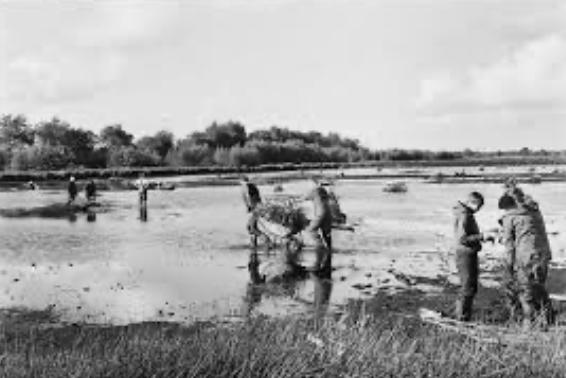
Movingly, Mary wrote about this area in Curlew Moon, a book which details her 500-mile walk for Curlews in 2016. Mary says:
I met “Granny”, an old lady who grew up in the peatlands where the locals still, just about, speak an ancient Germanic language called “Plattdeutsch.” Granny was in the living room of Ashley and Anita’s house who live in Derbyshire. Ashley had called me when I was walking in the southern Peaks and offered to cook me a dinner to say thank you for raising awareness of the Curlew’s plight. He picked me up from a train station:
Ashley speeds into the car park in a white, work-worn van. For some reason, the binoculars sitting on the passenger seat, surrounded by oily papers and grubby equipment, cheer me up as we hurried home. In their unpretentious, welcoming cottage in the country his delightful family are going through homework and chatting quietly. The smell of roast dinner adds to the homeliness and Anita is delightfully welcoming. Jack, aged eight, lists his favourite animals as dogs, megalodons, blue whales and cats. Granny, aged ninety-one and originally from western Germany, speaks the language of the northern lowlands – Plattdeutsch. Eventually, she remembers the local name for curlews as ‘wasser-tuten’, literally, water toots. They were common birds when she was a child, flying around them as they cut peat for fuel. Wasser-tuten, birds that toot as they stalk the sodden ground. It is a good image. Rain still falls outside the cottage. Perhaps some Derbyshire wasser-tuten are somewhere nearby, their feathers beaded in raindrops, I’d like to think so. Granny tells me she recently returned to the area where she was born but the peat and the tooting birds had gone.
Wasser-tuten, water-flutes, is still the most beautiful and fitting name for Curlews I have ever heard.
Schleswig-Holstien
Bergenhusen lies in the heart of the great Eider–Treene–Sorge lowlands in Schleswig-Holstein, one of the most important wet grassland landscapes in northern Germany for wading birds and migratory species. Although internationally famous as “the stork village ” because of its large breeding population of White Storks, the surrounding marshes and meadows are also important for Curlews, Black-tailed Godwits, Lapwings, Redshanks and Snipe.
The landscape around Bergenhusen is extraordinarily flat and open, shaped by rivers, winter flooding and centuries of grazing. Large areas of damp grassland, shallow pools and peat-rich soils remain, especially around reserves such as the Alte Sorge-Schleife. These wetlands are managed through water-level control, delayed mowing and extensive grazing to maintain suitable breeding habitat for waders.
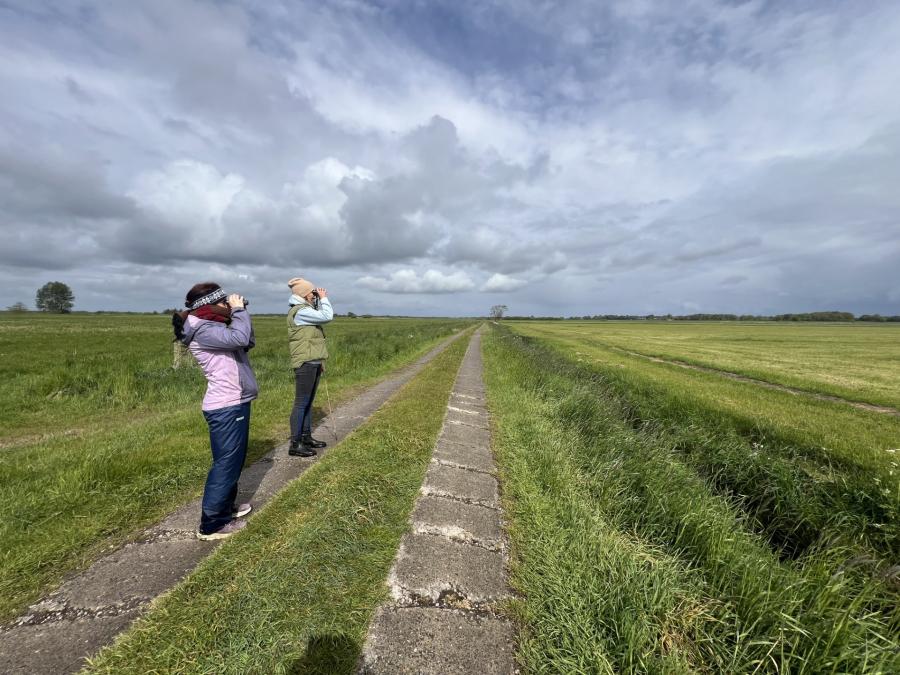
Like many Curlew landscapes across Europe, Bergenhusen reflects the sometimes uneasy balance between farming and conservation. The area remains a working agricultural landscape, but one where conservationists, volunteers and farmers must collaborate to protect breeding birds.
Lower Saxony
Bavaria
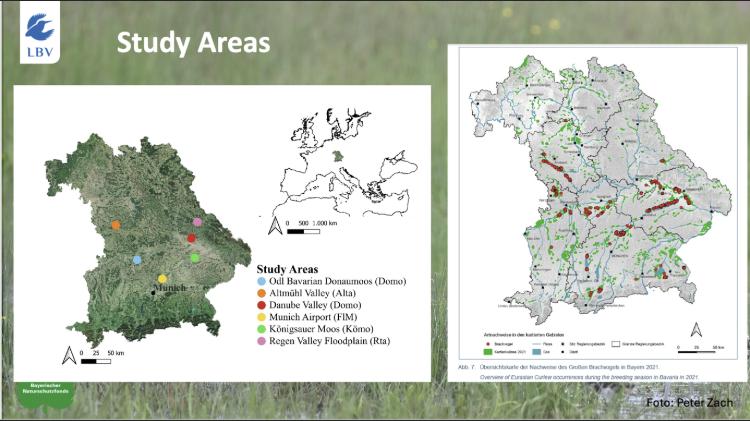
Bavaria still holds some important remaining landscapes for Curlews, particularly in its wet grasslands, river floodplains and peatland regions. A particularly good population is inside the confines of Munich airport. Much of the state is dominated by productive agriculture, but scattered areas of damp meadows, fenlands and restored wetlands continue to support breeding Curlews alongside other ground-nesting waders.
Many of these habitats are closely linked to Bavaria’s long history of farming and peatland drainage. Today, conservation efforts increasingly focus on working closely with farmers to maintain open landscapes suitable for breeding waders. Peatland restoration has also become an important part of this work, bringing together climate goals and biodiversity conservation.
The following posts explore in more detail the situation facing Curlews in this important part of Europe, and the dedicated people working to protect them.