Parliamentary Briefing on the UK Curlew Action Plan
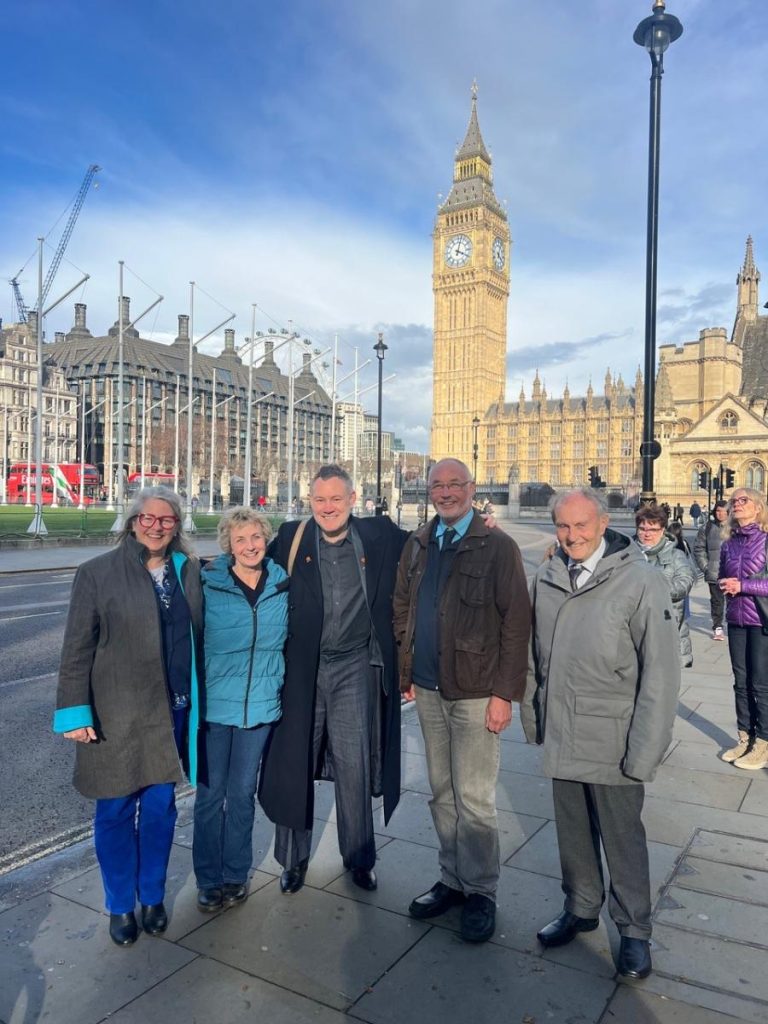
On 25 March 2026, we took part in a parliamentary briefing on the UK Curlew Action Plan, hosted and chaired by Chris Hinchliff, MP (North East Hertfordshire). Chris is emerging as a strong and thoughtful voice for nature restoration and has consistently supported calls for stronger protective legislation and shown a clear commitment to addressing the biodiversity crisis. He spoke at the launch of the Action Plan in January, and this briefing is the result of that event.

We are particularly delighted that he has taken the Curlew cause to heart, recognising both its cultural significance and its urgent conservation need. His leadership and willingness to engage with complex issues are exactly what is needed to drive meaningful change. Thank you, Chris, from everyone at Curlew Action.
A panel of four speakers outlined the diverse approaches needed to secure the future of Curlews: myself, the renowned ornithologist Professor Ian Newton, Katie-Jo Luxton, Director of Conservation at the RSPB, and the celebrated singer-songwriter David Gray, a passionate advocate for Curlews and wetlands. A Q&A followed, and our talks are shared below.

The UK Curlew Action Plan sets out a framework for Curlew recovery across the UK. It addresses the multiple pressures facing these birds, including intensive grassland management, unsuitable forestry, infrastructure development, leisure activities and, crucially, high levels of predation on eggs and chicks. These are difficult issues, but if recovery is to begin, we must find shared solutions.
Panel Presentations:
Mary Colwell – Introduction
The bubbling call of the Curlew, one of the most beautiful sounds in Britain, places these birds as cultural as well as natural icons. They have inspired music, poetry, literature and art for generations, and hold a special place in our natural heritage. This matters because they fire the public imagination as much as the scientific one.
They have also brought conservationists and environmentalists from across the spectrum together in a shared effort to help them. Curlews are a powerful species to coalesce around.
If you don’t know what they look like, they are large, long-legged, with a long, downward curving, beak. They spend the winter on the coast and then move inland to nest on the ground in fields and moors. Curlews use multiple landscapes across the UK from the coast to inland, from lowlands to uplands. By helping Curlews, we help many other species and their habitats as well.
We are privileged to have them here in the UK. Any politician who has them in their constituency , whether in summer or winter, should consider themselves blessed because the UK holds 25% of the world population of Curlews, making us a vital country for their survival.
We still have around 58,000 Curlews, but that figure hides a stark truth, we have lost half the population in just 20 years. Why? Because Curlews nest on the ground. Three to four eggs are laid in simple scrapes in the grass, protected only by the adults. This leaves them highly vulnerable to many of our activities such as farming, changing land use, afforestation, recreation, development and infrastructure expansion. These human-shaped landscapes also support high densities of generalist predators such as foxes and crows, which take a devastating toll on eggs and chicks. And now climate change adds further pressure, bringing droughts and floods during the breeding season.
That beautiful call is in danger of falling silent across large swathes of the UK, which is why the UK Curlew Action Plan is so important. It sets out a clear framework for protection and recovery, working at landscape scale and across organisations and civil society. Make no mistake, saving Curlews will require ambition, cooperation, collaboration and long-term commitment.
Many of these changes are in the hands of farmers and landowners who have pressures of their own to contend with, and so we must help them to do the right thing and support conservation action with the right agricultural schemes and farmer advice.
And my last point, Curlews are migratory, in the winter we host thousands of European birds, and a proportion of our own Curlews move to the west coast of France, Portugal and Ireland. Curlews need protection across their range and throughout the year. The inspiring South Lakes Curlew Project in Cumbria has a strap line – It takes a village to save a Curlew – well it takes nations to protect a migratory species, and as the UK is so important for Curlews, we must live up to that responsibility. We play a key role in ensuring the survival of a beloved bird that has set our hearts alight for generations. I hope you support the UK Curlew Action plan – and please note the word ACTION, everyone has a role to play, starting now.
Professor Ian Newton – The Science behind the Curlew Action Plan
The findings and proposals in the Action Plan are all evidence-based. They are not based on guesses, ideology, hidden agendas or anything other than scientifically collected data and experiment. This includes the measurement of the extent of population decline, studies of breeding output by many skilled individuals in many different areas – some areas with habitat management and others without, some areas with predator control and others without. These studies thus do not relate to a single area, but to many areas over a number of years – they are thoroughly consistent in their overall message of inadequate reproduction.
Years ago, Dick Potts – well-known game-bird biologist, emphasised that in managing for any species we needed to address three things: habitat, food-supply and natural enemies (chiefly predators). It is no good getting just one or two aspects right and omitting the third. This will just waste time and money. This is a message we could apply to Curlews and other ground-nesting birds: on many nature reserves over recent decades habitat has been managed to perfection (through which food-supplies have usually taken care of themselves), but little or no attention was applied to predation. The result: the birds that the reserves were designed to protect – whether curlew, lapwing, grouse or other ground-nesters – declined to nil.
The main problem for Curlew in modern Britain is undisputable: lack of productivity – inability in modern environments to produce enough young to offset the usual adult mortality. Bird ringing has provided no evidence that adult mortality has increased over the years, so decline can be attributed entirely to reduced reproduction. This shortfall is due in some lowland areas to modern grass management (chiefly silage production), in which the early mowing of grass destroys any eggs and chicks present. But almost everywhere else breeding failure is due to predation on eggs and chicks. And even where grassland management has been modified in the Curlew’s favour, predation still gets the eggs and chicks. The key predators, as we know from nest cameras and other evidence, include crows, foxes and, in some areas, badgers, but others may also be involved.
The importance of predation is demonstrated most clearly in areas of game management where predation is controlled whether in lowlands or uplands. In my view, grouse moors have been greatly underrated in their crucial importance, not just for grouse, but for all ground-nesting birds. This is due both to their habitat management and to predation control. You may be surprised to learn that some single grouse moors with their neighbouring fields in northern England now hold more Curlew than the whole of Ireland, yet into the 1980s Curlew were widespread, breeding abundantly in every county.
Clearly, there are factors operating in modern Britain that have enabled certain predators, notably foxes and badgers, to increase far beyond previous levels, and achieve much higher densities than in any other European country for which we have information. Unless we can resolve the predation problem, we face the likelihood that most ground-nesting species will disappear in the coming years from most of Britain, surviving perhaps in game-rearing areas and offshore islands lacking the relevant mammalian predators.
So the general message of our report is that, for restoring Curlew and other ground-nesting birds, we know what should be done, but it needs coordinated efforts by all relevant stakeholders at national level. We have to grasp the ‘inconvenient truth’ about predation. Predator control will need government support if it is to be effective across landscapes.
Katie-Jo Luxton – Collaboration, Cooperation and Agri-Environment Schemes
Saving Curlews is a shared endeavour. It demands collaboration across the conservation spectrum, between organisations, land managers, policymakers and communities. No single group can do this alone. That is why the UK Curlew Action Plan matters: it brings people together around a common goal.
At the RSPB, we are fully committed to making this Action Plan work. We recognise there are difficult and sometimes uncomfortable areas, none more so than predator management. But we are clear that, where evidence shows predation is limiting Curlew recovery, there is a need for targeted, lawful and evidence-based control alongside other measures such as habitat management. These are not easy conversations, but they are necessary ones if we are serious about reversing decline of Curlews.
The Action Plan provides a template for recovery, but it will only succeed if farmers and land managers are properly supported. They are the people doing the work on the ground. Agri-environment schemes must give them the tools, incentives and confidence to do the right thing for ground-nesting birds like Curlew. We know from successful projects like the Glenwherry Curlew recovery project in Northern Ireland, that focused famer advice is key to supporting farmers to deliver the right management for Curlews. None of the current schemes in the 4 Countries of the UK are currently sufficient to enable Curlew recovery and the advice component is woefully lacking. We will continue to work with all four governments to help shape schemes that would have a real prospect of supporting famers to be bring back Curlew to their fields.
We also know there are wider challenges such as tree planting in the right place, questions around game bird and moorland management and the intersection with ongoing issues of illegal persecution of birds of prey. We will continue to campaign on the issue of illegal persecution and are actively promoting licensing of the gamebird sector (as has already happened in Scotland) to try to stop this. But to save Curlew, we must have an open dialogue with the shooting sector, and we have all worked hard together to find common ground in the development of the Curlew Acton Plan.
For me, this is personal. I grew up on farms in Gloucestershire and Radnorshire, and the sound of Curlews was the sound of my childhood. To see how quickly they are disappearing is heartbreaking.
But we are not giving up, and we are working with everyone who shares our passion for Curlews. The RSPB is fully committed to keeping the song of the Curlew alive across our landscapes for generations to come.
David Gray – Culture, Curlews and People
You might think it strange that I’m here today, I’m certainly the odd one out. Perhaps it’s just a case of one singer sticking up for another, and, as you’ve already heard, the curlew is the most extraordinary singer.
I want to talk a little about how important the curlew is in a cultural context. This is a bird that can be traced back through our art, music and writing for over a thousand years, from the early poetry of The Seafarer right up through Yeats, Ted Hughes, Dylan Thomas and Seamus Heaney, to the literature of the present day. The curlew is a bird that continues to inspire deep feeling, and a creature that has been etched into our cultural heritage over many, many centuries.
Curlews are emblematic of the wild and windswept landscapes that they inhabit, and to those that come to know it, their searing song is like a magical manifestation of the spirit of those wild places. This haunting sense of power and mystery is the central reason why curlews appear so readily in our culture and poetry, and why they inspire such remarkable levels of passionate support.
Listening to them provokes in us a powerful sense of fellowship with their wild and windblown lives, awakening as it does so, a lingering remembrance of our own not too distant creatureliness and of the wild and ancient bonds that we share with these birds to the landscapes that surround us.
I don’t think it would be unreasonable to suggest that the curlew’s catastrophic declines could be said to hold up a mirror to our own declining relationships with the natural world as a whole.
One of the great challenges of supporting the curlew is that this is a bird that is landscape wide. It is my own personal belief that the curlew cannot be successfully restored and maintained in our landscapes by conservationists, farmers and landowners working in a vacuum. For the project and the action plan to succeed, it will need the support of ordinary people and communities right across the country.
The contemporary British landscape is, from an ecological perspective, a landscape that is badly out of balance. If our intention is to restore these landscapes and the many remarkable creatures that they contain, then we will first need to restore our own relationships with them. We are not going to protect and make space for something, unless we have first learned to love it, and through that love, to respect and better understand it.
This is where the soul-stirring power of the curlew offers a unique opportunity to rebuild these vital nature connections and where, not only policy makers, but the creative skills of musicians, artists and storytellers have a crucial part to play.
If a charismatic and culturally prominent bird like the curlew is to be saved then it is going to require everybody working together and pulling in the same direction, and not only that, but acting in a timely fashion as there is not a moment left to lose.
To allow a pure and ancient magic such as this to slip away, is surely unthinkable.
The discussion with the audience after the presentations was engaging, wide-ranging and thought-provoking, tackling challenging topics such as predator control, heather burning and gamebird releases. These are essential conversations. Until we face difficult realities head-on, progress will remain limited. Only courageous-decision making and landscape-scale change will restore wildlife. Curlews, alongside other ground-nesting birds, need open landscapes rich in insects and where predation pressure is not overwhelming. Achieving this is difficult in a countryside asked to deliver so much. This meeting was another step in opening the conversations needed to protect a much-loved yet rapidly declining bird.