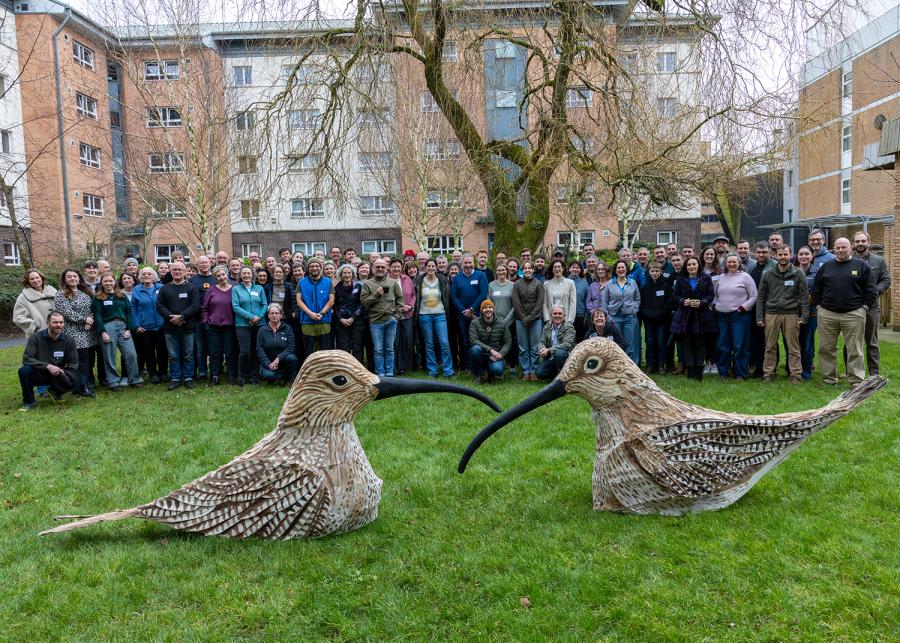
Over the weekend of 6–8 February, we held the second in-person European Curlew Fieldworker Workshop at Lancaster University in the north-west of England. This is Curlew Action’s flagship event, bringing together curlew conservationists, scientists, artists, educators, musicians and others from across Europe to share ideas and inspire one another. It is our contribution to a positive outcome for nature, and if the feedback comments and the atmosphere in the room were anything to go by, it was a success beyond what we had hoped.
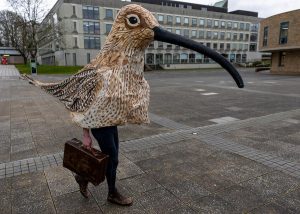
We heard about nest fencing and the latest science on why eggs fail before hatching (around 14% of wild eggs). We held workshops on predator management and monitoring methods. We saw the positive impacts of using drones and dedicated conservation apps, and we explored the musicality of the curlew’s song with a classical musician. Two giant curlew puppets, Heathcliff and Cathy, got it together and laid an egg in a piece of comic drama. We also held intense, personal sessions on ecological grief and the covert sexism that is still experienced by women working in the field. Other areas covered were education and activism, giving the whole event a holistic and varied feel that touched people in a deep and personal way.
What was obvious was that the battles being fought in the fields and moors of the UK and Europe are real and attritional. The forces acting against the survival of ground-nesting birds like Curlews are existential, nothing less than how we grow food, develop economies, tackle climate change, extract resources and build our communities. To be the voice of creatures with no political or economic power is demanding, and the stakes are high. Everyone who works in this space knows they are a foot soldier in a much greater battle to protect Planet Earth from the overwhelming forces that threaten it in pursuit of other priorities.
That reality surfaced in tears and deeply felt emotion. It was humbling to see and to know that people felt safe enough to express what is usually reserved for solitary moments. I left the university convinced that conservation must step up and overtly embrace the emotional dimension of what we do and become far more open to the depth and breadth of the human experience involved in saving what we care so much about.
The weekend helped me to understand that despair and joy are not experienced alone, that we are all battling through tears and laughter. As one delegate put it:
“I felt so hopeless last week, and this weekend has filled me with so much hope and inspiration. Keep up the good fight people.”
Only a revolution in thinking will turn this Earth drama away from disaster and towards a positive ending. It will take all of us to come together and work for the common good and be willing to work alongside those we may view as enemies. There will be compromises on all sides along the way, but if the goal remains clear and well-articulated, we have a chance. A low- carbon, high biodiverse world will look very different to the one we occupy today, but what exactly it will entail seems hazy and uncertain, making it hard for people to commit. And change is never easy; there are too many unknows, it is frightening to step forward, far safer to keep on the known track.
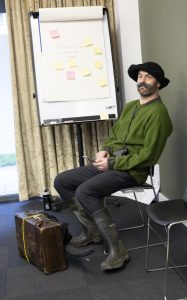
All this conflict and confusion is ripe territory for a Bard to step into the fray and crystalise out where we stand. Laying out our flawed humanity may cause us to pause and consider more carefully our next steps and the consequences they carry.
In December, I watched Shakespeare, My Family and Me, where Dame Judi Dench explored her lifelong relationship with Shakespeare from earliest childhood to today (she is in her 90s). Our greatest writer has been her constant companion for nigh on a century, a friend who is unparalleled in an understanding of what it is to be human on a testing, tumultuous, yet wonderful planet. I envy her ability to spontaneously quote him, no matter what needs to be expressed, because Shakespeare, as she says, “was able to sum up what we all feel about any emotion we ever have.” It’s a beautiful and thoughtful programme about an actor who has brought Shakespeare into modern hearts and minds for many decades.
It coincided with my own late-onset dive into his work over the last few months, and it is shameful that it has taken me so long to see its true wonder. My school text was The Merchant of Venice, which I remember finding a bit weird and gruesome, and the brutality of its message passed me by entirely. Apart from occasionally and superficially enjoying a few of the greats, my soul has remained largely ignorant of the shifting depths of his words until now, and I have barely turned a page.
No matter what genre, Shakespeare’s plays expose the real motivation deep within the human heart itself, whether the character tries to conceal it or not. Power, love, revenge, goodness, mischief, duplicity, honour, whatever the impulse, they interlock, clash, merge and grow as the characters interact, driving the play forward towards comedy or tragedy.
I hadn’t fully realised the importance of Act 3, the pivot point in the middle of a five-act play. This is where the drama begins to resolve, for good or ill. The sails are set into the future, towards disaster or a happy outcome. Act 3 gathers it all, and the irreversible is set in motion.
In the tragedies, Hamlet kills Polonius, Macbeth murders Banquo, Othello commits to killing Desdemona, and so on, decisions and actions with disastrous consequences. In the comedies, the crest of a cross-purpose wave reaches a peak and tangled confusions abound, setting the stage for resolution and relief. In A Midsummer’s Night Dream, Bottom gets an ass’s head, in Twelfth Night, Olivia falls for Cesario and so on. This pattern generally holds true, but there are moments threaded throughout which show that Shakespear knew life is never so cleanly cut and comedy and tragedy intertwine, and there are times when we don’t know whether to laugh or cry.
I have become increasingly fascinated by the underlying currents that move individuals and nations to make the decisions they do. What motivates us to act at all? And, more specifically for me, why do we care, or fail to care, about protecting the earth? After a decade of working in conservation, it is obvious that saving a bird species is 10% science and action, 90% dealing with people. Understanding humanity and how we interact is key to the future of life on earth.
I wonder what Shakespeare would write if commissioned to tackle this subject. How would he frame the complexity of trying to save a species, a landscape, an ocean, whole ecosystems? How would the exchanges between the different factions play out?
The cast of characters is long and rich: conservationists, scientists, politicians, economists, tech giants, polluters-for-profit, caring individuals and faceless corporations, all of us strutting and fretting upon the stage of this planet, vying for what it has to offer and seeking dominance. And all the while, the stage itself, Planet Earth, is not passive, but changing in form as we tear at it. Unless we step back from its relentless abuse, it too may have its revenge and undo us through heat and flood.
The drama being acted out across the Earth is of Shakespearean proportions. It feels as though, right now, we are in Act 3. We have laid and developed the plot, and now it is reaching its turning point. Where would the Bard take us, given what he understood about the nature of humanity? There will be consequences for our actions, a reckoning, but what kind?
Every day, small actions, as well as hugely significant international ones, are played out around the world, tipping the outcome of this drama in one direction or the other. Are we moving towards unravelling or harmony? In this Act 3 moment, we may yet decide how the final scenes unfold.