
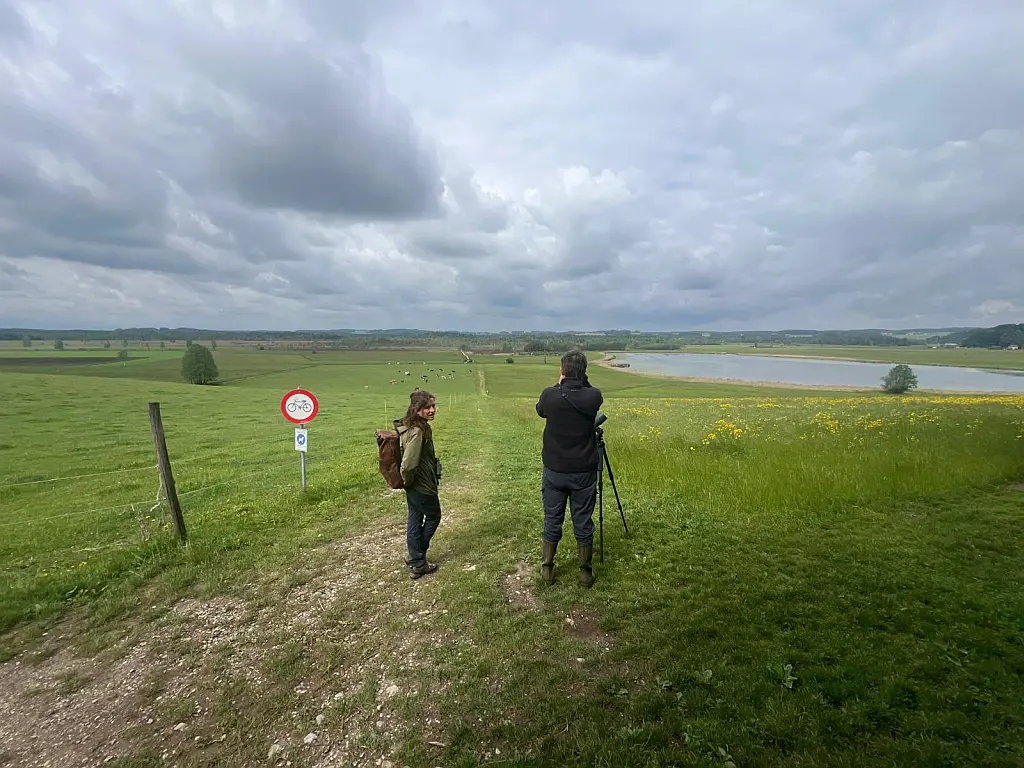
It was the final full day of our Germany–Austria trip, and our one full day in Austria itself. Verena Rupprecht, who leads the LBV Telemetry for Meadow Birds project, kindly drove us for two hours from Munich Airport across the border into Austria, where we met BirdLife Austria's Florian (Flo) Billinger at Ibmer Moor. This extensive wetland and moorland complex lies not far from Salzburg, Austria's fourth-largest city, and is one of the country's most important landscapes for breeding waders.
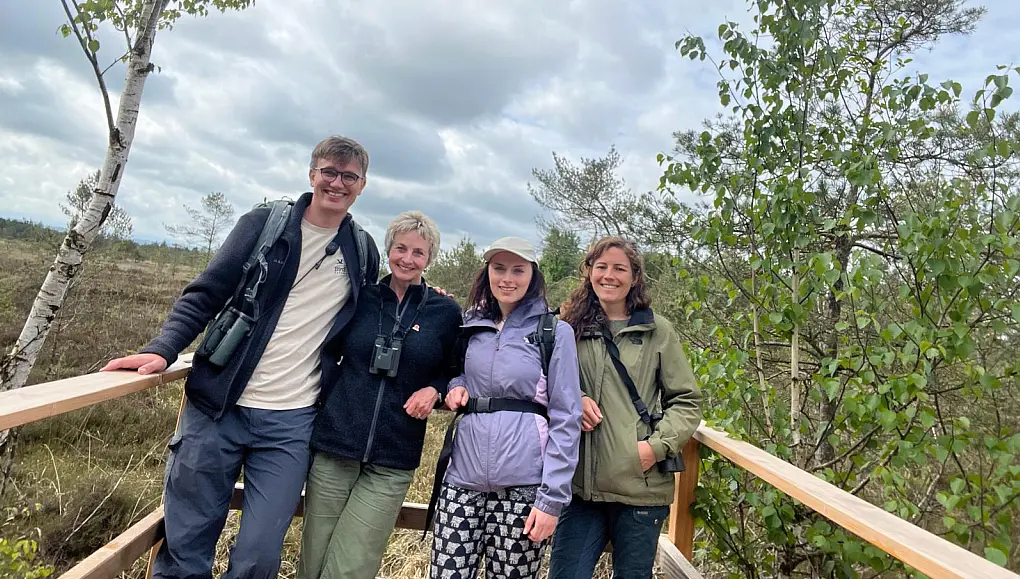
There are 17 or 18 breeding pairs of Curlew here, which doesn’t sound like many, but this is around 10% of Austria’s Curlew population. Habitat is a mixture of moorland and wet meadow, with just over 50% (9) nesting in wet meadow habitat. This is compared to around 500 pairs nesting in the German state of Bavaria, which is similar in size to Austria. At this site, some nests have camera traps without fencing, while others are fenced. Monitoring helps to establish the differences in survival and causes of mortality between fenced and unfenced nests.
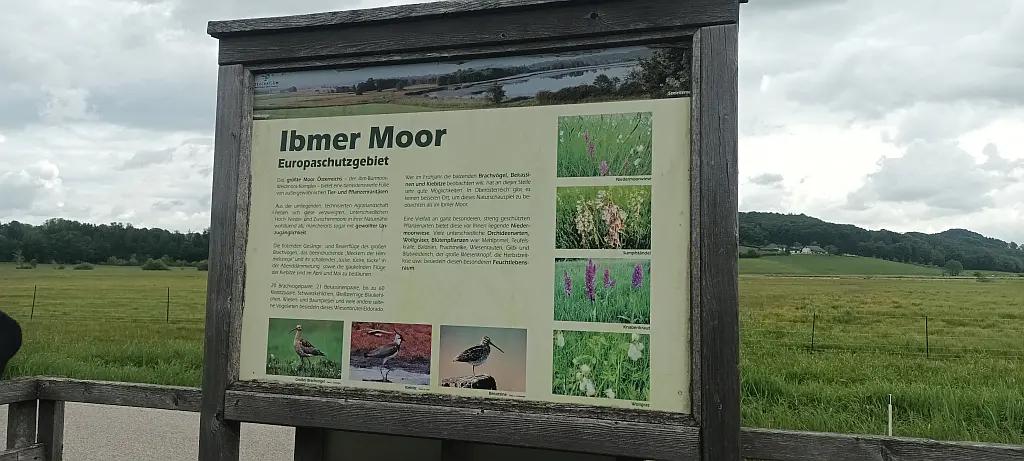
We walk for about twenty minutes along wooden boardwalks taking us first through woodland and then out to pasture where cows graze up the side of a hill. Tree pipits call along the way. We pass a nest about a hundred metres or so to our right with a camera pointing at it. Flo tells us that a nearby nest belonging to the same pair had recently been predated by a fox, making this their second nesting attempt of the season. The previous day, both a fox and an adder had passed close to the nest, causing obvious distress to the adult birds, but fortunately neither predator found the eggs. We had recently been shown photographs of an adder preying on a Redshank nest elsewhere in Europe, a reminder that breeding waders face a wide range of threats.
A long, heavy-duty fence surrounds several nests over a field and on the far side of a lake. We use Flo’s scope to look over at the birds, and we see a marsh harrier flying around close to wandering Curlew. Nearby, there is an area where bushes have been removed, and we are told that Common Snipe are now nesting as a result. After a while, we head over to the far side of the lake to get a better look at the fence and what is within it.
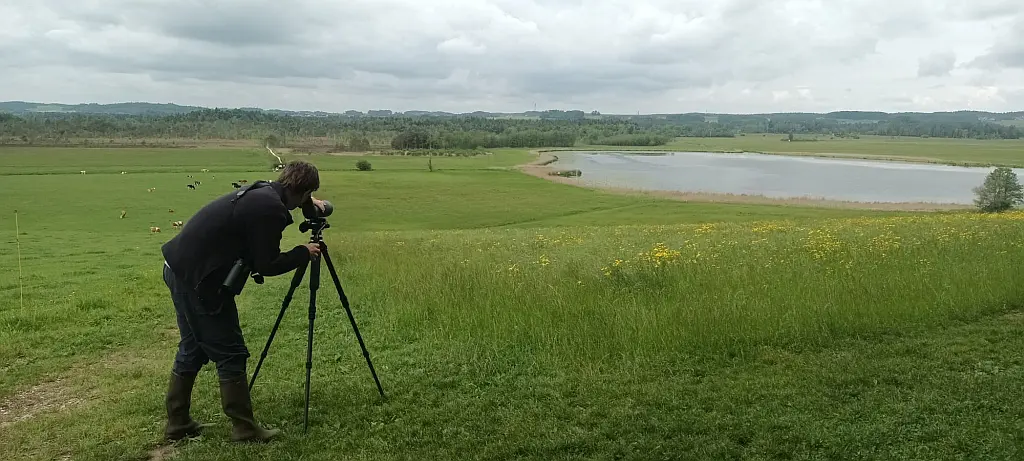
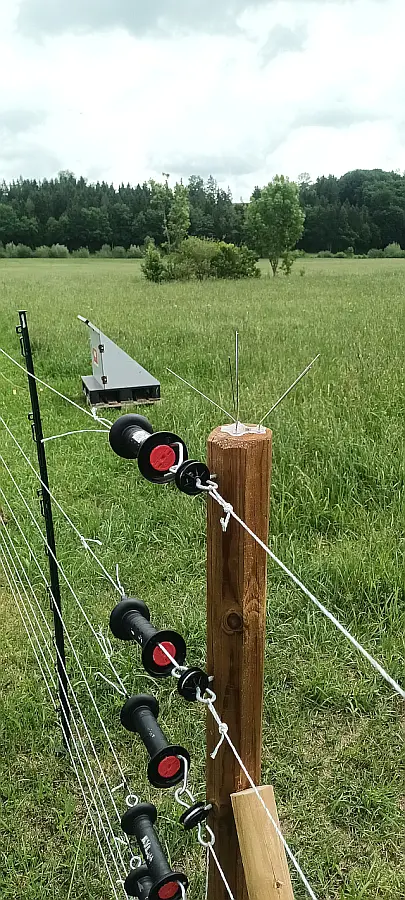
This fence is nothing like the fences we have seen in Bergenhusen or Bavaria – it is much sturdier, measures two kilometres in length, is electrified with two power sources (necessary due to the fence’s length), and apparently took ten people two days to erect. But even a fence as robust as this one isn’t impenetrable: one Curlew clutch has already been taken by a pine marten and another, less surprisingly, by a marsh harrier. The week previous, while in North Rhine-Westphalia in Germany, we were shown a video of a stone marten entering a fenced area without breaking its stride. In the area outside of the fence, we are told that more than two thirds of nests have been lost to red foxes and pine martens (90% at time of writing, all taken by foxes and pine martens). The numbers are saddening, especially with such a low number of nests to start with.
Flo tells us that productivity here is so low that monitoring it is near pointless, with the odd two or three chicks fledging every few years. This site is home to the only Curlew conservation project in Austria, which specifically looks at breeding success of Curlews, and involves a team of three, plus fifteen volunteers and two farm workers/technical support. Yet, the population has actually doubled since monitoring began in the nineties. One explanation for this is that it is fed from the likely source population of Munich Airport some two hours away.
Interestingly, a decade ago fencing was considered a temporary solution in some places, but so little has changed on a landscape scale that they are still very much needed. As we walk, Mary and I reflect on whether headstarting could eventually become a sticking plaster applied for too long in the absence of broader landscape change. It is an invaluable tool for buying time, but its long-term success depends on tackling the reasons Curlews are struggling in the first place and creating landscapes capable of sustaining populations naturally.
Verena suggests that fencing and predator control are simply the realities of conservation, with no sustainable end in sight. I do wonder, if Curlews are still hanging on in 200 years, what will be different? Will they ever thrive at any level, or will intensive management, given the world that we have created, always be a requirement for their survival?
Some areas show more hope than others, and Ibmer Moor is a site that clearly suffers from chick predation, despite the breeding population doubling in the last ten years. As we have heard echoed in other areas, Flo doesn’t like the idea of choosing what has to die so that something else can live, although again, he fully understands the complexities and the need for predator control. When asked what would really help Curlews in this habitat, Flo’s response is ‘rewetting the land’, the same answer given by a conservationist in Bavaria the day prior. Wetter land would mean healthier, more resilient meadows, and a potential greater difficulty for predators to get to nests.
We head to a second site in the afternoon which is part of a Special Protection Area (SPA) where no management is carried out - the nests are simply counted every four years. This site has about 20 breeding pairs of Curlew and is the biggest colony within the Salzburg region. As well as hills, it is surrounded by houses and trees, making it a difficult place for a Curlew to rear young. In the distance Flo spots a red kite and points his scope towards it. Excitingly, we see that it has a GPS tracker on its back which can be clearly seen through the scope whenever it flies face on to us. On the drive out, I watch a black cat stalking along the meadow.
The conditions that fieldworkers and conservationists have to work in are emotionally heavy. Skilled, knowledgeable and caring people work around the clock and can easily feel that their efforts aren’t having the impact they would like to see. Flo attended our European Curlew Fieldworker Workshop in February of this year. As we walk along to the edge of the electric fence at Ibmer Moor, he remarks that attending allowed him to appreciate that there are people all over Europe going out during the breeding season and fighting the same battles as him. He tells us of the joy he noticed in other people who dedicate their time to Curlews. He came back from the workshop with pages upon pages of notes to further teach him about what can be done for Curlews, but perhaps just as importantly, with a greater connection to people from afar doing work like him.