
A Visit to Insh Marshes
If I were a Curlew, I’d choose here – as many do, listening to the calls echoing all around. Standing on a viewing point above the western end of the RSPB’s Insh Marshes reserve, Thijs Claes, Estate Operations Manager, and Colin MacLennan, RSPB volunteer, described their hopes for this remarkable landscape.
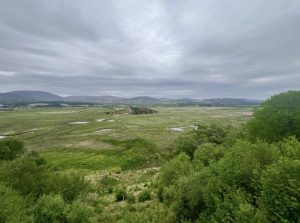
The western end of the RSPB Insh Marshes
The wide floodplain stretched away on either side of us, a wide finger of wetland lying between the surrounding hills. The reserve extends for around 10 kilometres in length and reaches up to 2 kilometres in width; a marshy, pool-dotted flatland created by glaciation thousands of years ago. Many of the isolated hills and ridges that punctuate the landscape are also glacial features, tell-tale mounds of earth and stone pushed and sculpted by ice before being left behind as the climate warmed and the glaciers retreated.
Yet this landscape is not simply a relic of the past. It is an ongoing experiment in how we might restore wetlands for wildlife in today’s climate stressed and nature depleted world.
Insh Marshes stretches along the River Spey between Kingussie and Kincraig in the Cairngorms and is considered one of the largest and most important floodplain wetlands in the UK. The landscape we look at today is not only the result of glaciation but also of river movements as the water meandered across the land, creating a rich mix of marsh, fen, wet grassland, pools, reedbeds and woodland.
The RSPB has managed the marshes since 1973, and the aim is not simply to protect wildlife, but to restore the natural processes that once shaped the floodplain and allow them to function on a landscape scale.
This emphasis on process rather than prescription means that Thijs and his team are working to hold water on the land for longer, reduce the impacts of historic drainage, and recreate the complex mosaic of wet habitats needed by a suite of breeding waders. Their focus is not on any single species, but on creating the conditions that Curlews, Lapwings, Redshanks and Snipe need to thrive, alongside countless insects, plants and other wetland wildlife. The marshes also provide important winter habitat for migrating swans and geese, while their ability to store water helps slow its movement downstream during periods of heavy rainfall.
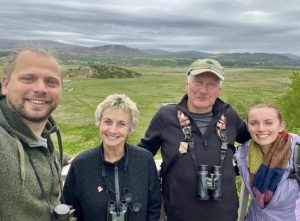
Thijs Claes, Mary Colwell, Colin MacLennan, Flo Blackbourn
As we talked, it became clear that achieving this vision requires intervention. Encroaching trees and shrubs are removed, drains are blocked and fox control is in place, albeit as a light-touch measure. Predation management is something we spent a while discussing. About half of the reserve borders land managed for driven grouse shooting, where intensive predator control is undertaken. Thijs believes this undoubtedly benefits some of the breeding waders on Insh, although contact with the moors is limited. In contrast, the opposite side of the valley is characterised by woodland expansion and rewilding, creating a very different ecological setting with its own opportunities and challenges.
In fact, badger numbers have increased significantly over the last fifteen years, and they undoubtedly add predation pressure to the waders. So too do recovering populations of birds of prey, including Sparrowhawks, Red Kites and Goshawks. “I prefer to see these as challenges rather than problems,” said Thijs. Predation is certainly an issue, but it is best managed by thinking through it rather than by trying to implement widespread lethal control. Predation is natural, but the unusually high level we see today requires creative thinking.
When it comes to Foxes and Badgers, Thijs and Colin believe that they readily swim across pools and rivers, but actively avoid boggy, marshy ground that is difficult and energy-intensive to cross. As a result, most successful Curlew nests are found right in the middle of wet areas, often on floating vegetation and among the reeds, which is unusual to see. The result is that nest predation is much lower Compared to the surrounding drier areas.
A new predator is now on the block – Wildcats. Insh Marshes is now home to two adult females with kittens and a roaming male, and there is little doubt that they prey on Curlew chicks, as seen on remote cameras. “They definitely take chicks. We’ve even seen some with fledged Curlew. So once you think, ‘Okay, they’re safe now,’ a wildcat can still get to them.”
Yet Thijs was keen to place this within a broader ecological context. Wildcats are part of a functioning ecosystem, interacting with other predators in complex ways. The successful Wildcat reintroduction programme has also dramatically reduced feral cat numbers in the area, addressing one of the major threats to the Wildcats themselves, namely interbreeding.
The interactions between predators are often overlooked. Foxes, Badgers, Otters, raptors and Wildcats do not operate independently; they compete with, influence and respond to one another in complex ways. As Thijs explained, “If a Fox and a Badger meet each other at night, they’re not hunting. They are looking out for each other and making sure they don’t get into trouble.” For predators, injury can be costly and potentially fatal, so encounters with competitors is avoided whenever possible.
The reserve also benefits from large colonies of gulls and dense concentrations of breeding waders, which collectively mob and harass potential predators. Thijs described watching an otter being chased across the marsh by more than twenty waders and gulls, while Colin recalled a Lapwing successfully driving off a White-tailed Eagle.
There are officially around 90 pairs of Curlews on Insh (Thijs thinks the actual figure may be lower due to counting methods, more like 70), and the productivity, i.e. the number of fledged chicks per pair each year, is at the level it needs to be for the population to remain stable. All of which is very heartening to hear.
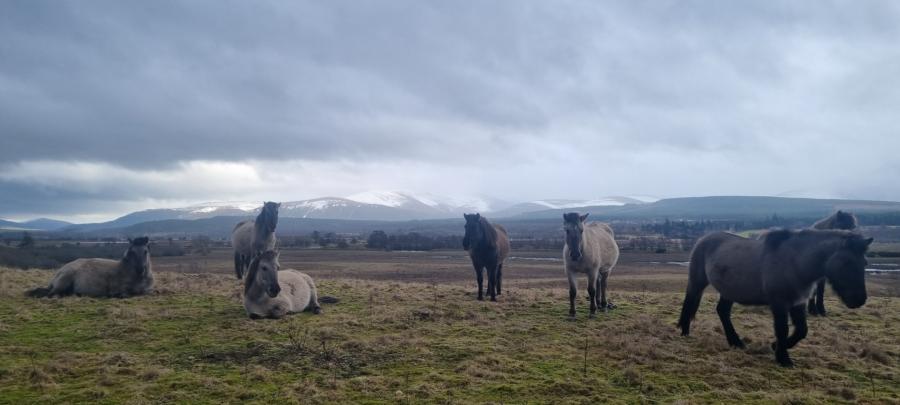
Other management is in the form of Konik ponies, a primitive breed of small horses originating from Poland, renowned for their hardiness and distinctive mouse-grey coat and dark mane. “One of the main reasons why we brought the ponies in was to break up the reedbed a little bit so that it stays suitable for the waders.” The small herd of 12 graze both the reeds and rushes, helping to maintain an open structure.
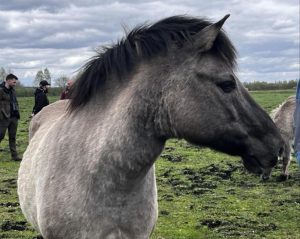
Konik ponies in Poland
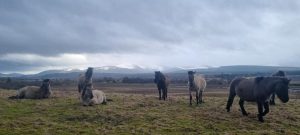
Konik ponies on the reserve. Photo Thijs Claes
But it is water that is the prime architect of this landscape. The floodplain still bears the scars of historical drainage, with large ditches cut through the marsh to channel water away, which is obvious to see from aerial photographs, which show a chequerboard of channels. “There’s definitely still an impact of those drains on this landscape, which makes the vegetation not as floaty or fenny that the curlew seem to like.”
Restoring that natural wetness means slowing water down, reconnecting streams to the floodplain and, where possible, blocking drainage channels. Fortunately, the reserve has acquired a water-loving ally. “The nice thing is that we’ve got beavers now, and they kind of do it.” A substantial Beaver dam, built only eighteen months ago, is already altering how water moves through the reserve. “What the Beaver has done with building a dam here is pushing that water back up in the floodplain, and water has to go through the floodplain now.”
Instead of rapidly draining away, water is being held on the marsh and spread more naturally through the land. The long-term impacts are still being studied, but the early signs are encouraging.
We then moved to the eastern end of the reserve, to an area that visiting conservationists often admire. It is greener, reedier and, at first glance, appears to be perfect wader habitat.
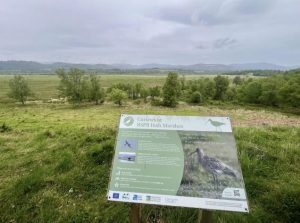
Eastern Insh Marshes
“They say, ‘This is brilliant. We wish we could have it like that.’ And then I tell them, ‘This is our worst bit!'”
Despite looking ideal to human eyes, these grasslands suffer higher levels of nest predation and support fewer Curlews. The ground is drier, making it easier for predators to move through, and there is more tree cover. In the wetter parts of the reserve, where Curlews are most successful, habitat complexity is created by natural hydrology and the simple tendency of water to find its own level.
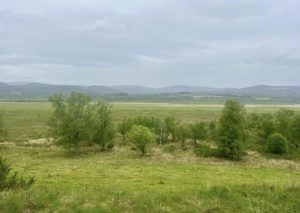
Eastern Insh Marshes
“Where we were earlier, that’s where we have our 90% hatching success and densities of nests that you can compare to the best in the world, really.” It is a reminder that the best wildlife habitats do not always look the way we imagine from textbooks.
Snipe also thrive in wetter areas with taller vegetation, while Redshanks also benefit from parts of the marsh that are less suited to Curlews. “You could argue the reserve is actually probably even better for Snipe than it is for Curlew.”
Another vital ingredient is something increasingly rare in modern landscapes: peace. Public access onto the site is very difficult due to the nature of the ground and not encouraged during the breeding season. “We basically don’t go out there from April till end of July, apart from doing our surveys., and much of that is by telescope” The birds are given space to get on with the business of raising young.
I asked Thijs about his personal attachment to Curlews, how emotionally connected is he to this charismatic bird? “For me, it is not so much about one species but more about, is nature working in this place?” This more pragmatic view is rooted in deep respect for the wider ecosystem. Success is not measured by maximising Curlew numbers, but by ensuring that the birds present can successfully raise enough chicks to sustain the population. “What I want is that the curlews that are here are raising enough chicks so that they will stay here.”
The conversation then turned to the wider community. Conservation projects, particularly those involving Beavers, river restoration and rewilding can provoke anxiety in rural areas, especially where people have direct experience of flooding.
“There was a lot of concern when we were talking about river restoration because of flood risk.” Years of consultation have gradually built trust, however, and most local people now appear more accepting of the landscape. “The majority of people are very happy to have this on their doorstep.”
Not everyone is convinced. Some neighbouring farmers still remember a time when the floodplain supported more breeding waders while being farmed more intensively, and they question whether restoration is really the answer. Others experience what Colin described as “conservation fatigue” – a feeling that every year brings a new species, project or environmental issue demanding attention. From waders to wildcats to beavers and eagles, it can sometimes seem as though there is always another conservation priority competing for people’s time and attention.
Yet there are signs that attitudes are changing. Beavers, once viewed with suspicion, are increasingly accepted as people see that they can coexist with local communities while bringing environmental benefits. Wildcats, eagles and other wildlife are attracting visitors and supporting tourism, while the reserve continues to engage local people through guided walks, Junior Ranger schemes, school visits, community groups and creative events.
One of the most successful initiatives was the “Wader Welcomes”, celebrations marking the arrival of breeding waders each spring, led by Thijs. “I invited artists, musicians and poets to come and celebrate the start of the season.”
For Thijs, conservation is not simply about restoring habitats, it is also about creating opportunities for people to connect with the wildlife around them and understand why these landscapes matter. In a world increasingly disconnected from nature, that may prove to be just as important as any drainage ditch, beaver dam or grazing pony.
He related two particularly moving personal stories including one that involved a volunteer from nearby Newtonmore. This lady threw herself into the work from the very first season and quickly became a valued part of the team. Not long afterwards, she was diagnosed with cancer. There were difficult periods when she was unable to take part, but throughout the four years of the project she returned whenever she could, finding comfort and purpose in being out on the reserve among the birds she loved.
Sadly, she has since passed away, but her connection remains. Before her death, she donated her spotting scope so it could continue to be used in the conservation work she cared so deeply about. She also knitted a Curlew hat for Thijs, which he still treasures. “It’s my favourite hat,” he said with a smile. “I’m surprised I’m not wearing it now. If it’s below 20 degrees, I’m probably wearing it.”
It was a touching reminder that conservation is not only about species and habitats; it is also about people, and the deep sense of solace, community and purpose that nature can provide during life’s most difficult times.
On another occasion, a local woman contacted Thijs after the death of her husband. While clearing out the attic, she had come across old photographs of Curlew nests. The discovery brought back a flood of memories from a happier time in their lives, when they had recently moved into the area and were excited to find Curlews breeding close to their home. The photographs became far more than simple records of wildlife; they were treasured reminders of shared adventures and a life they had built together. It was another example of how Curlews can become woven into people’s personal histories, carrying memories and emotions that endure long after the moment itself has passed.
Looking out across the floodplain, Thijs imagined what the reserve might look like in fifty years’ time; not dramatically different, but subtly wilder. More natural water movement, fewer drainage scars, more wildlife. Perhaps even truly wild herbivores taking over some of the ecological role currently performed by the ponies. Most importantly, it would remain a place where nature comes first. “It should stay a place for nature.”
In a world where wildlife is increasingly squeezed into ever smaller corners, that simple vision felt both refreshing and profound. And then, a white bird flashed across our field of view, flying from the marsh to a hole in a dead tree behind us.
“A Goldeneye nest! The first natural one on the reserve!”
Instantly our attention shifted to yet another small wonder. Insh Marshes is full of such surprises. Beneath its calm surface lies a thriving, dynamic wetland where water, wildlife and time continue to shape the landscape. It was a privilege to be shown its many hidden stories by Thijs and Colin, whose deep knowledge and affection for this watery wonderland shine through in everything they do.
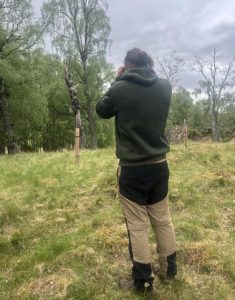
Tijs Claes watching a Golden Eye Nest