
Recently, I had the privilege of attending Flo Blackbourn’s presentation “When conservation strategies collide: rewilding and the future of waders” at the 2026 conference of the International Wader Study Group. Flo offered a persuasive call for dialogue to find common ground between wader conservationists and rewilders, which resonated with my own background in rewilding and present work in civil discourse.
I am something of a “reformed” rewilder, having once served as a board member and subsequently deputy director of the US-based Rewilding Institute. Although I am no longer a rewilding hardliner, I continue to have a great deal of respect for the organisation and movement, and I fully believe that common ground is obtainable.
Rewilding is diverse and multifaceted, and people become involved for a variety of reasons; I am aware of no one, however, who joined the cause out of a vendetta against Curlews or other ground-nesting birds. ‘Rewilding’ might be a trendy buzzword these days, but it still captures the imagination of those who yearn to do something to undo the harm that humanity has caused to other species. Rewilding offers itself as something bold, ambitious, and forward-looking. It is grassroots, democratic, and open to outsiders. It wears its love of nature and wildlife on its sleeve.
For me, one of the most attractive aspects of the rewilding movement was its non-anthropocentrism. At a time when mainstream conservation organisations seemed to talk about nothing but ecosystem services and nature’s benefits to people, I found myself drawn to the unapologetically ecocentric stance of Dave Foreman and other rewilding leaders: wildlife and wildlands should be protected for their own sake.
In the beginning, I was the worst kind of rewilder. As a philosopher by training and at heart, I let myself get sucked into an interest in ecocentrism that was primarily theoretical. I was deeply intrigued by exploring the idea that humans have a moral responsibility to protect the autonomy of ecological processes – but mostly because it was a nearly vacant niche in the philosophical literature. It was the birds who eventually brought me back down to Earth…
For independent reasons, like living next to Ohio’s only Ramsar site, I had become a diehard bird enthusiast around the same time that I took an interest in rewilding. During my stint as a Rewilding Institute leader, I mentally compartmentalised my personal concern for birds from my theoretical interest in the idea of “protecting nature’s autonomy.” As soon as I was able to look back from a detached state, however, I recognised the errors in my ways.
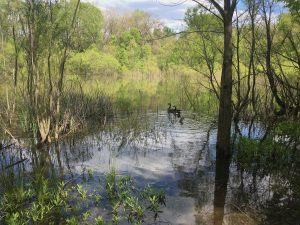
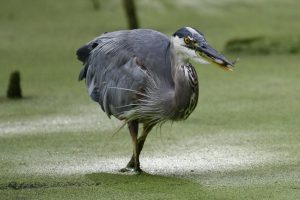
First, I realised that I’d been ignoring the moral implications of my empathy for birds as individuals. In daily life, there was never any question that I thought of birds as distinct individuals, whether they were the Great Blue Herons who staked out their territories along the Olentangy River, the tragically killed songbirds whose bodies I collected as a Lights Out collision monitor, or the tracked birds whose stories occasionally made the headlines (from 4BBRW, the record-breaking Bar-Tailed Godwit, to Min, the Russian Steppe Eagle who racked up huge data-roaming charges). The traditional ethic of rewilding views nature in terms of collectives – species, populations, communities, ecosystems – not individual sentient creatures. But I couldn’t deny that the lives of individual birds matter any more than we would deny that our pets’ lives matter.
This awakening led to the recognition that birds and other animals have perspectives of their own, and that an alternative approach to non-anthropocentric conservation ethics is to take those non-human perspectives seriously. When I tried to see the issues from birds’ points of view, I was forced to accept the conclusion that ideals like “nature’s autonomy” or “wilderness for its own sake” were concepts that no bird would ruffle their feathers about. Birds would want reliable food sources and suitable habitat to hide from predators, find mates, and raise chicks – and they simply wouldn’t care whether that existed in a pristine wilderness, an agricultural landscape, a grouse moor, or a heavily-managed conservation area. No species but Homo sapiens seeks the “wilderness experience” as an end in itself.
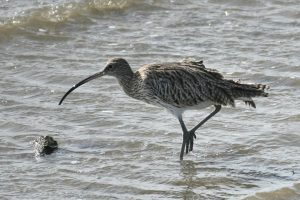
The UK’s Curlews are among the non-human animals who would surely choose human-led management of their habitats over a fully hands-off approach, and that’s something that non-anthropocentrically inclined rewilders like myself need to take seriously.
Thus, I am here today as testament that even the most hardline, theoretically-driven rewilders can come to be sympathetic to Curlew conservation – sometimes just by spending time in the presence of wild birds and developing an affinity for them. That said, I was an anomaly in the rewilding movement. I met exceedingly few other rewilders who had become involved out of interest in the philosophical thesis that we have a moral obligation to respect the autonomy of natural processes. Indeed, the vast majority did not want to debate philosophy at all (alas!); they just wanted to do effective, on-the-ground work to protect wildlife populations and prevent species extinctions. They happened to find inspiration and inclusion in rewilding.
Because people are drawn to rewilding for a variety of reasons, there is no single bone of contention between rewilders and Curlew conservationists. The philosopher C.L. Stevenson usefully differentiated between disagreements in belief and disagreements in interest.
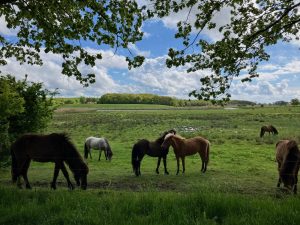
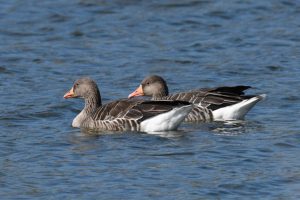
Disagreements in belief can be resolved, at least in principle, through empirical investigation and appeal to the facts. For example, some rewilders might genuinely desire to prevent the extinction of all wild species – including Curlews – but take for granted that all species will be better off if we simply reintroduce keystone species and otherwise leave nature alone. Many already acknowledge that some top-down control is needed to prevent all land from turning into dense forest, although most want to allocate this task to free-roaming herbivores instead of human land managers. Rewilding Europe, for example, places much emphasis on the introduction of large grazers to maintain open habitats. The controversial but influential “rewilding” of Konik ponies and Heck cattle in the Oostvaardsplassen was motivated by the need to keep the landscape open to sustain an important moulting habitat for Greylag Geese. Some advocates might assume that rewilding is a true “silver bullet” that can protect all birds who depend on open landscapes. When they are wrong, this might simply be due to a lack of information about the specific needs and threats facing species like Curlews.
In contrast to disagreements in belief, disagreements in interest turn on value differences that can’t be resolved through appeal to the facts or any amount of scientific investigation. A disagreement in interest could exist, for example, if a rewilder believes that it’s okay to risk the local extinction of Curlews because it’s more important to allow natural processes to take their own course. A disagreement in interest would also exist if a compassionate conservationist held that it’s never morally justified to kill a sentient animal – foxes included – in the name of protecting a threatened species. (Given my own “sentientist” leanings, I grapple with such issues myself, and I find one useful paper on the topic to be “The moral residue of conservation” by conservation ethicists Chelsea Batavia, Michael P. Nelson, and Arian Wallach. In sum, many decisions in conservation involve moral dilemmas with no good solution, and the best decision might often be one to which grief is an appropriate response.)
Disagreements in interest can be particularly tricky to negotiate, but let me close by mentioning a helpful framework developed by my colleagues at the Ohio State University Center for Ethics and Human Values: the 4Cs of Civil Discourse. Although it was designed with political disagreement in mind, the 4Cs framework can apply equally well to dialogue between Curlew conservationists and rewilders. For example:
Be Curious – Come to the discussion open to learn about the knowledge, experiences, and success stories that rewilders bring to the table.
Be Charitable – Assume that all parties are acting in good faith out of a genuine desire to do right by wild nature and non-human species, and to do so on the basis of the best evidence.
Be Conscientious – Take time to listen to the arguments of those who disagree. The goal is not to shut them up or tear them down. Admit that their critiques could even be useful!
Be Constructive – Remember that we are all fighting against the grain for the protection of vulnerable wildlife during an era of ecocide, and that’s a cause that is infinitely more pressing and important than winning an argument. Finding common ground is crucial, because it is the first step toward moving forward together. As Mary Colwell aptly said in an excellent recent Curlew Action blog on the same theme, “If we can find common ground for the Curlew, perhaps we can find it for the wider living world as well.”
Finally, I want to stress the importance of dialogue as a means to overcome the tribalism that cultivates close-mindedness. Personally, I am able to write this article only because I put some necessary social distance between myself and some of my erstwhile rewilding colleagues. If I had started out as an upstart in the wader conservation community, perhaps I would have needed to do the same in order to take seriously the perspectives of wilderness advocates. In close-knit conservation communities, adherence to a certain paradigm can go beyond practicality and become a matter of social identity, making it particularly difficult to charitably entertain other viewpoints. Breaking down social barriers is thus as important as breaking down the intellectual and ideological ones.
Kate McFarland holds a PhD in Philosophy and currently works as the Center Associate for the Ohio State University Center for Ethics and Human Values. As much as possible, she devotes her free time to promoting the good of her feathered friends.