
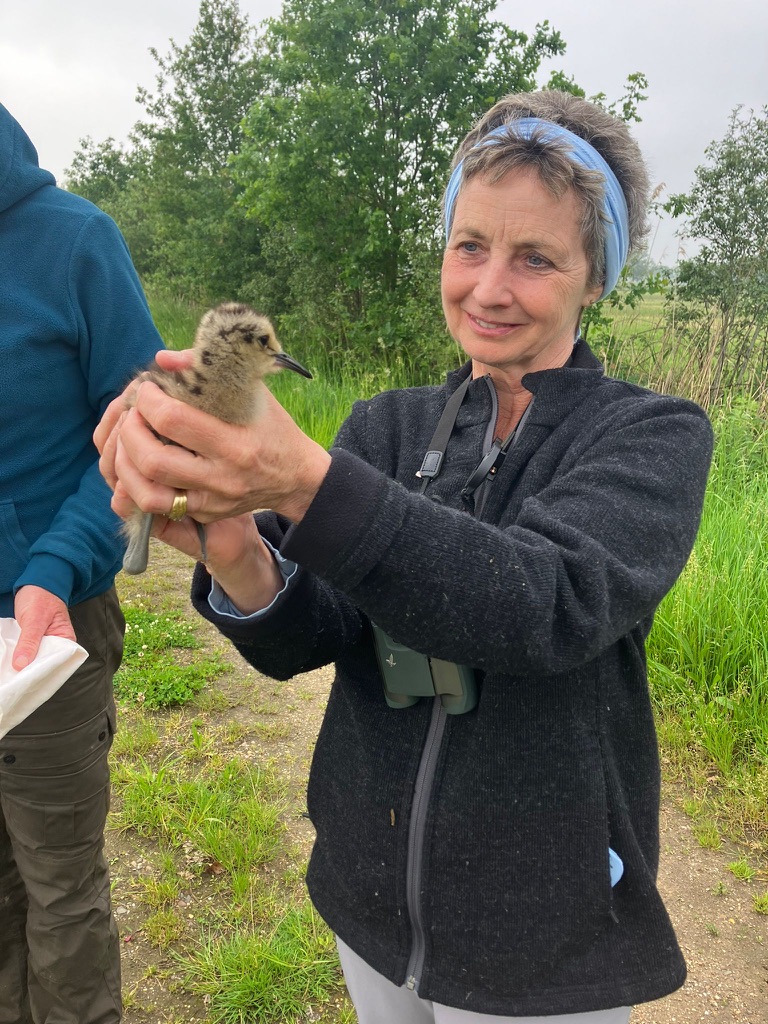
by Graham Appleton
Everyone associated with Curlew Action, or the wider world of curlew conservation for that matter, will be delighted to learn that Mary Colwell has been awarded an MBE in the King’s Birthday Honours List. Although officially a recognition that she is now a ‘Member of the Order of the British Empire’, wouldn’t it be great if this acknowledgement of Mary’s work for curlews also translates into the funding needed for ‘More Brooded Eggs’!
Photo by Richard Bunce
The citation associated with Mary’s MBE reads as follows: ‘Founder and Director Curlew Action. For services to Nature’. That’s all true but it does not tell even part of Mary’s story. I wonder how many wonderful tales she has told about the natural world in her time as a producer and director of BBC Natural History Unit series, both in radio and TV? Her broadcasting career reached millions of people. Britain Goes Wild with Bill Oddie attracted an audience of 3.4 million viewers, while British Isles: A Natural History, presented by Alan Titchmarsh, was shortlisted for three BAFTA awards. Alongside her television work, Mary also produced numerous programmes for BBC Radio 4, helping to bring stories of the natural world to audiences across the UK, a skill she carries forward into her conservation work.
She also instigated and spearheaded the long-running campaign for a GCSE in Natural History. Despite numerous setbacks and delays, the qualification is now expected to be introduced into schools in 2029. Taken by 16-year-olds across England, the GCSE aims to place nature firmly within mainstream education. Mary has long argued that if young people grow up understanding and valuing the natural world, the prospects for wildlife conservation will be far stronger in the decades ahead. For her, the qualification is not simply about education; it is about creating a generation better equipped to care for the landscapes, habitats and species on which our future depends.
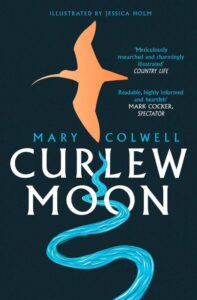
Mary’s campaign, to raise the profile of the plight of the UK’s breeding curlew, started ten years ago when she walked from Ireland to England, with a wee trip to Scotland, to learn more about the species and to talk to people who were trying to make a difference. ‘Curlew Moon’, the book about her trip, was published in 2018 and I was very pleased to write a WaderTales blog to highlight the campaign.
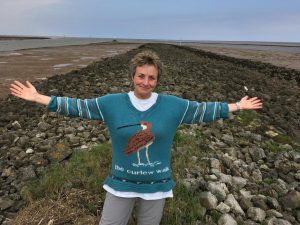
By then, she was already formative in organising Curlew conferences in Ireland and England. Over the following eighteen months, similar gatherings took place in Scotland and Wales, while two influential meetings were hosted by the then HRH Prince Charles, first on Dartmoor and later at Highgrove. In 2018, a Curlew Summit was also held at Downing Street. The momentum continued with the formation of both the Curlew Recovery Partnership and Curlew Action in 2020. Mary would be the first to claim little credit for any of these developments, but anyone who knows her – or who has found themselves persuaded to support Curlew Action – will recognise the pivotal role she has played. For many, she has become one of the driving forces, and certainly one of the most recognisable voices, in Curlew conservation.
One of the biggest achievements of Curlew Action is in encouraging the sharing of expertise and experiences between different groups of curlew fieldworkers within the UK and across Europe. Given that vast numbers of curlews migrate across country borders each autumn and spring, this increased international focus makes a lot of sense. Fieldworkers face common challenges as they tackle high levels of chick predation, build fences and intervene when farming activities threaten nests, so it is great that Curlew Action can provide a forum for a free flow of information and inspiration. Three pan-European conferences have already taken place, with the next one planned for February 2027. As Mary says, “it takes nations to save a migratory species”.

I asked Mary about her reaction when she learnt about the MBE, and she said:
“Obviously, on a personal level, I was really delighted, but overwhelmingly I was so pleased for the profile it could give to curlews, other wading birds and the habitats they depend upon. Any honour represents the work of so many people, and this couldn’t be more true than for the Curlew Action team, and all the others who are working so hard to protect these magical birds. So, I dedicate it to everyone out there doing what they can, day in and day out.”
This quote exemplifies Mary’s collaborative style of leadership.
Over the last decade, the plight of UK curlews has received plenty of royal attention. One of the early release sites for captive-reared chicks was on the Sandringham Estate in Norfolk, alongside the hide where the late Duke of Edinburgh used to pursue his passion for ornithology. Some of these young Curlew are now breeding in Eastern England and the estate is still a focal point for the release of head-started birds. In 2018, when he was the Prince of Wales, HRH King Charles invited curlew conservationists to Dartmoor, to discuss how to support the species, especially on Duchy of Cornwall land, leading to a rearing and release programme funded by the estate. Awards such as the MBE are proposed by members of the public and vetted by an independent panel but this one may well have a royal seal of approval too!
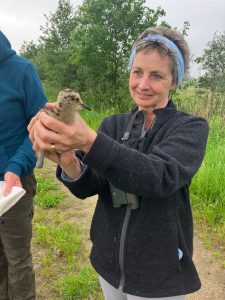
Mary dedicates most of her time to curlews, and it is wonderful that this is being recognised with an MBE to add to her BTO Marsh Award, the RSPB Medal and the ZSL Silver Medal. She sees curlews as ambassadors for wildness and working landscapes, so pretty much everything she does relates to them. When we met recently, I asked Mary what the future holds for her. She replied that “running a charity is a more than a full-time job, even one as small as Curlew Action” and she had concerns about future funding. Mary and the Curlew Action team are at the heart of curlew conservation, but their outputs are collaborations and communications, not scientific reports and successful nesting attempts.
Funding for their outreach and awareness-raising work, behind-the-scenes networking, support for fieldworkers, and the task of bringing people together is always difficult to secure. Yet these activities are often where some of the most important conservation gains are made. An additional £100,000 a year for Curlew Action would have a transformative impact, strengthening Curlew conservation not only across the UK but throughout Europe. And if that support were forthcoming, perhaps MBE really could come to stand for “More Brooded Eggs.”
