
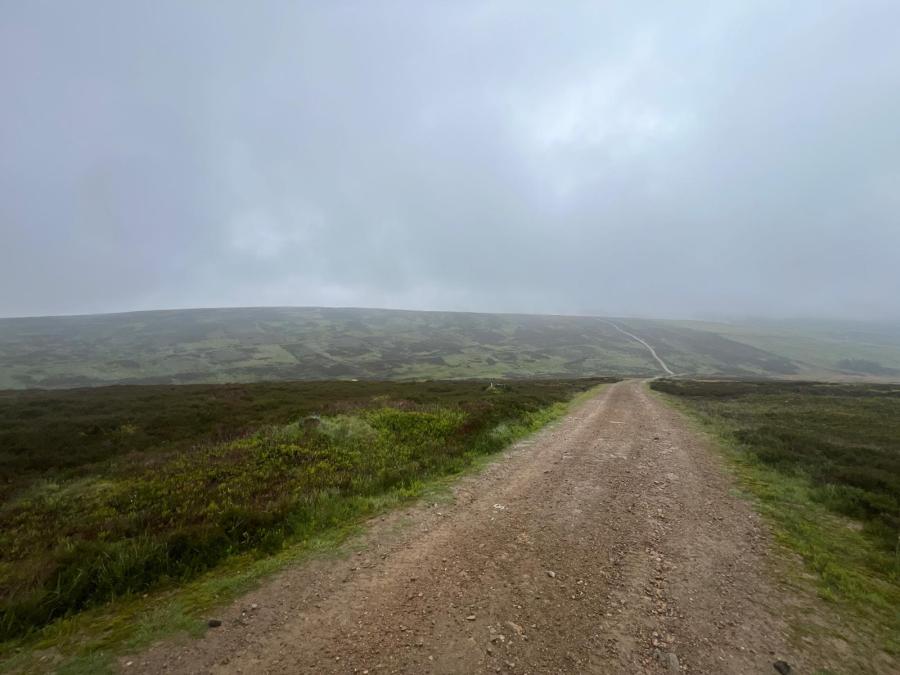
Heading south from Insh Marshes, our Scottish tour next takes us to two grouse moors: the Rottal and Glenogil Estates. We visit them on consecutive days to learn more about how Curlews are faring on grouse moors in Scotland, a managed habitat which, in England, is known as one of their last strongholds. Our main takeaway from these two visits is that, despite both estates having driven grouse shooting, they are different in terms of management intensity. Yet both are delivering for Curlews and other ground-nesting birds.
It is day two of our Scottish grouse moor visits, having visited the Rottal Estate the day before – read our blog entry about that visit here. We travel only fourteen miles from Rottal to the Glenogil Estate. Unlike the day before, the fog is thick and it rains almost constantly. We arrive at the site and meet Dr Daniel Hoffmann, Scientific Director of the German Game Conservancy, as well as Danny Lawson, Head Gamekeeper, and Manu Koch, who is undergoing his masters research here. We spend the first hour or so sitting inside around a table, discussing the estate and how it is run while avoiding the rain.
The estate is owned by the German businessman, and Daniel and Manu are researchers looking into how the estate works for waders. It is 6,000 hectares in size, twice the size of the Rottal Estate. As we talk to the group about the estate’s management, we become aware of many differences between here and Rottal, despite their close proximity. One of the starkest differences is the intensity of management.
Here, almost every nest has a camera on it so that its fate can be determined. We are told that the estate’s sheep pose a threat in the main Curlew-breeding area, where nest disturbance is not rare, and we discuss potential mitigation for this. There are between 60 and 70 Curlew nests on the estate, with an 80% hatching and 50% fledging success rate. The main nest predators, apart from sheep, are foxes and badgers. It is important to note, however, that sheep grazing has benefits too, keeping vegetation short for Lapwings.
Apart from farming, the estate is intensively managed for grouse shooting, with a strict heather-burning schedule and numerous deployed traps, which we see during our drive around the estate in the late morning and early afternoon. I count about a dozen within an hour.
The estate employs ten gamekeepers, compared with Rottal’s two, although Glenogil is twice the size. Danny tells us that the estate is proud to be able to carry out its predator control “properly”, in the sense that traps are checked more frequently than required by law and can be set with care. Because there are enough gamekeepers, everyone has time to do their work with precision. It is understood, however, that this is not replicable across all estates in the UK.
The fact that licences to protect lambs are so much easier to obtain than licences to protect wild birds is criticised; another thing which NatureScot, could and should change, we are told. Bruce had commented similarly the day before. A licence to shoot Ravens to protect lambs can be granted in the space of a day, we are told, but the government is considered to be cautious about giving sporting estates financial support for conservation work because of the negative public image such estates often have.
Danny tells us that he understands that the government may not see giving funding as an option, but that restricting activities on grouse moors is closing doors in terms of conservation ability and only making their work harder. However, those we meet on the Glenogil Estate are happy with moors being licensed, saying that this will hold individual estates to account if they engage in bad behaviour.
Contrary to public image, grouse-shooting estates are rarely profitable these days, and there is a fear that more and more estates will sell up and that the land will be used for forestry. This may be a cause for celebration for some, but it could have catastrophic impacts on ground-nesting birds that rely on these managed landscapes. As is often the cry of such estates, producing grouse produces other birds too, such as Curlews, Lapwings, Oystercatchers, Skylarks, and the list goes on. Whether this output is intentional or nothing more than a byproduct of intensive management, the fact is that land-use change may well cause these populations to collapse.
Worryingly, because nest protection is not a legal requirement, we are told that some new landowners on estates are already engaged in a “waiting it out” plan. They leave wader nests unprotected in the knowledge that, in several decades, or even several years, no more waders will be nesting there. The protection will therefore be gone, and the site can then be afforested.
As we drive slowly up a track in the dense fog, a dozen Red Grouse chicks suddenly explode from nowhere about a metre to our left, scattering away from us as their parents appear from within the vegetation. The site is also home to 50,000 released pheasants. The abundance of pheasants in the UK is often considered a major contributor to fox numbers, as they provide an ample food source, but the debate on this subject remains fiery.
Danny tells us, as have several others involved in predator control, that the fox control carried out in response to the need to protect so many pheasants balances out the benefit to fox populations that might otherwise be seen. He further argues that higher pheasant numbers mean more income generation, which in turn makes nature conservation on these estates profitable. Otherwise, estates might fail, and the birds that benefit from their management would no longer receive protection.
The Glenogil Estate takes on students to participate in the conservation side of the work, monitoring habitat and checking nests. This may explain why almost every nest is monitored by camera. This is not something we have heard of before, but the estate is clearly a hub of research, allowing a better understanding of how waders fare on grouse moors and which techniques do, or do not, work for them — and, no doubt, for grouse too.
Near the end of our upland tour of the estate, we see a couple of Oystercatcher nests in the gravel right beside the tracks. These have been marked with rock piles so that they are not missed. They are so inconspicuous that, even from a foot away, it would be easy to accidentally tread on one.
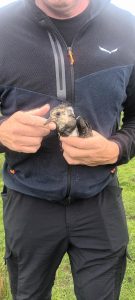
We stop in a field so that Daniel and Manu can help a Lapwing chick that has a line of sheep wool tightly wrapped around its leg. They manage to catch the chick with ease and carefully cut the wool away.
The pair also keeps an eye out for a Curlew with a damaged leg, which returns each year and which they affectionately call “Schrotti”, a word used affectionately in German for a broken or beaten-up object. They talk about him throughout the car ride around the estate, telling us that he has always had an inexplicable leg issue and that, surprisingly, one of his chicks seemed to be born with one as well.
“He hasn’t returned this year, though,” we are told earlier in the day, but when we reach the field in which he usually nests, Daniel is convinced that he sees Schrotti across the field. The reaction to this possible reappearance makes it clear that Curlews are much more than a by product at this estate - they are very much a loved feature.
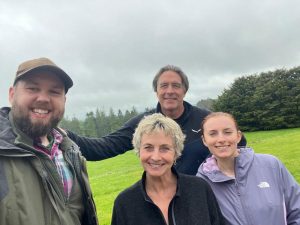
Front: Manu Koch, Mary, Flo