
By Flo Blackbourn
Heading south from Insh Marshes, our Scottish tour next takes us to two grouse moors: the Rottal and Glenogil Estates. We visit them on consecutive days to learn more about how Curlews are faring on grouse moors in Scotland, a managed habitat which, in England, is known as one of their last strongholds. Our main takeaway from these two visits is that, despite both estates having driven grouse shooting, they are different in terms of management intensity. Yet both are delivering for Curlews and other ground-nesting birds.
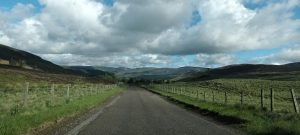
It is a sunny Sunday morning. We drive through the long valley leading up to the steading on the 3,000-hectare Rottal Estate, in the heart of Glen Clova, where we meet Dee Ward, owner and manager of the estate. On the drive up, the land around us starts to fill with nesting Oystercatchers, while Curlews and Redshank fly over to our left. You can often tell when you have entered the perimeter of such moors because of the sudden increase in visible ground-nesting birds.
Dee welcomes us, along with NatureScot’s David Parish and Highland Game’s Bruce Cooper, to the steading, where we go inside to talk about the estate and how it is run. We meet the estate’s upland beef farmer, Nikki Yoxall, who tells us about the agricultural side of the estate.
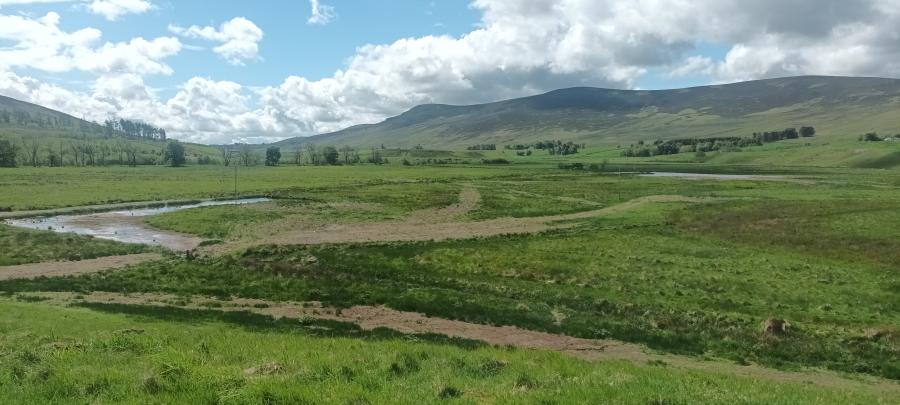
Something I found surprising before my visit was that Dee is involved in, and supportive of, a level of rewilding, or “renaturalising”, as he prefers to call it. He was featured in an article by the Scottish Rewilding Alliance about his estate and the renaturalisation of the river on his land through re-meandering.
Nikki tells us about the estate’s wildlife-friendly farming methods, which involve moving grazing cattle daily so that no one area is overgrazed. The farm is also organic, which makes cow dung more insect-friendly. Stocking density is sometimes intentionally high for the benefit of the land; for example, a high number of cattle may be put into a small area of rush to compact the vegetation and make it better for nesting birds.
Grazers are very much part of the nature-friendly vision of the estate, which moved away from sheep farming with the intention of grazing the land in a way they consider healthier for nature. Most importantly, when it comes to the sustainability of such practices, we are told that the farm is profitable, and that they envisage it becoming completely independent of subsidies by 2030. By contrast, many upland farms are struggling, whereas we are told that the focus on nature here has only led to greater success.
We talk more generally about the move towards nature-friendly farming, and what can be done to encourage others to make similar changes. Nikki explains that, for change to last, people need to adopt nature-friendly farming because they genuinely care about the natural world and their community, rather than simply following instructions in exchange for incentives they do not truly value.
The farming here can be described as high nature value farming, meaning that it fits into the “land sharing” rather than “land sparing” approach to conservation. The estate is also Wildlife Estates accredited, a certification renewed every five years after an independent assessment, which means the estate is considered to be successfully balancing sustainable rural activities, such as sport shooting, with long-term conservation.
Dee tells us that a series of wetlands was recently created on part of the estate. Later, he drives us through the landscape to show us the channels that have been dug so that water from the adjacent burn can flow through these channels when it is in spate. It is dry at the moment, but when it floods in winter and occasionally in spring it will allow these wetlands to hold a lot more water, providing natural flood management as well as hopefully encouraging more lapwings, redshank and other waders into the area.”
Right on cue, three tiny Lapwing chicks become visible through the grass beside us. According to recent RSPB census data, the site hosts around 140 breeding pairs of Lapwing and 50 pairs of Curlew. We see several chicks of both species, at one point seeing eight Curlew chicks within about ten metres of us in the space of ten minutes.
The estate contains managed moor and employs two gamekeepers, but it also includes grazing meadows, woodland, and wetland. Dee stresses the importance of this mosaic of habitats as he drives us around the different parts of the land. The meadows are rich with a multitude of wildflowers and Skylarks hover nearby. Later, we see an adult Water Rail before, one by one, five tiny black fluffballs of chicks appear and run out of the vegetation towards her in the water.
Several times during our visit, Dee emphasises the importance of a “nuanced approach” to conservation, and of adaptive management on sites like these. This is a common conversation in the wader conservation world, as one-size-fits-all schemes have been found to be limited in their success. For example, agri-environment schemes focused on ground-nesting bird conservation can be tremendously successful in some parts of the UK, while being of very little help in others.
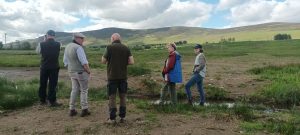
When asked whether the vision for Rottal is going to plan, we are told that the only disappointment is that the government is not doing more to buy into nature. Dee is asked to comment on the fact that many people view the success of ground-nesting birds on shooting estates as an unintended consequence, and that those from estates may emphasise it to make their work sound good for nature.
“If it works, then so what?” Dee responds, and indeed, waders succeed in these places whether you like the reason for it or not. Dee further explains that practicality needs to be put before emotion in these contexts. Keepered moors are delivering waders, often acting as source populations for otherwise threatened species. “As soon as we park our differences and focus on the game at hand, the further we will get.”
Like many people we have met on our trips, Dee believes that more needs to be done to financially support those delivering for nature. He tells us that, rather than making money from farming and then putting that money into nature, he feels that he and other landowners should be able to make money directly from protecting nature. Dee believes that, if a value can be placed on ecological services, people could be funded for protecting land. For example, a payment of £X per hectare could be made for flood management where the land has been altered to deliver this service.
Some conservationists say the same about the “cost” of individuals of certain species, or units of land of certain habitats. But this is a viewpoint that divides conservationists, as many feel that putting a price on nature is a risky first step, which could lead to nature being “bought out” by the highest bidder, for example, by a business seeking to mitigate against habitat destruction.
Another issue we hear about a lot, and which seems particularly pronounced in Scotland, is reforestation and afforestation. Scotland has highly ambitious targets of 21% tree cover. This restricts the areas in which wind farms can be built, which in turn leaves fewer places for construction that do not risk impinging on protected habitats, including ground-nesting bird sites. How things will progress remains to be seen.
At both estates we visit on this trip, the topic of a particular Scottish grouse-shooting estate comes up several times. We are told that this estate once had a whole community built around its management for grouse. It has since been bought, is in the process of being forested, putting ground-nesting birds at a severe disadvantage, and has broken up the community as a result of job losses.
After seeing several sites and many birds around the estate, we return to the steading for lunch, where one of the dishes includes pheasant from the estate. Bruce and David offer to show us more wader sites in the area outside the estate itself in the afternoon, so we head out soon afterwards, bidding Dee thank you and goodbye.
We bump into John Cruikshanks, Field Researcher for the West Angus Working For Waders team, who is protecting local wader nests. Bruce points him out across a field as we pass by in the car. He is crouching near a nest, setting up a camera alongside a volunteer who is helping him. We stop at the field to meet him.
“There is a Lapwing chick between us,” he tells us as soon as we arrive, pointing to a muddy patch in the ten or so metres between us and them. You would never be able to tell with the naked eye, but John knows the field, and one of the parents is warning us to leave.
John finishes setting up the camera, and we move away. He introduces himself and talks about his role. Compared with the estate, waders are struggling here on the nearby farmland, and he can remember there being many more waders even just three years ago. He states the necessity of predator control if the waders here are to have any chance at all, but also says that farmers need to do more for them.
Mary asks him more about what he does and what he gets from the job. “I’ve been going for forty-odd years,” he replies. “I’ll never stop. I just love it.” Bruce agrees with John’s sentiment, telling us that John works almost every hour of every day during the season to protect these birds. It is indeed a labour of love.
We travel to a few more fields and see more Lapwings and Curlews, as well as a few Oystercatchers. Some fields are protected for breeding Lapwing, and some sites here are managed by Working for Waders. Farmers are compensated for avoiding the mowing of wader nests, or for protecting areas of land more widely.
Unfortunately, though, we are told that this does not have the desired effect in all instances, and there is not always much that can be done about it without damaging existing relationships with some farmers. We are told that proper subsidies would be more effective, and so once again we hear that more needs to be done by government.
At the bottom of a field in front of us, Lapwing chicks pop up from beneath a parent that is lying on top of a Tupperware lid. We are told that a farmer moved the eggs while mowing but did not want to touch them when returning them, so three nests have since continued on these plastic lids. Luckily, each has continued successfully, although moving the eggs in the first place is technically a wildlife crime, even when carried out for sympathetic reasons.
Clearly, farmers care about nature in almost all cases, but conflicting priorities and a lack of stronger support mean that far less is achieved than could be possible with more substantial backing. The day leaves me feeling the stark contrast between a nature-friendly estate with the resources to focus on nature, and the surrounding farms which do not have those resources, despite those living on them very possibly caring about nature just as much.