
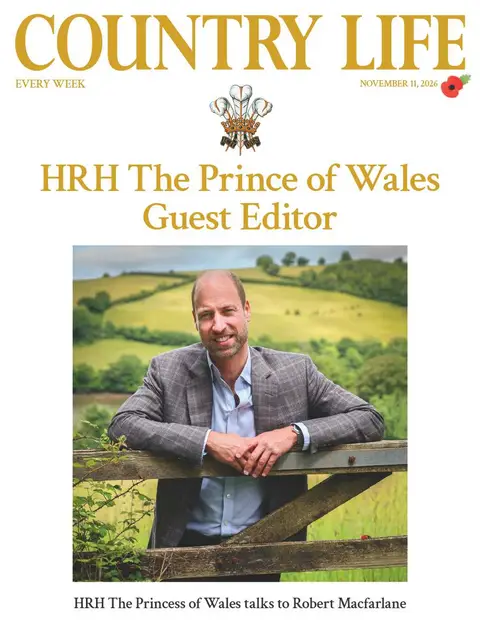
To be included among the ten conservation heroes in Prince William’s guest-edited edition of Country Life is a wonderful honour, and a great boost for our work at Curlew Action. I am delighted, grateful and encouraged. Above all, I am pleased that curlews, and the people working so hard to protect them, have been given this attention.
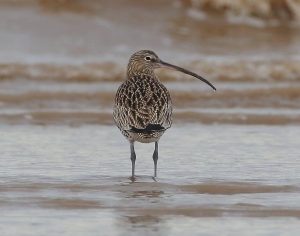
The photograph shows me holding a Curlew chick. There is something extraordinary about having such a small, vulnerable life briefly in your hands. Those impossibly long legs will one day carry it across fields and mudflats; those developing wings may take it thousands of miles. For now, its future depends on surviving another day.
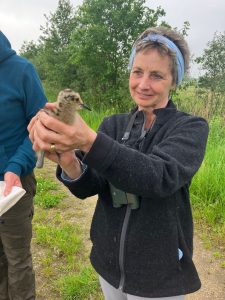
We cannot know what will happen to that particular bird, but we can work to give it a chance.
In his introduction to the magazine, Prince William describes a determination he encounters in communities across the country: “this place is worth fighting for”. Those words will resonate with many people involved in Curlew conservation. A place becomes personal through the lives, memories and attachments gathered there. For some, the return of the Curlew each spring is part of what makes it home.
We have become accustomed to measuring value through money or usefulness. What does something earn? What does it provide? How does it contribute to growth? These questions dominate decisions about land and, increasingly, the language we use to defend nature. But true value does not depend on a price tag or a service rendered. Curlews and the other wild creatures of farm and moor do not have to justify their existence by adding to a bottom line. They simply are. They have lives of their own, ancient journeys to make, young to raise. They bring beauty and song into a fractured world that can, at times, feel songless. Their calls matter to us, but their right to exist does not depend on our appreciation.
And they are still here. Despite everything, Curlews return, establish territories and begin again. Around them are many good people determined to keep them close to their communities, such as farmers adjusting their work around nesting birds, fieldworkers rising at dawn to check nests and search for chicks, volunteers racing against time to erect electric fences, researchers asking difficult to answer questions. Their efforts rarely attract much attention, but together, they keep possibilities alive.
Conservation teaches us a great deal about uncertainty. We can do everything we know how to do and still lose a nest. An approach that succeeds in one landscape may disappoint in another. We cannot control all the factors that often seem as ungraspable as like the wind. Weather can suddenly change, predators adapt and change, funding comes to an end, a war breaks out thousands of miles away and the world teeters on a knife edge. We must make decisions with incomplete knowledge and on shifting sands – and with as much hope as certainty. And always remain willing to learn.
That can be exhausting. When the stakes are high, certainty is deeply attractive. We want a clear way forwards and with rock solid knowledge to support us; we want to be sure that our efforts will be enough. Yet uncertainty also means that loss is not inevitable, that there is still room for discovery, for a different approach, for people who have disagreed to find something they can do together. We need conviction about why this work matters, alongside humility about how best to do it.
Prince William asks whether we have the “nerve to back them before they are proven”. That willingness matters enormously to small charities and new ideas. Curlew Action began because people believed that bringing conservation, education and culture together around this bird could make a difference. They offered support before we could demonstrate everything we hoped to achieve. Recognition like this helps our work travel further and keeps us going.
My hope is that someone turns the page of this feature, sees a Curlew and wants to know more.
Thank you to Country Life and to the Prince of Wales for celebrating this work, and to everyone who helps us continue it. There is still so much worth keeping, and so much we can do to help it endure for the generations to come.