
Photo: © The Trustees of NHM, London
Visit to the Natural History Museum’s cetacean collection -
London, 18th August 2026
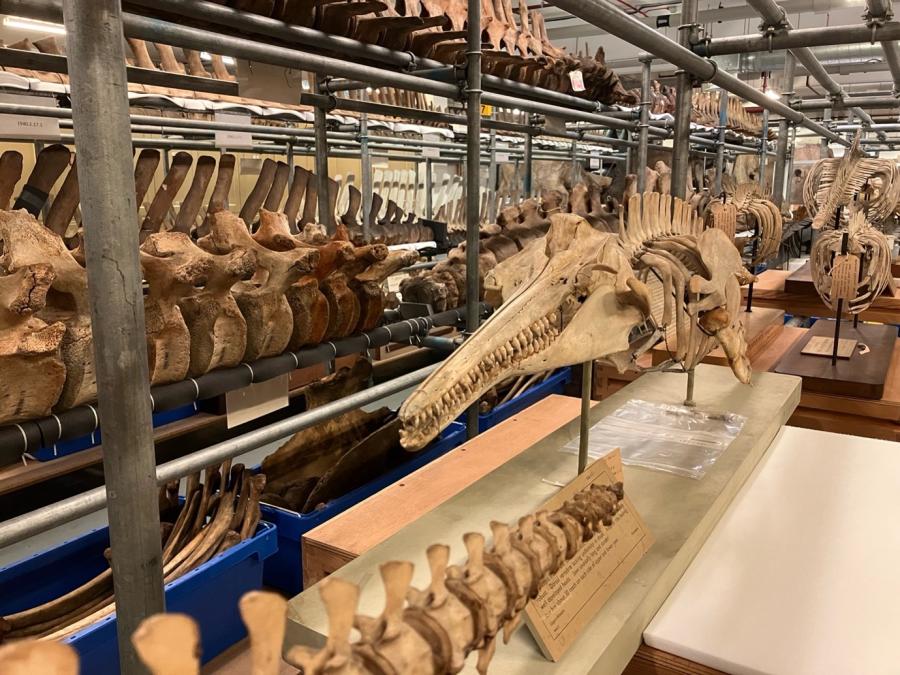
A whale skeleton is both an object of science and the remains of a life, a truth that became powerfully clear as David Gray and I followed Richard Sabin, Principal Curator of Mammals at the Natural History Museum, through its extraordinary cetacean research collection. Around us were thousands of bones: skulls, vertebrae, jaws, ribs, flippers, ear bones and baleen, gathered over centuries and from oceans across the world.
They are primarily scientific specimens which are immensely valuable as stores of biological information, but each skull and spine once supported flesh, sinew and nerves. Each belonged to a breathing, sensing animal that moved through an ocean, encountered others, searched for food, communicated, perhaps reproduced and cared for young. They were highly intelligent, intensely social beings.
The challenge is to hold both truths at once. Museums preserve evidence, but they also preserve memory and story. Through collections like these it is now possible to trace not only the changing lives of animals, but the changing story of ourselves.
A whale in the Thames
In January 2006, a female northern bottlenose whale swam into the Thames. She’d lost her way and taken a wrong turn into the North Sea. For a brief time, she became a national celebrity as people crowded the riverbanks and television cameras followed attempts to save her. Unfortunately, the rescue was unsuccessful as she had become so weakened by not being able to find food and trying to find her way back to the North Atlantic. A post-mortem examination by the Zoological Society of London showed she’d died from severe dehydration, muscle damage and kidney failure. Twenty years later, she continues to be an important part of a global research collection studied by scientists from around the world. From time to time, her skeleton has been displayed in the public galleries, helping the NHM tell both her story and the wider story of our changing oceans.
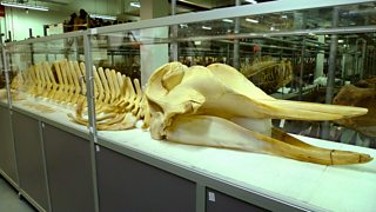
The information held in these bones can help restore the animals as individuals. Science helps tell their stories.
This is something Richard feels strongly about. Used well, science does not diminish an animal by reducing it to measurements; it can do precisely the opposite. Data can become the biography of a once-living creature. A ratio of isotopes can tell us where an animal travelled. Growth layers can reveal its age. Chemistry can show what it ate. Bones, teeth and baleen can carry evidence of pregnancy, disease, injury and environmental pollution. Piece by piece, science puts flesh back onto the skeleton.
Reservoirs of information
There are around 6,500 cetacean specimens in the NHM’s collection, some centuries old. They are not simply stored awaiting display; along with collections held in other museums, they form an international research resource, used by scientists and scholars from around the world. Recently, Richard examined a stranded spectacled porpoise which had been sent to him by colleagues in the Falkland Islands. This was the first spectacled porpoise to be added to the NHM collection since the Shackleton-Rowett Expedition a century ago, providing an opportunity to examine genetic and environmental changes across time. That one animal therefore carries information about itself, its species and the changed ocean in which it lived, and becomes part of an important time-series.
Richard called museum specimens “reservoirs of information”, and the phrase seems exactly right. The remarkable thing is that we don’t yet know everything they contain or indeed, may be able to tell us. A specimen collected 150 or 200 years ago can now answer questions its collector could never have imagined. Stable-isotope techniques, genetics, imaging technology and chemical analysis allow researchers to extract information that was scientifically inaccessible when the animal died.
And that is one of the most compelling arguments for collections such as this. We cannot know what questions researchers will be asking in 50, 100 or 200 years, or what techniques they will have available. Preserving specimens is an act of faith in future curiosity. They are irreplaceable archives of global biodiversity.
The whale still in the bone
One object made the physical presence of these animals particularly vivid - a blue whale shoulder blade collected at South Georgia in 1913. More than a century later, it is still seeping oil.
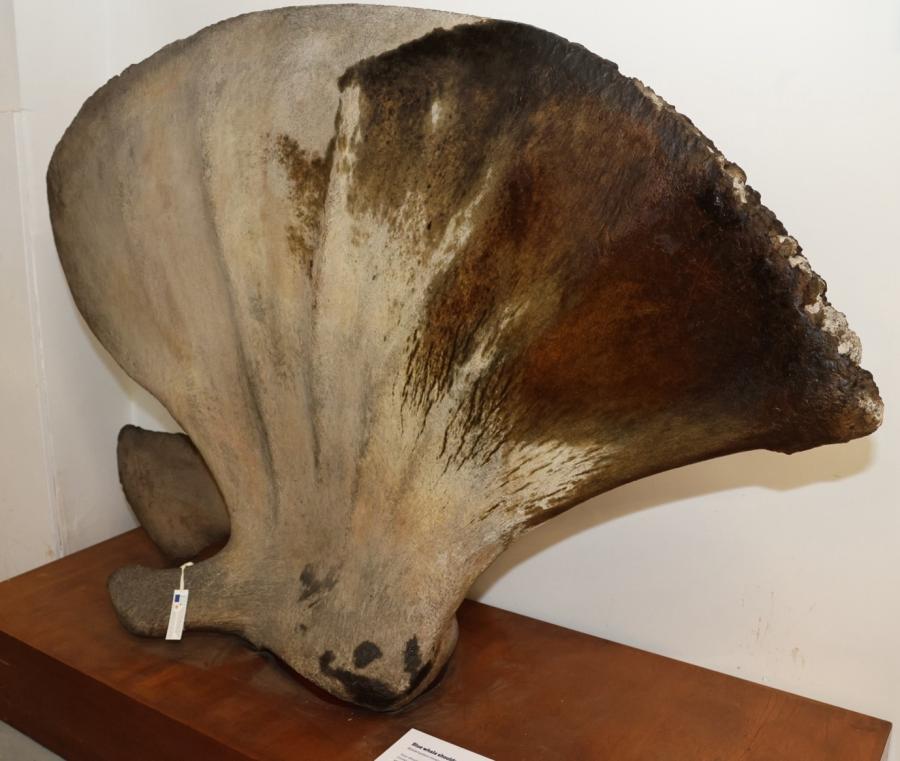
Whale bones, especially those of the great whales, contain large quantities of lipid within their porous structure. Cleaning removes the flesh and much of the fat, but oil can remain deep inside the bone and migrate slowly to the surface for decades. It is one of the practical conservation problems museums face when caring for large cetacean skeletons. But standing beside the shoulder blade, the phenomenon felt like more than a conservation headache.
We think of a skeleton as the final, dry architecture of an animal, everything soft and living long gone. Yet here was a bone that refuses to die, that is still oozing the very substance that we once coveted and for which we slaughtered on an immense scale. More than a hundred years after the whale died, a remnant of its physical life was literally working its way to the surface.
For centuries we looked at these immense, intelligent animals and saw oil for lamps, lubrication and industry; baleen for corsets, umbrellas and countless manufactured objects; flesh and bone to be rendered and sold. A whale could be translated into barrels of oil and cash, converting its astonishing living complexity into daily objects; yet they were still beguiling and mysterious.
Melville understood that contradiction better than almost anyone. Moby-Dick is full of whales being dismantled, rendered and turned into useful substances, while at the same time the living whale continually escapes his attempt to comprehend it. In the chapter “A Squeeze of the Hand”, Ishmael works lumps of congealed spermaceti between his fingers until the substance becomes almost mystical and the shared labour turns spiritual and ritualistic. “I squeezed that sperm till I myself almost melted into it.” There is something deeply uncomfortable in the wonder. The material is beautiful, tactile, enchanting; and in Ishmael’s hands it becomes a sacred and shared experience.
The blue whale shoulder blade was not simply evidence of a whale; in a small and haunting way, it still contained the whale, with all its wondrous fluids.
The noise we cannot see
Some of the stories preserved by whales are stories about us. Richard showed us how well adapted cetaceans are to a world dominated by sound. In toothed whales, the head has become a sophisticated acoustic instrument. In sperm whales, one nostril has effectively become part of a sound-producing system capable of generating powerful clicks that travel across the ocean, while structures in the head help focus sound to help it navigate and map the world around it. David described it as being like a lens, but a lens for sound.
For an animal living in darkness at depth, sound is not an optional extra, it is how the world is perceived; which makes our increasingly noisy oceans troubling. Shipping, sonar, seismic exploration, construction and other human activity have introduced sound on an enormous scale into habitats that evolved without it.
Even here, museum specimens can speak. Baleen whales naturally develop waxy earplugs as organic debris accumulates in their sealed ear canals. Rather than blocking sound, these plugs may help transmit it to the inner ear. Like tree rings, they build up in layers through a whale’s life, and scientists can analyse them for hormones such as cortisol, revealing patterns of physiological stress over time. Those patterns can then be compared with known events and increasing human activity in the oceans. An earplug becomes an archive; the whale has recorded our presence inside its own body.
An older relationship
Elsewhere in the collection we encountered another chapter in the long and changing relationship between people and whales. During construction work along the foreshore of the Thames near the O2 Arena in London in 2010, the skeleton of a North Atlantic right whale was discovered. Carbon-dating placed it somewhere between about 1590 and 1650 CE. Known as the Bay Wharf or Greenwich whale, the bones tell a grimly familiar story. Cut marks suggest it was hauled onto the foreshore and butchered. Its skull was missing, perhaps taken because of the value of its baleen. The eastern North Atlantic population to which it belonged is now functionally extinct, lost to centuries of commercial whaling.
Here the collection becomes historical testimony. Over several centuries whales came to be regarded principally as commodities. Vast, sentient animals were reduced to units of production, little more than floating barrels of oil and corset stays.
While looking at the Greenwich whale, Richard read from a pamphlet published in 1658, Londons wonder: being a most true and positive relation of the taking and killing of a great whale neer to Greenwich. It describes a 58-foot whale that appeared near Greenwich and was killed on 3 June that year, only a few years after the latest possible date for the Greenwich whale.
The account is horrifying. The animal was attacked with “harping-irons, spits, swords, guns, bills, axes, and hatchets” and “all kind of sharp instruments”. Eventually two anchors were driven into its body, after which blood poured into the water. Hundreds of people arrived by land and water to see its body.
It is difficult to read now. A magnificent wild animal had appeared impossibly close to London, inciting wonder, curiosity, fear until they became inseparable. The whale was, all at once, an animal, a spectacle, a source of valuable materials and something to be conquered.
And then, the story changed. Today whales are among the most revered animals on Earth. We speak of their intelligence, their songs, their social lives and their cultures. People travel across oceans simply for the possibility of seeing one surface for a few seconds. When a whale enters the Thames now, enormous efforts are made to protect it. In 2018, when Benny the beluga whale remained in the Thames for several months, a nearby fireworks display in Gravesend was postponed because of concern that the noise might distress it. The contrast with Greenwich in 1658 could hardly be greater.
Whales are still hunted by humans and threatened by fishing gear, ship strikes, pollution and the noise we pour into their acoustic world, our relationship with them is hardly innocent, but something fundamental in our imagination has shifted. To read of a stranded whale being attacked by the public brandishing many weapons is incomprehensible today.
The bones in the museum have remained silent witnesses to the past while the human story around them has changed beyond recognition. That is another reason for keeping their bones. They preserve not only the history of whales, but a history of us - what we valued, what we destroyed, what we failed to understand, and how we have learned to see another living creature differently.
What we forget
Richard spoke about something close to the idea of shifting baselines - generational amnesia. For younger generations, industrial whaling can feel impossibly distant. There is little residual cultural memory of the sheer scale of slaughter, or of the most successful conservation campaign of all time in the 1970s – Save the Whales. Very few young people can relate to the enchantment of hearing whale song for the first time. The same is true of abundance. If we have never known an ocean filled with whales, we do not experience their absence as loss. These collections resist that forgetting.
One example dates from October 1927, when around 150 false killer whales stranded in the Dornoch Firth in Scotland. The Natural History Museum collected the entire group and transported the animals south by train. Old newsreel footage shows museum staff preparing rows of heads on the lawn at South Kensington. Almost a century later, the skeletons of those animals remain together as a pod in the museum. Modern researchers can study their skeletal morphology, genetics and growth patterns in ways that nobody in 1927 could have anticipated. A catastrophe became an archive that has helped us understand more about their world.
Some of the strangest objects in the museum take the story much further back in time. During the nineteenth-century HMS Challenger expedition, scientists dredged up curious mineral lumps from the deep ocean floor known as polymetallic nodules, which had slowly formed from layers of iron and manganese minerals. A few of them have something extraordinary at their centre - the ear bone of an ancient whale. Whale ear bones are exceptionally dense and can survive on the seabed long after the rest of the skeleton has disappeared. It then provides a hard surface around which minerals gradually accumulate, layer upon layer, until a rocky nodule is formed. The process is unimaginably slow, measured in millimetres over millions of years. At the centre of the nodule is the remains of an individual animal that once heard and navigated through an ancient ocean.
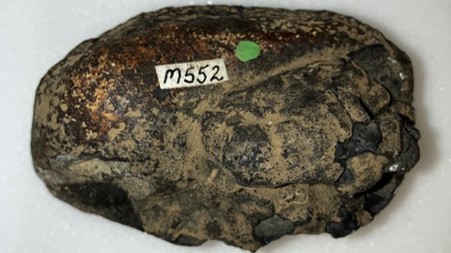
To hold one is therefore to hold two histories at once - the remains of a whale that swam eons ago, and the record of an unimaginably slow geological process that continued long after it died. Suddenly the timescale of the collection opens out, from the few decades of an individual whale's life, through centuries of human exploitation and scientific collecting, to millions of years of evolution and geological time. And all of it is contained in an object small enough to hold in your hand.
The hand inside a flipper
There were moments of simple wonder too. A Ganges River dolphin's forelimb revealed the familiar pattern of five digits. Inside the flipper is, unmistakably, something very like our own hand.
Fifty million years ago there were no cetaceans as we know them today in the oceans. The Earth was much warmer, there was little permanent polar ice and forests reached towards the poles. Mammals were undergoing an evolutionary radiation in the aftermath of the dinosaurs. Somewhere along the margins of the warm shallow seas of what is now Pakistan and India, a lineage of four-legged land mammals began spending more time in water. Within ten million years their descendants had become fully aquatic. Legs became flippers, nostrils began to move towards the top of the head, bodies became streamlined and the pelvis detached from the spine. The whale had entered the ocean. Their bodies were transformed by evolution, yet traces of that former existence remain as tiny pelvic and hind-limb bones, the underlying architecture of a terrestrial mammalian limb, even bud-like teeth that develop in baleen-whale embryos before being reabsorbed. Evolution is written into anatomy.
And so is extreme adaptation. Bowhead whales can live for more than 200 years. Sperm whales possess the largest brains on Earth. Narwhals have extraordinary tusks associated with a sensory world we still only partly understand. River dolphins have evolved remarkable echolocation systems for navigating turbid freshwater. The more closely we study these animals, the stranger they seem, yet science also reveals how much we share with them. That is part of their hold on us. We recognise the mammal in the bones, lungs, birth, milk, family relationships, but we also encounter an intelligence shaped by an environment almost entirely inaccessible to us. We share a planet, but not the same sensory world.
Drawing attention
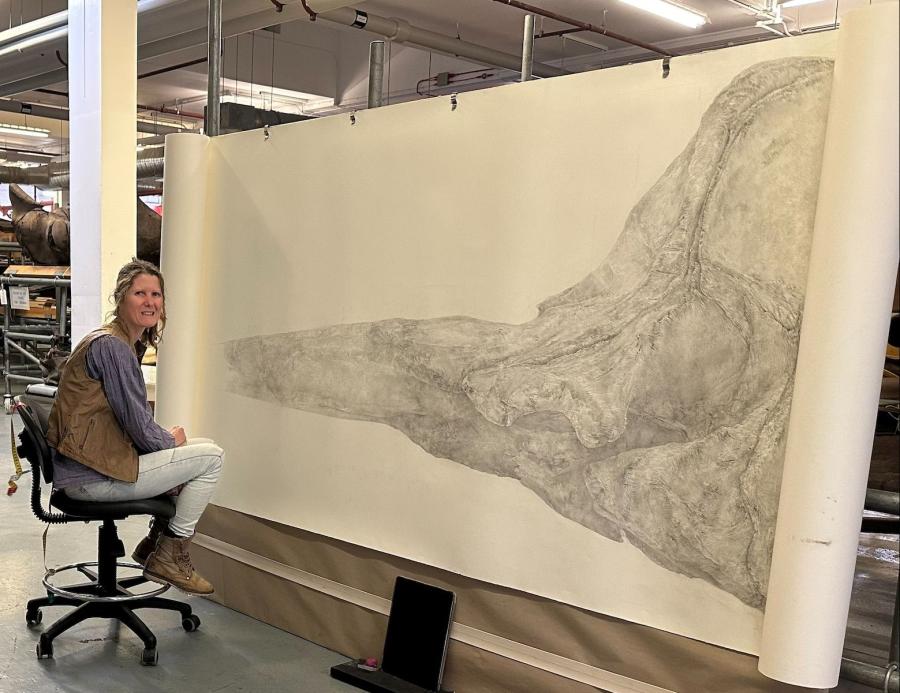
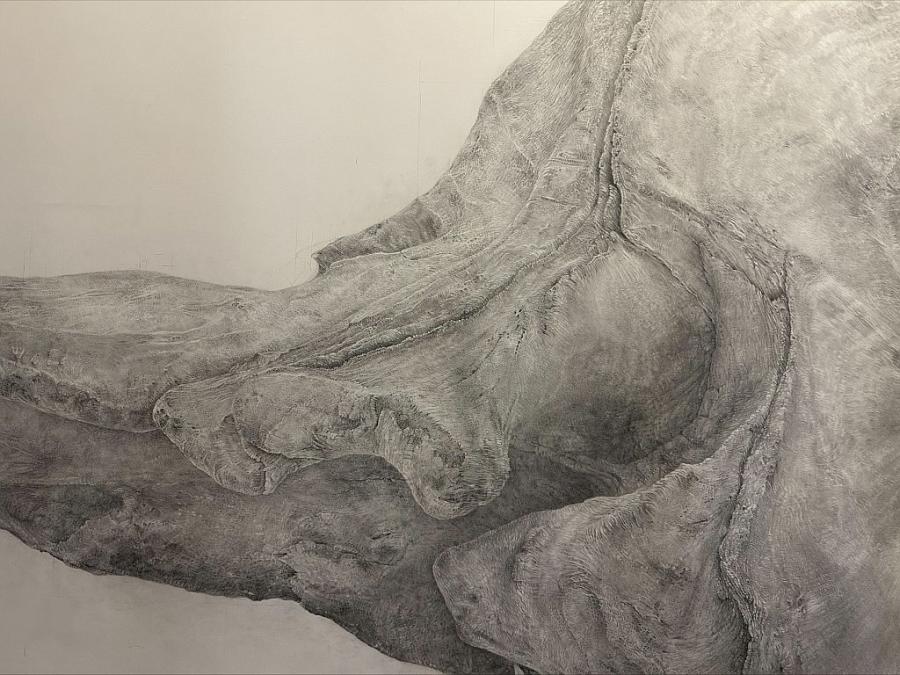
Science was only part of our conversation. Working among the bones is the artist Odile Kidd, who has spent around a year and a half making a life-sized pencil drawing of a sperm whale skull. She measures the animal directly rather than relying on grids or computer-generated imagery, and it is painstaking work. She and Richard are collaborating on a book. Richard sees art as another way of bringing people into a relationship with a specimen, with an ecosystem and with the natural world. A scientific paper may contain extraordinary knowledge, but relatively few members of the public will read or understand it because of its exclusive technical language. A drawing can make someone stop and stare. He used the phrase “dwell time”, which is very apt because that is exactly what much of our relationship with nature is missing. We glance, photograph, scroll and move on, but art asks us to stay, and staying changes what we see. Richard wants to help people to see the natural world beyond the constraints of spoken language and territorial boundaries. Over the years, he has been working with artists in the collections to explore visual storytelling, and the emotional responses their work can generate.
Odile’s drawings are so precise that in one representation of an Amazon River dolphin, a visiting scientist was able to identify skeletal features that placed the animal within its geographical population. But the drawing did more than record scientific detail - it restored the animal’s dignity and presence.
Meeting another intelligence
Our conversation kept returning to what it actually feels like to encounter a living whale.
Divers recount spine-tingling tales of meeting a whale eye-to-eye. Belugas can seem almost alien in their intelligence. Sound is central to their world, and they appear to use it not simply to navigate but to investigate who we are with sonic firings that map our whole bodies. To be close to one is to have the strange sensation that while you are watching the whale, the whale is forensically examining you. There is something profoundly affecting about looking into the eye a wild animal that is also staring back at you. For a moment the direction of our gaze is reversed. We cease to be the observer looking at ‘nature’ and become one animal being regarded by another. Richard has had this experience on two separate occasions – once with a common dolphin and once with a humpback whale. They held each other’s gaze, and the experiences still resonate strongly within him. It fundamentally changed his working relationship with the specimens he curates.
We talked about stories of cetaceans apparently protecting humans and other animals, including rare accounts of humpbacks intervening when people were threatened. We can argue about words such as altruism and how much human intention we should attribute to another species, but the important thing is to remain open to the possibility that other forms of intelligence and sociality are richer than we have allowed ourselves to imagine.
Whales repeatedly unsettle the boundary we draw between ourselves and the rest of life, and it is why encounters with them can feel so powerful. They remind us that ours is not the only mind through which the world is known.
Bones, memory and wonder
At some point our conversation moved towards something David and I have discussed many times - the importance of wonder and enchantment in conservation. Facts matter enormously; without rigorous science we cannot understand what is happening to the natural world or know whether our attempts to protect it are working. But facts alone do not tell us why any of it matters to the heart and soul of humanity. Standing among thousands of whale bones makes that impossible to ignore. These are not simply calcium structures arranged on shelves. They once held up living bodies where muscles pulled against them, blood flowed around them, nerves carried sensation, brains received information from worlds we can scarcely imagine. Some of these animals crossed oceans, travelled in families, called to one another through darkness, protected their young, encountered ships, harpoons, fishing gear, pollution and noise. Some belonged to populations that no longer exist.
That is why a natural history collection such as this is not simply a storeroom of the dead. At its best, it is a place where the dead continue to inform the living. Science can recover part of their story. History can tell us what humans thought of them. Art can help us look for longer. Emotion can remind us why we care. And truly honouring the animal requires all of them.
The skeleton can never become a whale again. But through attention we can resist allowing the whale to become merely a skeleton. By drawing all the threads together, a real creature emerges and lives again. We can also observe ourselves. We can trace our changing relationship with whales through these bones - from animals feared and hunted, to commodities rendered into oil and baleen, to creatures increasingly recognised as intelligent, social and culturally complex. The story is not a simple progression towards enlightenment, whales continue to be damaged by the world we create, some are still hunted. But our imagination of them has changed profoundly.
The specimens held in the Natural History Museum hold both histories at once - theirs and ours. That is what moved me most about the whale store. A collection does not freeze the past, it allows the past to keep changing as science asks new questions and each generation brings a different way of looking. But the bones stay where they are and they keep on revealing. Even centuries later, the whale is still there, seeping from the bone.