
Blog post by Kitty Bushell
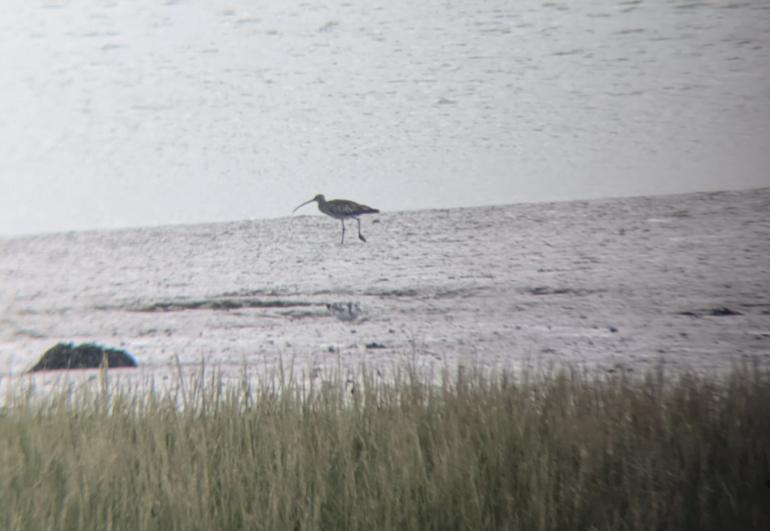
Love is a verb. It’s a widely-quoted lyric, and an excellent philosophy to follow when it comes to standout species like the Curlew.
In recent years, watching and appreciating birds has skyrocketed. Since 2018, birdwatching as a hobby has increased by a notable 47%, led by 16-29 year-olds (welcome to the fold, we’re so glad you’re here).
With so many new bird watchers on the scene, we can’t help but ponder the potential. How much progress and positive change could be set in motion if those new bird watchers and, by extension, bird lovers also became bird advocates or even bird protectors.
The hardest part, looking up and becoming aware of birds in the first place, is done. From here, the transition from bird watching to loving to protecting really is all downhill.
A bird with a big fanbase
The only thing (nearly) as impressive as a Curlew’s beak is the space it occupies in the public imagination. Few birds have captivated writers, poets, musicians, and artists quite like the Curlew.
The public’s love for the species has now gone so far as to be a defining feature of the Curlew itself. References to admiration, awe, and love for this bird even find their way into scientific contexts and descriptions.
The BTO’s introduction to the Eurasian Curlew describes its call as “a well-loved feature indicating the health” of habitats; the UK Curlew Action plan nods three times to the “well-loved” nature of the bird in its introduction alone.
The question becomes, then, how could a species so unanimously adored be pushed so dangerously close to the edge?
A bird with a big problem
As much as knowledge of and love for the Eurasian Curlew is rising, its numbers are drastically declining.
Species trend data from the BTO shows a 51% decline from 1995 to 2024, and, in 2015, Curlews were added to the Red List (the highest priority) on the UK Conservation Status Report (RPSB). Since the 1980s, Curlew populations have declined by an average of 60% across England and Scotland. It’s a tragic loss for any species, but it seems nonsensical for one that holds such a special place in the hearts of people everywhere.
So, where does that leave us?

Love is a doing word…
We have a bird whose population is in rapid decline, and a population whose love for this bird is growing day by day.
On the one hand, this is a cruelly ironic disconnect; on the other, it offers an opportunity to turn the tide. Reminding people exactly what ‘the stuff of love’ entails (knowledge, the courage to speak up, campaigning, awareness, activism, and more) could be the key to unlocking more support for Curlews than ever before.
Love, in the truest sense of the sense of the term, is a doing word. In the Oxford English Dictionary, “love” is defined as “manifesting itself in concern for the other’s welfare and pleasure in his or her presence”. If we channel this active, highly empathetic, and operative form of love in the way we love species like the Curlew, we can mobilise an already engaged community to share, speak out, and stand up for these birds.
How do I love thee? Let me count the ways.
Encountering a Curlew is a privilege, but it shouldn’t be. For the meantime though, we need to be equally as vocal about Curlew protection as we are about its much-loved qualities, from its enchanting song and iconic bill to its mysterious position in folklore.
In his poem titled ‘Extinction’, Alastair MacIntosh writes, “ I would rather we lost / the / entire contents / of every art gallery / in the whole world / than lose / forever / the cry of the Curlew”. What he’s expressing, the sheer magnitude of what we stand to lose, and of what’s bound up in a Curlew’s song, is exactly why our love must be active and embodied.
The UK Action Plan for the Eurasian Curlew shares this sentiment in its opening Call to Action: “Curlews are widely appreciated across society. By building on this affection and promoting shared working, we will go a long way to making this Action Plan work.” And, as WWT puts it, “The decline of the curlew is not just the loss of a valuable wetland species, but a significant cultural and heritage loss too”.
In this case, perhaps it is not better to have loved and lost than to never have loved at all. In fact, viewing love for a species as an action overwrites this impossible dichotomy entirely.
How can you love the Curlew?
Here are some ways you can love Curlews to the depth and breadth and height your soul can reach:
- Share the love. Share social media posts by organisations that work to help Curlews like Curlew Action, Curlew LIFE, and The Curlew Recovery Partnership.
- Celebrate the species. Forget Valentine’s Day, express your love on World Curlew Day, 21st April (more info here).
- To be loved is to be known. Get to know the Curlew and the challenges it’s up against. Use accurate resources to understand the unique threats this species faces so you can better support it.
- Love is patient, love is kind. If you have the time to spare, volunteer with wader conservation charities and projects near you. Alternatively, join organisations like the RPSB that support action for waders like the Curlew.
- Lend your voice. Write to your MP and local representatives. Share with them the impact that the Curlew has on you, and encourage them to support policies that can help the species (eg: nature-friendly farming).
With love
Legends says that, in the 7th Century, the Curlew was blessed by St Beuno, who was overcome with gratitude for the bird that rescued his book from the waves. Over 1,000 years later, it’s time that we conjured up those same strong emotions and did a little rescuing ourselves in return.
Consider this an invitation to let your love – in the fullest sense of the term – for the Curlew shine through.