
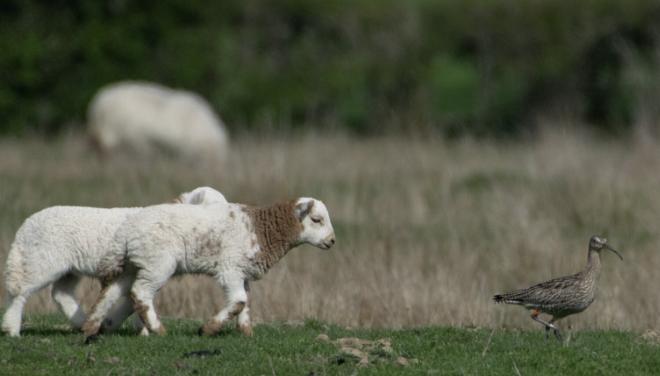
Southwest Scotland is one of those places where the challenges facing ground-nesting waders become vividly clear. Curlew, Lapwing, Redshank, Snipe and Oystercatcher still breed across these rolling hills and farmed valleys, but their future depends on navigating a web of farming practices, land management, predation, forestry, wind farms and economic pressures. Here, many competing demands are placed on the land, and wading birds are increasingly confined to isolated fragments of suitable breeding habitat.
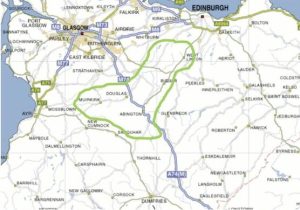
The area of the RSPB’s Southern Scotland Wader Monitoring Programme
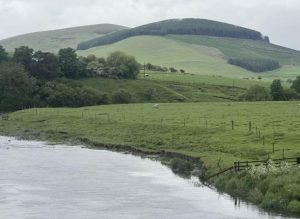
A typical scene along the banks of the river in the Clyde Valley area. Photo: Mary Colwell
Overview
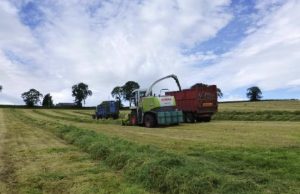
Silage cutting. Photo: Farmers Journal
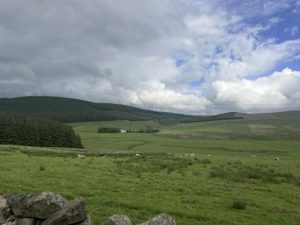
Forestry plantations are widespread across the landscapes where the Clyde Valley Wader Initiative is working. Photo: Mary Colwell
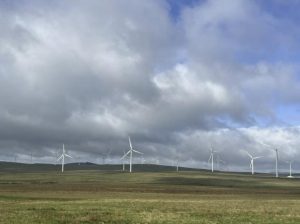
Wind farms are common and applications for new developments continue to increase. Photo: Mary Colwell
In recent decades, the area has changed significantly, with grassland intensification in some areas, destocking in others, afforestation, and more latterly, the expansion of wind farms
Traditional mixed farming systems, characterised by fodder crops, rough grazing and a diversity of habitats, have largely been replaced by more uniform grass-based production. The shift away from small-scale mixed farming and late-season cropping towards silage production has been driven by economic pressures and the need for greater efficiency, but it has also reduced the variety that once characterised these landscapes.
Forestry has continued to expand, driven by national tree-planting targets, carbon markets and demand for timber. While woodland creation certainly brings benefits, conservationists working with breeding waders are increasingly concerned about the cumulative impact of large-scale planting across upland landscapes, particularly where new forestry is replacing or fragmenting the open ground used by breeding waders. In parts of Dumfries & Galloway and the Borders, the pace of change has been significant enough that it now forms a major part of discussions about the future of these birds.
Wind farm developments are also an increasingly significant feature. One fieldworker described the pressures associated with renewable energy development as “immense”.
New applications, extensions and repowering schemes continue to come forward across the Southern Uplands, often in the same areas that support breeding waders. While renewable energy is essential to tackling climate change, wader conservationists are increasingly grappling with how to balance the urgent need for green energy with the protection of some of Scotland’s most important landscapes for Curlews, Lapwings and other ground-nesting birds. This is the reality of wader conservation in an increasingly fragmented countryside.
Yet the relationship between renewable energy and wader conservation is not solely one of tension. In an encouraging development, the renewables sector is helping to support much of the innovation taking place across the region. Funding linked to renewable energy developments is enabling thermal drone surveys, radio-tracking, NoFence collar technology and herbal ley trials, while also supporting field staff and Masters research projects. At a time when public resources are increasingly stretched, many involved in the project see these partnerships as an important opportunity to advance wader conservation into the future.
The connection extends beyond funding alone. During our visit to Airds Moss (see a separate blog on that visit), discussions frequently returned to the increasingly unpredictable weather experienced during the breeding season. Changing spring conditions, including periods of heavy rainfall and cold weather, are creating additional challenges for breeding waders. Tackling climate change is therefore an essential part of securing their long-term future, and renewable energy will undoubtedly be part of that solution. The challenge is finding ways to deliver both clean energy and thriving populations of breeding waders across the same landscapes.
To help us get a grip on it all, we were warmly welcomed by the RSPB team working in the area, led by Dan Brown, Senior Conservation Advisor with RSPB Scotland.
Dan and I had met a decade earlier when I had just finished my 500-mile walk for Curlews in 2016. I was beginning my odyssey into the world of waders, while Dan was starting what would become a decade-long effort to understand and reverse the decline of breeding waders through the Clyde Valley Wader Initiative. Meeting again felt poignant and fitting.
Clyde Valley Wader Initiative
The Clyde Valley Wader Initiative was established in the early 2010s to bring together farmers, estates, conservation organisations, graziers and researchers to help reverse the alarming decline of breeding waders across the region. Led by the RSPB and facilitated by Jennifer Struthers of SAC Consulting, who plays a pivotal role, the initiative works in partnership with a network of land managers across the region, taking a landscape-scale approach that recognises waders cannot be conserved on reserves alone. By testing practical management on working farms, the project has become one of Scotland’s most important partnerships for breeding wader conservation.
The work we looked at centred on the Douglas and Angus Estates and neighbouring farms, and it was clearly a shared effort to understand why some birds succeed while others fail in this highly managed, multi-use landscape.
“Managing these different relationships is sometimes a bit of a challenge, if I’m being honest,” explained Dan. “The people aspect is really important in trying to come up with consensus.”
That consensus has not always been easy to achieve, but it has produced one of the most comprehensive studies of breeding waders in a working agricultural landscape anywhere in the UK. More than 900 nests have now been monitored across a range of farms and different management approaches. One of the turning points came in 2019.
“We found ten Curlew nests here,” he recalled. “This is an area with a full-time keeper and lots of agri-environment management. Not a single one of those ten nests hatched.”
The result was shocking. On paper, this was exactly the sort of landscape where Curlews should have been doing well, yet the birds were comprehensively failing to fledge any chicks. It prompted a fundamental rethink of what was really happening on these farms.
Land Managed with Waders in Mind
The team discovered that some of the most widely used agri-environment options were delivering surprisingly poor results. Grazed pastures managed specifically for waders often produced extremely low hatching success. “Anything that was grazed had really, really low hatching success,” he explained.
The reason appears to be more complicated than simple predation. Livestock themselves can create problems. Lambs, in particular, are endlessly curious. They investigate nests, roll eggs from scrapes and occasionally crush them. In addition, the disturbance and commotion associated with grazing livestock appears to create opportunities for predators, potentially making nests easier to locate.
Charlotte Connor, a fieldworker in Dan’s team who is tracking chicks, described watching the aftermath of a nest encounter, “Three of the four eggs were just cracked. None of the contents had been eaten. They were simply destroyed.” It was noted that the returning adult Curlew removed the cracked eggs from the nest and continued to incubate the undamaged one.
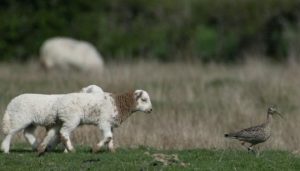
Sheep and lambs can cause problems for Curlews. Photo: Curlew Country.
Yet, the story is not simply one of removing livestock. The project is revealing a much more nuanced picture. While sheep can cause problems during nesting, the chicks themselves often move into grazed pastures after hatching. “They do gravitate towards the sheep-grazed pastures,” explained Dan. “The chicks are feeding on dung flies, they like the shorter vegetation, but use the rushes to dart into and hide.”
The challenge, therefore, is getting the timing right. It is important to protect nests during incubation, but it seems equally important to retain the benefits that grazing can provide once the chicks begin to feed.
One of the most promising findings has come from reintroducing rotational cropping to the uplands. Fields of brassicas, once common but now largely lost from the landscape, have become magnets for breeding Lapwings and some Curlews, with around 90% hatching success for Lapwings. “Time and again we would come out and just start to find lots of Lapwing nests.”
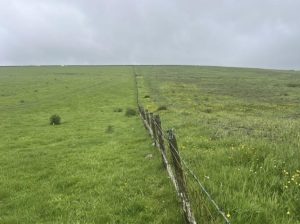
Brassica stubble field ® that provides nesting habitat for wading birds next door to one grazed by sheep (L), which is good for feeding chicks. The 7 Hectare brassica field held over 20 Lapwing nests. Photo: Mary Colwell
By June, these fields are full of structural diversity with patches of bare earth, flowering weeds, insects and cover. Curlew, Skylark, Meadow Pipit and Brown Hare all benefit. The findings have left the team both encouraged and frustrated. “We finally found something that really works, particularly for Lapwing,” said one researcher. “And then the money tap gets turned off.” A modest annual grant of £10,000 that helped support the work has recently been withdrawn, while there is still no national scheme designed to encourage farmers to adopt the approach more widely.
Fencing – visible and invisible
Electric fencing is providing another promising avenue. Small, fenced enclosures, occupying only a tiny proportion of a field, are not designed to exclude predators such as foxes and badgers, they are purely to keep livestock away from nesting birds during the most sensitive period and to give the birds a place to hide if aerial predators appear. Last year, every monitored nest within these trial areas hatched successfully. “We’re not trying to save every single nest,” explained Dan, “We’re investigating whether simply keeping livestock away from nests can make a difference.” Early results suggest that it can.
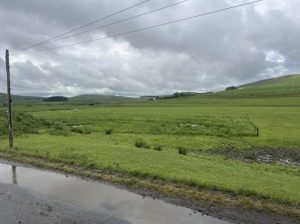
A fenced area on a farm near Abington that has successfully hatched chicks and provides a refuge. This fence cost £750. Photo: Mary Colwell
The project is also exploring the use of thermal drones to locate Curlew nests without causing disturbance, while NoFence collars may allow cattle to graze upland habitats more flexibly.
NoFence collars are GPS-enabled collars fitted to cattle that create virtual boundaries rather than physical fences. Farmers can set grazing areas digitally, and when an animal approaches the boundary, it first receives an audio warning, followed by a mild stimulus if it continues. This allows livestock to be moved and managed remotely, helping farmers control where cattle graze without the need for extensive fencing. In upland areas, they help create more flexible grazing patterns that benefit both farming and wildlife, including breeding waders, especially in areas that are more remote and difficult to access. “We’re all about trial management at the moment and trying to figure out what’s working,” he said.
Predation
Unsustainable levels of predation remain one of the most difficult issues to tackle, as it does elsewhere. Foxes, crows, ravens, badgers, red kites and buzzards all feature in discussions. Yet the team is keen to avoid simplistic explanations. “There’s still this temptation from some stakeholders to focus on a single issue, and quite often that’s badgers.” Instead, the emphasis has been on understanding how habitat management, livestock practices and landscape design interact with predation risk.
In fact, in the pub one night, farmer Doug Telfer from Glendouran Farm, genuinely loves the birds he sees on his land, was visibly frustrated by the increase in badgers. He described finding a nest one day and then seeing it destroyed the next as very upsetting, and he is convinced badgers are to blame. He is old enough to remember when waders were common and badgers were not. For Dougie, it is obvious they are having a major impact.
Across much of the area, many farmers have witnessed a substantial increase in badger numbers during the same period that breeding waders have declined. This reflects a wider trend across much of the UK, where badger populations have increased significantly over recent decades following legal protection. Whether or not the two trends are directly linked remains a matter for evidence, but for those who work these landscapes every day and care deeply about the birds, the apparent coincidence is a source of concern and frustration. This doesn’t come from hostility towards badgers, but from a genuine sense of despair at seeing wader populations diminish despite their efforts to help them. It is clear a solution has to be found.
Yet despite all these challenges, optimism remains. One of the strongest impressions from the visit was the commitment of the farmers themselves. Many have contributed their own time, money and machinery to test new ideas. “They have been brilliant,” said Dan, “Really engaged,” and if Dougie is typical, I wholeheartedly agree.
That commitment was recognised when the Clyde Wader Initiative won a Nature of Scotland Award. What surprised the conservation team most was how much it meant. “I was actually taken aback by how chuffed the farmers were.” Sometimes, all it takes is to say thank you to keep people close and engaged.
Ultimately, the project has developed a simple philosophy. Every conservation intervention, they argue, must pass three tests: “It needs to work for the birds, work for the farmers and work for the funder.” If any one of those pieces is missing, long-term success becomes difficult.
Southwest Scotland does not yet have all the answers. Curlews remain challenging to conserve, predation rates remain high, debates about the causes continue, and funding remains uncertain. But after more than a decade of careful monitoring and experimentation, the project is beginning to identify practical solutions that fit real farms and real landscapes.
As Dan so succinctly put it, “It’s not all great and it’s not all bad. But we are making progress.”
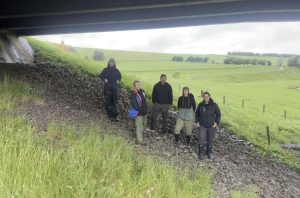
Charlotte Conner (chick monitoring), Mary Colwell, Dan Brown, Mhairi Parnell and Erin Duffy (both undertaking Masters projects) sheltering from the rain under a road bridge whilst discussing the challenges and joys of fieldwork in the Clyde Valley. Photo: Flo Blackbourn.