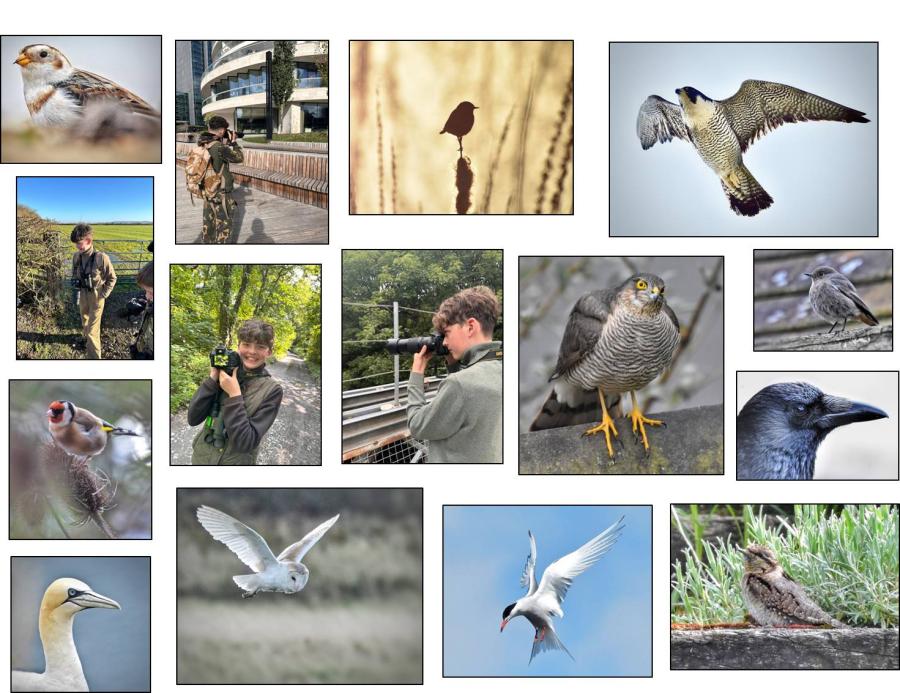
Hi! My name is Bud, I’m 13 years old and I’ve been into wildlife for as long as I can remember! I have early memories of hearing booming Bitterns at RSPB Westhay and watching Redpolls on my feeders in my old home in West Wales. However, 3 years ago, sparked by a book from my favourite author MG Leonard, I began to get more into birding and conservation.
During this time I had the opportunity to explore a relatively new habitat for me, the coast. I soon developed a love for coastal wildlife, which led to a fascination with Waders and the array of birds included in this group.
In the last year or so I plucked up the courage to put myself out into the birding community, join some groups and give talks from the view of a young conservationist. I tussled with my emotions; the prospect of standing up in front of people was nerve wracking but I felt strongly about speaking up for what matters to me. Afterwards it felt amazing knowing that I had gone with my gut and got the chance to waffle about my true love of birds!
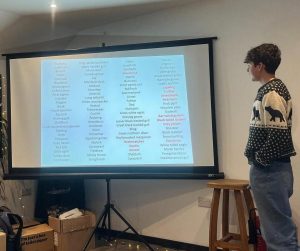
My most recent talk was in December last year, for one of the wildlife groups I attend Birds of Poole Harbour. The prompt of “Year Listing” had been suggested and I decided to personalise it by focussing on the waders I had been lucky enough to spot through the year.
Initially I wondered how I could fill a 5 minute time slot, however after 12 minutes of nattering about preening habits and preferred habitats, I realised I could have gone on for an hour! I find the Wader group intensely captivating, mainly due to the fact that they can inhabit similar habitats but have all carved out their own niche in terms of food source. I wanted to draw attention to the incredible evolution of Waders’ bills and the specific adaptations that have made their daily lives compatible with one another.
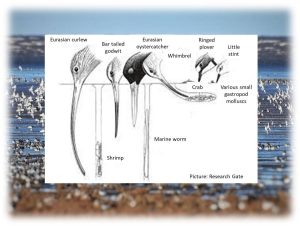
Although some prey items may overlap there is an incredibly varied diet within the wader family. The Black-tailed Godwit; a speedy snapper, feeding on grasshoppers beetles and a slightly slower creature… snails! Their 12cm long bill is also capable of reaching wriggly worms deep within the mud! Markedly different to the Turnstone; small but systematic in its feeding habits, a group can strip a small stretch of shingly beach of its small aquatic insects, molluscs and crustaceans in mere minutes! The RSPB poster bird, the avocet is petite, pied and an all round pretty wader. It uses its slender upturned bill to sift through the water and feed on their favourite food; small aquatic insects. And of course, the iconic bill of the Curlew is perfectly adapted for probing for species of worms and I’ve even seen some attempting to swallow crabs! As the largest UK Wader, the Curlew got an extra special mention! In comparison, their bill alone is longer than its relative the Little Stint, which highlights the diversity of this group!
Curlews are beautiful waders and have a glorious, warbling call that make them one of the most characterful wader species in the UK! Personally I love them because at first glance they may look ‘brown’ but if you are lucky enough to get a good look at one, you start to notice the mottled plumage in various shades of soft brown and sandy beige, the bluish legs with knobbly knees, the white rump in flight and the slight pink tinge to the underside of their impressive down-curved bill.
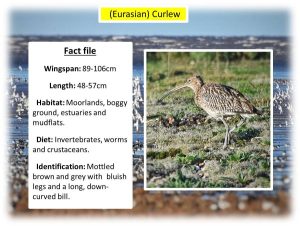
Although the body of the talk was a summary of the birds I’d managed to see over the year, it was important to me that it wasn’t just a tick box exercise or a long list of species. I wanted to capture and share some of the incredible experiences I’d had over the year. As for curlew, my favourite experience was at RSPB Snettisham where the number of curlews outnumbered the birders! Far more than anywhere else I had ever been, Not only that, they were so contented; walking around in front of us, only deciding to fly off when we were about 5 metres away! In that moment I hoped that anyone who loves curlews could have an experience like that.
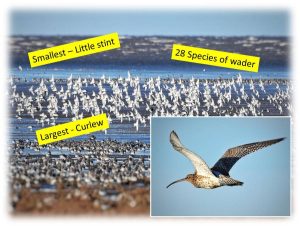
I also included a spotlight slide on curlews to highlight the 65% decline in their population since 1970. I was fortunate enough to see a pair with their chick on the Yorkshire Moors and witnessed first hand how attentive they are as parents. When Curlews find the ideal habitat, they return to the same scrape annually if possible, so it is vital that these habitats are protected.
Breeding Curlews are farmland birds, nesting in hay and silage fields and on Moorland grazed by sheep, cattle and ponies. Changes in farming practices have massively reduced the vital habitat they need to feed, lay their eggs and raise their chicks. However work is being done to connect with farmers and restore their habitats. Government-funded support for nature-friendly farming is critical. To halt the Curlew’s decline, adequate funding is needed to support farmers with the following: managing vegetation with Curlews in mind, having wet areas, disturbing the Curlews as little as possible, making farms less attractive to predators.
Citizen science is another great way of getting involved with practical conservation – there are lots of great monitoring and survey schemes around to take part in.
Amazing people and organisations such as Curlew Action, the RSPB, WWT and the Wildlife Trusts are unrelenting in their attempts to aid the recovery of curlews in the UK and give them a fighting chance in our ever urbanised world and I intend to help wherever possible.